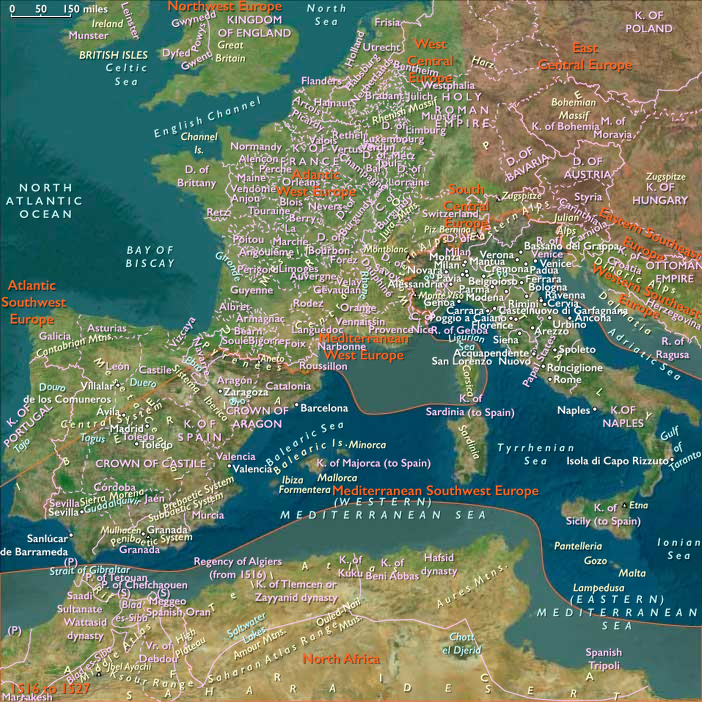
Christopher Columbus's voyages to the West from…
October 1517 CE
Christopher Columbus's voyages to the West from 1492 to 1503 had had the goal of reaching the Indies and to establish direct commercial relations between Spain and the Asian kingdoms.
The Spanish had soon realized that the lands of the Americas are not a part of Asia, but a new continent.
The 1494 Treaty of Tordesillas reserves for Portugal the eastern routes that go around Africa, and Vasco da Gama and the Portuguese had arrived in India in 1498.
Spain urgently needs to find a new commercial route to Asia.
After the Junta de Toro conference of 1505, the Spanish Crown had commissioned expeditions to discover a route to the west.
Spanish explorer Vasco Núñez de Balboa had reached the Pacific Ocean in 1513 after crossing the Isthmus of Panama, and Juan Díaz de Solís had died in Río de la Plata in 1516 while exploring South America in the service of Spain.
Ferdinand Magellan, after taking a leave from Portuguese service without permission, had fallen out of favor with the crown.
He had been wounded serving in Morocco, resulting in a permanent limp, and had been accused of trading illegally with the Moors.
The accusations had been proved false, but he had received no further offers of employment after May 15, 1514 other than, late in 1515, as a crew member on a Portuguese ship, but he had rejected this sole offer.
After a quarrel with King Manuel I, who has denied his persistent demands to lead an expedition to reach the spice islands from the east (i.e., while sailing westwards, seeking to avoid the need to sail around the tip of Africa ), he leaves in 1517, for Spain, seeing an opportunity in the new Habsburg government, In Seville, he befriends his countryman Diogo Barbosa and soon marries his daughter by his second wife María Caldera Beatriz Barbosa. (They will have two children: Rodrigo de Magalhães and Carlos de Magalhães, both of whom will die at a young age; his wife will die in Seville around 1521.)
Magellan devotes himself to studying the most recent charts, investigating, in partnership with cosmographer Rui Faleiro, a gateway from the Atlantic to the South Pacific and the possibility of the Moluccas being Spanish according to the demarcation of the Treaty of Tordesillas.
In October 1517 in Seville, Magellan contacts Juan de Aranda, Factor of the Casa de Contratación.
Following the arrival of his partner Rui Faleiro, and with the support of Aranda, they present their project to the new Spanish king, Carlos I, the future Holy Roman Emperor Charles V. Magellan's project, if successful, will realize Columbus' plan of a spice route by sailing west without damaging relations with the Portuguese.
The idea is in tune with the times and had already been discussed after Balboa's discovery of the Pacific.
Locations
Groups
Topics
Commodities
Subjects
Regions
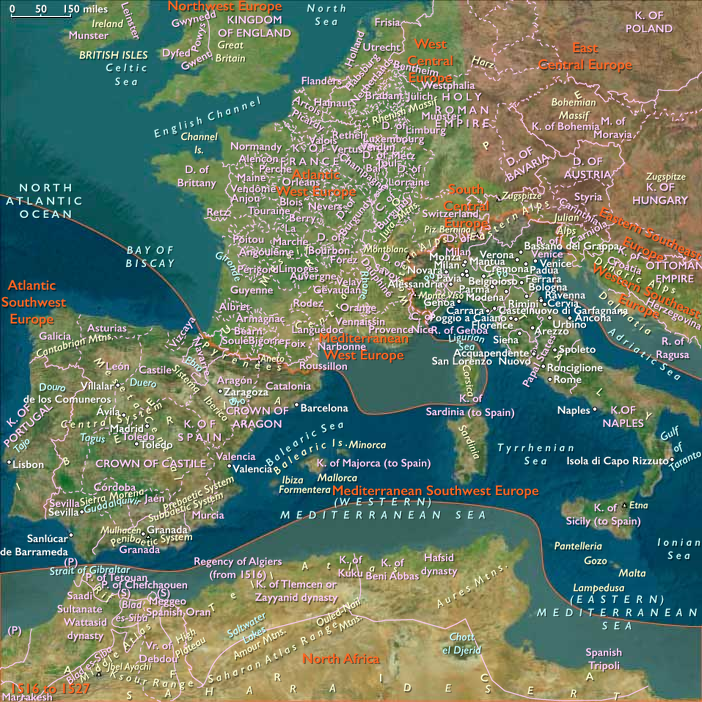
Southwest Europe
View →Subregions