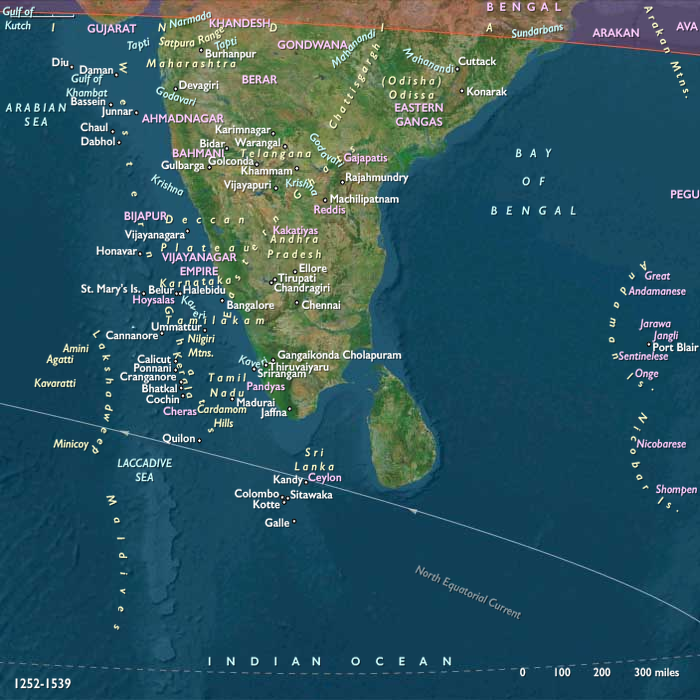
Cochin rescued, a conference is immediately called…
September 1503 CE
Cochin rescued, a conference is immediately called between the Portuguese commanders and the Trimumpara Raja to assess the situation.
It is clear that the Zamorin had relied on the collaboration of the rulers of Edapalli, and other neighboring princelets, for the siege, so a punitive expedition of four caravels sets out (under the commands of Nicolau Coelho, Duarte Pacheco Pereira, Pêro de Ataíde and António do Campo) to attack the collaborators at the Vembanad lagoon.
Notably, Edapalli (Repelim) and Kumbalam (Cambalão) are dealt with severely.
The punitive expedition seems to have put an end to the Vembanad family quarrel and established the Trimumpara Raja as ruler in his own right over the lagoon.
More precisely, senior members of his family were probably deposed and it is from this date that Trimumpara formally takes the Edapalli throne for himself, thereby becoming recognized overlord throughout the Vembanad lagoon.
However, the Portuguese insist that Trimumpara Raja remain based in Cochin city rather than move to Edapalli, unlike previous Edapalli kings.
Thus 1503 is commonly cited as the foundation year of the Kingdom of Cochin.
In the meantime, Francisco de Albuquerque has persuaded Trimumpara Raja to allow the Portuguese to erect and garrison a fortress in Cochin.
The timber fortress is named Fort Sant'Iago by Afonso de Albuquerque, in honor of the knightly Order of Santiago to which he belongs (it is also the name of his ship).
It is erected in a part of the Cochinese peninsula, known to the Portuguese as Santa Cruz (or Cochim-de-Baixo, 'Lower Cochin', now known as Fort Kochi), just a little northwest of the old city of Cochin proper (Cochim-de-Cima, 'Upper Cochin', now Mattancherry) (the seat of Trimumpara Raja).
Fort Sant'Iago is the first Portuguese fort in Asia.
Locations
People
Groups
Topics
Commodities
Regions
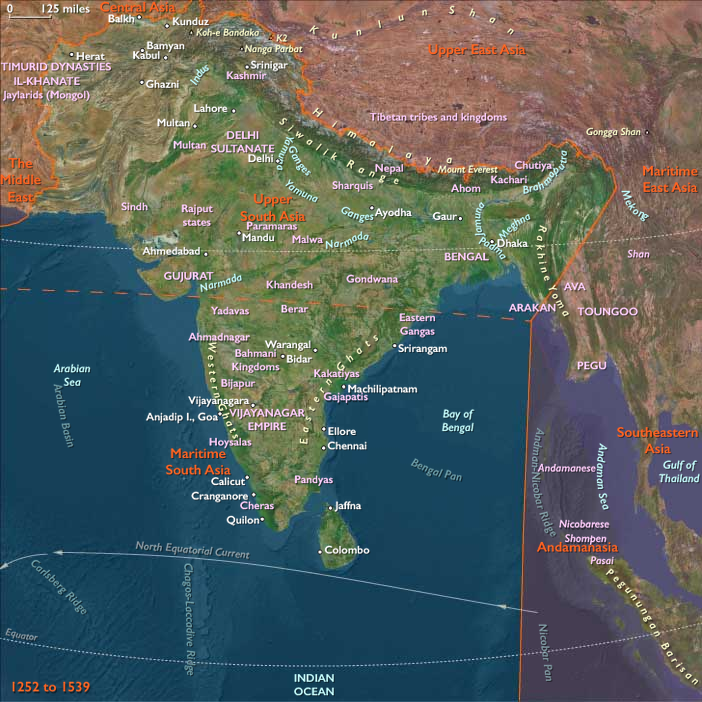
South Asia
View →Subregions