Colonna's judgment proves to be accurate: the…
April 1522 CE
Colonna's judgment proves to be accurate: the Swiss are unwilling to make another assault, and march for home on April 30.
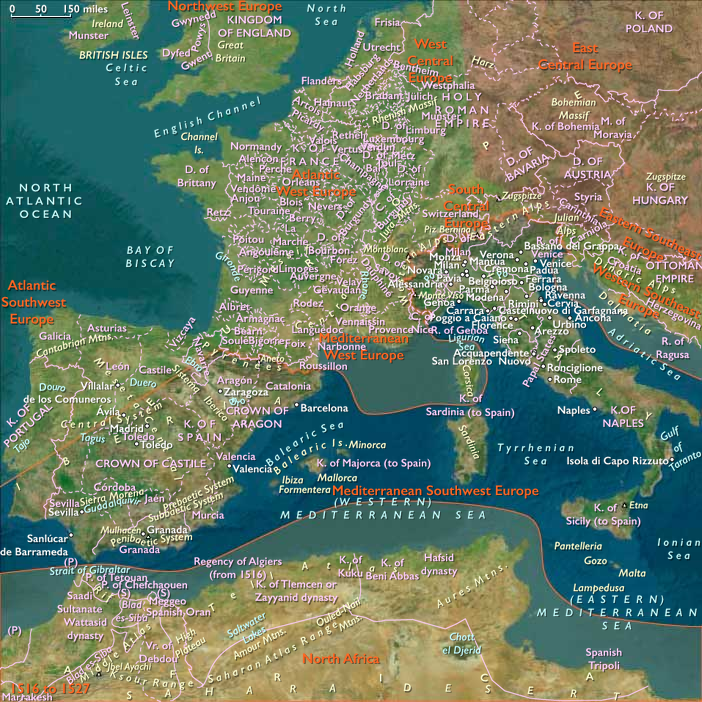
Lautrec, believing that his resulting weakness in infantry makes a further campaign impossible, retreats to the east, crossing the Adda into Venetian territory at Trezzo.
Having reached Cremona, Lautrec leaves Lescun in command of the remnants of the French army and rides unescorted to Lyon, to make his report to Francis I.
While Swiss mercenaries will continue to take part in the Italian Wars, they no longer possess the willingness to make headlong attacks that they had at Novara in 1513 or Marignano in 1515; their performance at the Battle of Pavia in 1525 will surprise observers by its lack of initiative.
More generally, the battle has made apparent the decisive role of small arms on the battlefield.
Although the full capabilities of the arquebus will not be demonstrated until the Battle of the Sesia (where arquebusiers will prevail against heavy cavalry on open ground) two years later, the weapon nevertheless becomes a sine qua non for any army that does not wish to grant a massive advantage to its opponents.
While the pikeman will continue to play a vital role in warfare, it will be equal to that of the arquebusier; together, the two types of infantry will be combined into the so-called "pike and shot" units that will endure until the development of the bayonet at the end of the seventeenth century.
The offensive doctrine of the Swiss—a "push of pike" unsupported by firearms—has become obsolete.
Indeed, offensive doctrines in general are increasingly replaced with defensive ones; the combination of the arquebus and effective field fortification have made frontal assaults on entrenched positions too costly to be practical, and they will not be attempted again for the duration of the Italian Wars.
As a result of the battle, the word "bicoca"—meaning a bargain, or something acquired at little cost—entersthe Spanish language.
Locations
People
Groups
Commodities
Subjects
Regions
Southwest Europe
View →Subregions