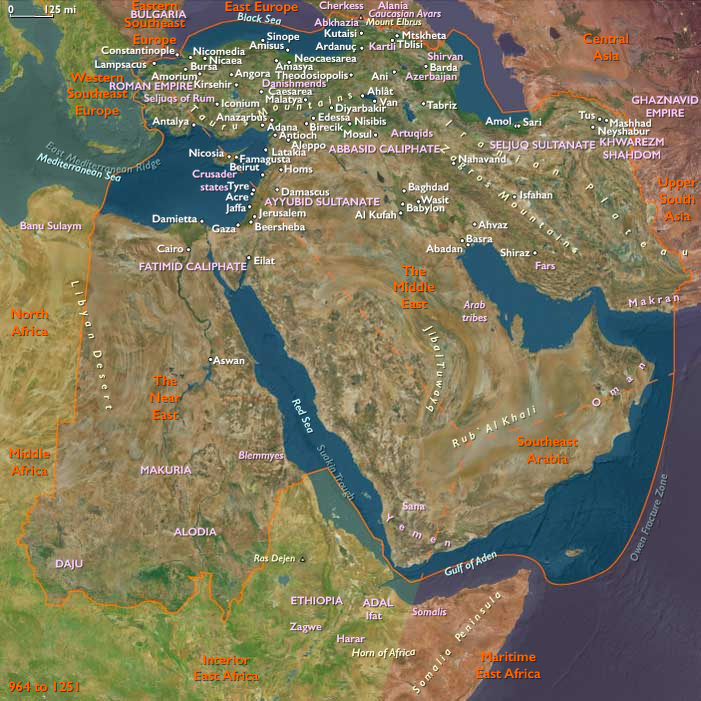
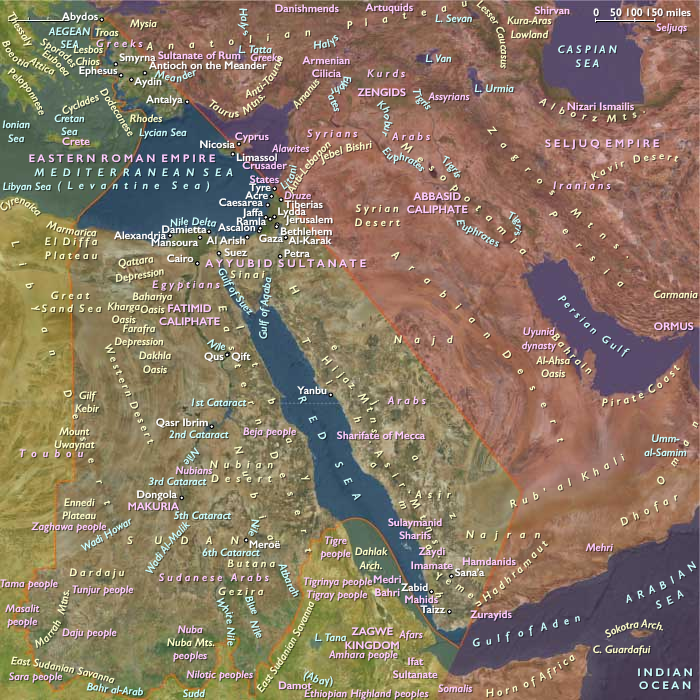
Conrad travels to Tyre on his own …
Years: 1190 - 1190
March
Conrad travels to Tyre on his own ship on March 1190, when the weather is better, and soon returns with supplies for the Crusaders, which helps the resistance against the Egyptian fleet on the shore.
Locations
People
- Amalric II of Jerusalem
- Conrad of Montferrat
- Eleanor of Aquitaine
- Guy of Lusignan
- Henry II, Count of Champagne
- Humphrey IV of Toron
- Isaac II Angelos
- Isaac Komnenos of Cyprus
- Isabella I of Jerusalem
- Richard I of England
- Saladin
- Sibylla
Groups
- Arab people
- Armenian people
- Kurdish people
- Germans
- Christians, Miaphysite (Oriental Orthodox)
- Frisians
- Greeks, Medieval (Byzantines)
- Muslims, Sunni
- Muslims, Shi'a
- Syrian people
- Danes (Scandinavians)
- Flemish people
- Flanders, County of
- Abbasid Caliphate (Baghdad)
- Cyprus, East Roman (Byzantine)
- French people (Latins)
- France, (Capetian) Kingdom of
- Pisa, (first) Republic of
- Christians, Roman Catholic
- Christians, Eastern Orthodox
- Armenia, Baronry of Little, or Lesser
- Roman Empire, Eastern: Komnenos dynasty, restored
- Antioch, Principality of
- Jerusalem, Latin Kingdom of
- Palestine, Frankish (Outremer)
- English people
- Italians (Latins)
- Tripoli, County of
- Hospitallers of St. John of Jerusalem
- Templar, Knights (Poor Knights of Christ and of the Temple of Solomon)
- Sicily, Kingdom of
- Jaffa and Ascalon, County of
- England, (Plantagenet, Angevin) Kingdom of
- Egypt, Ayyubid Sultanate of
Topics
Commodoties
Subjects
Regions
Subregions
Related Events
Filter results
Showing 10 events out of 81 total
Periodic raiding expeditions are sent from Al-Andalus to ravage the Iberian Christian kingdoms and return with booty and slaves.
The Almohads, after having failed in their endeavor the year before, reconquer the city of Silves when the governor of Córdoba attacks the city in 1191 and takes three thousand Christian slaves.
The city, again under Muslim rule, will soon prosper to the point of being called the Baghdad of the West.
In the same campaign, the Almohads take also Alcácer so Sal, while Palmela and Almada are sacked.
Atlantic Southwest Europe (1192–1203 CE): Consolidation of Portuguese and Castilian Frontiers, Navarre’s Diplomatic Adaptation, and Galician Cultural Vitality
Between 1192 and 1203 CE, Atlantic Southwest Europe—including Galicia, northern and central Portugal, Asturias, Cantabria, and northern Spain south of the Franco-Spanish border (43.05548° N, 1.22924° W)—experienced sustained territorial consolidation, refined regional identities, and vibrant cultural continuity. In Portugal, King Sancho I (1185–1211 CE) decisively strengthened frontier territories, governance stability, and national sovereignty. León and Castile, under Alfonso IX of León (1188–1230 CE) and Alfonso VIII of Castile (1158–1214 CE), solidified internal governance and clearer civic identities, decisively shaping regional political coherence. Navarre, transitioning from Sancho VI "the Wise" (d. 1194 CE) to Sancho VII "the Strong" (1194–1234 CE), carefully navigated complex diplomatic landscapes, preserving regional autonomy and stability amid broader Iberian shifts.
Political and Military Developments
Strengthening Portuguese Frontiers under Sancho I
King Sancho I decisively strengthened Portugal’s territorial governance, particularly focusing on fortifying newly conquered southern territories such as Évora and Beja. He encouraged strategic settlement initiatives ("povoamento"), consolidating Portuguese control and reinforcing frontier security. Sancho’s territorial policies decisively advanced Portuguese sovereignty, civic coherence, and national identity.
León and Castile: Stabilization and Frontier Consolidation
In León, Alfonso IX maintained internal governance stability and cohesive frontier defenses despite occasional diplomatic friction with neighboring Castile and Portugal. His prudent administration significantly reinforced Leonese regional identity and territorial coherence. In Castile, Alfonso VIII decisively secured frontier territories against Almohad incursions, particularly in preparation for later confrontations. His governance policies significantly solidified Castilian civic identity, territorial integrity, and frontier security.
Diplomatic Adaptation and Stability in Navarre
After succeeding his father in 1194, Sancho VII "the Strong" decisively adapted Navarre’s diplomatic strategies, maintaining strategic neutrality amid complex Iberian politics. Sancho VII carefully balanced alliances with Aragón, Castile, and southern Muslim territories, decisively preserving Navarre’s regional autonomy, territorial coherence, and governance stability.
Economic Developments
Continued Agricultural Prosperity
Agriculture sustained robust productivity, decisively supported by Moorish agricultural techniques, including advanced irrigation and diversified crop cultivation (citrus, olives, almonds, vineyards, grain). Thriving livestock husbandry, artisanal industries, and regional mining operations (especially precious metals in Galicia) significantly supported economic resilience, population growth, and regional stability.
Maritime Trade Networks Expansion
Portuguese ports, notably Lisbon, Porto, Braga, and Coimbra, continued to expand maritime commerce significantly with northern Europe, particularly England, Normandy, Brittany, and Flanders. Galicia, particularly through A Coruña, maintained vibrant maritime exchanges, significantly bolstering regional economic autonomy and cultural exchanges.
Pilgrimage-Driven Economic Activity
Santiago de Compostela’s pilgrimage route continued as a dynamic economic and cultural artery, decisively supporting robust commerce, artisanal industries, hospitality infrastructure, and international cultural exchange. Ongoing pilgrimage flows significantly reinforced Galicia’s economic resilience, cultural prominence, and regional identity.
Cultural and Religious Developments
Galician Cultural Vitality and Santiago’s International Prestige
Galicia maintained flourishing cultural vitality, decisively supported by Santiago de Compostela’s pilgrimage prominence. Ecclesiastical patronage, substantial architectural investments, manuscript production, scholarly activities, and educational initiatives significantly reinforced Galicia’s distinctive cultural identity and European-wide prestige.
Monastic Intellectual and Agricultural Innovation
Monastic communities sustained active intellectual pursuits, manuscript preservation, scholarly traditions, and agricultural innovations. Cluniac-inspired reforms decisively shaped ecclesiastical discipline, liturgical uniformity, and stronger alignment with Rome, significantly influencing Iberian religious identity and cultural cohesion.
Continued Cultural Syncretism and Regional Traditions
Orthodox Christianity continued integrating indigenous Iberian and Celtic traditions, notably in rural Galicia and northern Portugal. These enduring syncretic practices decisively fostered regional identity, social cohesion, and cultural resilience amid broader territorial and political changes.
Civic Identity and Governance
Portuguese National Sovereignty and Civic Consolidation
Portugal decisively strengthened national sovereignty under King Sancho I through strategic territorial governance, frontier settlements, administrative reforms, and civic stability. Sancho’s effective leadership significantly solidified Portuguese identity, territorial integrity, and enduring national coherence.
Leónese and Castilian Civic Stability
Under Alfonso IX, León maintained effective governance, civic stability, and regional identity coherence, significantly reinforcing internal administration and territorial integrity. In Castile, Alfonso VIII decisively secured frontier defenses, administrative stability, and robust Castilian civic identity, significantly influencing regional governance and Iberian political coherence.
Navarre’s Diplomatic Stability and Governance Autonomy
Under Sancho VII, Navarre decisively adapted its diplomatic strategies, maintaining regional autonomy, governance stability, and distinct civic identity. His strategic neutrality significantly preserved Navarre’s territorial coherence, internal stability, and diplomatic resilience amid broader Iberian political shifts.
Notable Regional Groups and Settlements
-
Portuguese: Decisively consolidated national sovereignty and civic stability under Sancho I, significantly shaping territorial coherence, frontier governance, and Portuguese identity.
-
Castilians and Leonese: Maintained clearly defined civic identities, significantly reinforced by effective frontier governance and administrative stability under Alfonso IX and Alfonso VIII.
-
Galicians: Continued robust cultural and economic prominence, significantly sustained by pilgrimage traditions, maritime trade, and ecclesiastical patronage.
-
Basques (Navarre): Maintained resilient regional autonomy, diplomatic stability, and governance effectiveness under Sancho VII, significantly influencing northern Iberian political coherence.
Long-Term Significance and Legacy
Between 1192 and 1203 CE, Atlantic Southwest Europe:
-
Decisively strengthened Portuguese territorial sovereignty, national identity, and frontier governance under Sancho I, significantly shaping Portugal’s medieval trajectory and enduring legacy.
-
Experienced continued internal stability and civic coherence in León and Castile, significantly influencing regional governance structures, territorial integrity, and Iberian political dynamics.
-
Successfully navigated diplomatic complexities and preserved Navarre’s regional autonomy, governance stability, and diplomatic resilience under Sancho VII, decisively influencing northern Iberian geopolitics.
-
Sustained robust economic prosperity, pilgrimage-driven commerce, cultural resilience, and effective local governance, significantly influencing Atlantic Southwest Europe’s enduring medieval historical trajectory.
This pivotal era decisively shaped national sovereignty, regional identities, diplomatic alignments, territorial stability, and cultural continuity, profoundly influencing Atlantic Southwest Europe’s historical trajectory and enduring medieval legacy.

Atlantic Southwest Europe (1204–1215 CE): Decisive Territorial Advances, Diplomatic Complexity, and Regional Identity Consolidation
Between 1204 and 1215 CE, Atlantic Southwest Europe—including Galicia, northern and central Portugal, Asturias, Cantabria, and northern Spain south of the Franco-Spanish border (43.05548° N, 1.22924° W)—experienced significant territorial expansion, intensified diplomatic complexity, and a heightened sense of regional and national identities. Portugal, under the dynamic leadership of King Sancho I (d. 1211 CE) and subsequently his son, King Afonso II (1211–1223 CE), solidified governance, advanced territorial coherence, and refined civic administration. León and Castile, ruled respectively by Alfonso IX (1188–1230 CE) and Alfonso VIII (1158–1214 CE), decisively navigated frontier challenges, internal stability, and diplomatic alliances against external threats. In Navarre, Sancho VII "the Strong" (1194–1234 CE) carefully preserved regional autonomy and diplomatic stability amid shifting Iberian alliances.
Political and Military Developments
Portuguese Territorial Stability and Administrative Reforms
During his later years, King Sancho I decisively consolidated Portugal’s territorial frontiers and promoted systematic settlement and agricultural initiatives ("povoamento") to secure newly conquered territories. After 1211, his son Afonso II shifted governance priorities toward centralizing administration, reinforcing legal structures, and strengthening royal authority, decisively enhancing Portuguese civic cohesion, territorial coherence, and national stability.
León-Castile’s Decisive Frontier Conflicts and Stability
In Castile, Alfonso VIII led decisive military campaigns against the Almohads, culminating in the landmark Battle of Las Navas de Tolosa (1212 CE), a turning point in Iberian Reconquista history, significantly enhancing Castilian territorial security and prestige. Meanwhile, Alfonso IX of León maintained internal governance stability, contributing decisively to regional identity coherence despite persistent diplomatic complexities. Both kingdoms significantly strengthened internal governance and clearly defined civic identities.
Navarre’s Diplomatic Stability under Sancho VII
Sancho VII continued carefully balancing diplomatic alliances between Castile, Aragón, and southern Muslim territories, decisively preserving Navarre’s regional autonomy, governance stability, and territorial integrity. His strategic diplomacy and administrative reforms significantly reinforced northern Iberian geopolitical stability and regional identity coherence.
Economic Developments
Sustained Agricultural and Economic Prosperity
Agricultural productivity continued robustly, significantly supported by Moorish agricultural techniques, notably advanced irrigation systems and diversified crop cultivation (citrus fruits, olives, almonds, vineyards, grains). Continued mining (especially silver and gold in Galicia) and thriving livestock industries decisively reinforced regional economic resilience, population stability, and territorial governance.
Expanded Maritime and International Commerce
Portuguese coastal ports, particularly Lisbon, Porto, Braga, and Coimbra, decisively expanded vibrant maritime trade networks, increasing commercial exchanges with northern Europe (England, Brittany, Normandy, Flanders). Galicia, particularly A Coruña, sustained active maritime commerce, significantly bolstering regional economic autonomy and prosperity.
Pilgrimage-Driven Economic Activity
Pilgrimage to Santiago de Compostela sustained dynamic regional commerce, significantly supporting hospitality industries, artisanal production, cultural exchanges, and economic resilience. Continuous pilgrimage flows decisively reinforced Galicia’s economic vitality, cultural prominence, and regional autonomy.
Cultural and Religious Developments
Santiago’s Continued Prestige and Galician Cultural Flourishing
Galicia maintained strong cultural vitality, decisively reinforced by Santiago de Compostela’s international pilgrimage prominence. Ecclesiastical investments, architectural advancements, scholarly initiatives, and manuscript production significantly shaped Galician cultural identity and international recognition.
Monastic Intellectual Contributions and Ecclesiastical Reforms
Monastic communities remained vibrant intellectual centers, significantly fostering manuscript preservation, scholarly traditions, educational advancement, and agricultural innovations. Cluniac ideals and ecclesiastical reforms decisively influenced regional religious life, liturgical uniformity, ecclesiastical discipline, and Iberian Christian identity.
Persistent Cultural Syncretism and Regional Traditions
Orthodox Christianity continued integrating indigenous Iberian and Celtic traditions, particularly evident in rural Galicia and northern Portugal. Persistent syncretism significantly reinforced regional identities, social cohesion, and cultural resilience amid broader political and territorial developments.
Civic Identity and Governance
Portuguese Centralization and Civic Stability
Under Afonso II’s centralized administrative reforms, Portuguese governance significantly strengthened, decisively enhancing civic stability, legal coherence, and territorial governance. His effective leadership significantly shaped Portuguese identity, national coherence, and medieval governance structures.
Leónese and Castilian Governance Coherence
León and Castile maintained robust governance stability, decisively reinforced by Alfonso IX and Alfonso VIII through clear administrative structures, frontier security, and clearly defined civic identities. Both kingdoms significantly shaped regional territorial integrity, governance coherence, and Iberian political stability.
Navarre’s Governance Autonomy and Diplomatic Stability
Sancho VII decisively preserved Navarre’s regional autonomy and governance stability through careful diplomatic alliances, administrative reforms, and territorial coherence. His strategic neutrality significantly shaped northern Iberian political stability and diplomatic resilience.
Notable Regional Groups and Settlements
-
Portuguese: Decisively solidified national sovereignty, territorial governance, and administrative cohesion under Sancho I and Afonso II, significantly shaping Portuguese civic identity and enduring medieval stability.
-
Castilians and Leonese: Strengthened governance coherence, territorial integrity, and clearly defined regional identities, significantly reinforced by Alfonso IX and Alfonso VIII through decisive frontier campaigns and diplomatic stability.
-
Galicians: Maintained cultural prominence and economic vitality, significantly reinforced by pilgrimage traditions, maritime commerce, and sustained ecclesiastical patronage.
-
Basques (Navarre): Sustained robust regional autonomy, diplomatic stability, and internal governance coherence under Sancho VII, significantly influencing northern Iberian political dynamics.
Long-Term Significance and Legacy
Between 1204 and 1215 CE, Atlantic Southwest Europe:
-
Decisively secured Portuguese national sovereignty, administrative centralization, and territorial governance under Sancho I and Afonso II, significantly shaping Portugal’s medieval identity and trajectory.
-
Experienced decisive frontier victories, civic coherence, and regional identities clearly solidified within León and Castile, significantly shaping Iberian political stability and territorial governance.
-
Navigated complex diplomatic landscapes and preserved Navarre’s regional autonomy and governance stability under Sancho VII, significantly influencing northern Iberian geopolitical dynamics and diplomatic coherence.
-
Sustained robust economic prosperity, pilgrimage-driven cultural exchange, maritime commerce, and regional governance stability, significantly influencing Atlantic Southwest Europe’s enduring historical trajectory.
This transformative era decisively shaped national identities, diplomatic alignments, regional stability, and cultural continuity, profoundly influencing Atlantic Southwest Europe’s medieval historical trajectory and enduring legacy.
Philip II's Opportunistic Strategy in the Anglo-German-Papal Conflicts (1212 CE)
By 1212, John of England and Otto IV of Germany were both embroiled in power struggles with Pope Innocent III, providing Philip II of France with an opportunity to advance Capetian interests in both Germany and England.
- John’s conflict with the papacy arose from his refusal to accept Pope Innocent III’s nominee for the Archbishop of Canterbury, leading to his excommunication in 1209.
- Otto IV’s struggle with Innocent III stemmed from his attempt to seize Sicily from the Pope’s favored candidate, Frederick II, violating previous agreements.
Philip sought to exploit these disputes:
- In Germany, he supported the rebellion of the German princes in favor of young Frederick II, undermining Otto’s rule.
- In England, he saw an opportunity for invasion, hoping to topple John and expand Capetian influence across the Channel.
The Marriage of Ferdinand of Portugal and Jeanne of Flanders (January 1212)
- On January 1212, Prince Fernando of Portugal, Count of Flanders, married Jeanne, the eldest daughter of Baldwin IX of Flanders (who had briefly reigned as Latin Emperor of Constantinople).
- Fernando (now known as Ferdinand, Count of Flanders) became entangled in a territorial dispute over Jeanne’s paternal inheritance, particularly Artois.
Philip’s Intervention in Flanders: The Capture of the Newlyweds
- As Jeanne and Ferdinand traveled to Flanders, they were ambushed and captured by Prince Louis (future Louis VIII of France), the eldest son of Philip II.
- Louis aimed to force Jeanne to surrender her claim to Artois, which had been taken back by force by her father after the death of her aunt, Elizabeth of Flanders.
- To secure their release, Jeanne was compelled to cede these Flemish lands to Philip, expanding Capetian control over Flanders.
Jeanne and Ferdinand Join the Anti-French Alliance
- After their release, Jeanne and Ferdinand aligned themselves with Philip’s enemies, reviving an anti-French coalition consisting of:
- John of England.
- Otto IV of Germany.
- The discontented Flemish nobility.
- This new alliance set the stage for a renewed war between France and its rivals, culminating in the Battle of Bouvines in 1214, where Philip II would secure his greatest military triumph.
Philip’s manipulation of the Anglo-German conflicts and his intervention in Flanders allowed him to consolidate power in northern France, though it also provoked new enemies who would challenge him militarily in the coming years.
Sancho I of Portugal: The Populator and Patron of Learning (1185–1212)
Throughout his reign, Sancho I of Portugal focused on strengthening the political and administrative foundations of the young kingdom, accumulating a national treasury and fostering economic growth. He actively supported new industries and the merchant middle class, recognizing their importance in Portugal’s long-term stability and prosperity.
The Populator: Founding and Repopulation Efforts
Nicknamed "the Populator", Sancho I was instrumental in founding new towns and villages, including Guarda in 1199, and took great care in repopulating remote and strategic northern Christian regions. To achieve this, he encouraged Flemish and Burgundian settlers to migrate to Portugal, strengthening the demographic and economic resilience of these frontier lands.
A Patron of Literature and Education
A lover of knowledge and literature, Sancho I was among the first Iberian monarchs to personally engage in writing poetry, producing several books of verse. He also used the royal treasury to sponsor Portuguese students at European universities, ensuring that Portugal remained intellectually connected to the broader medieval European scholarly tradition.
Succession: The Rise of Afonso II (1212)
When Sancho I died in March 1212, he was succeeded by his eldest surviving son, Afonso II, the second-born of his marriage to Dulce, Infanta of Aragon. At twenty-six years old, the new king, known as "Afonso II the Fat", inherited a kingdom that had been economically strengthened and administratively organized, but he would soon face new political and ecclesiastical challenges.
Philip II’s Final Preparations for the Invasion of England (1213 CE)
By 1213, Philip II of France was making final preparations for his long-planned invasion of England, seeking to depose King John and install his own son, Prince Louis (the future Louis VIII), on the English throne. To ensure full support from his vassals and papal legitimacy, Philip carefully framed his attack as a religious crusade, denouncing John as an enemy of the Church.
Philip’s Assembly at Soissons and the Resistance from Flanders
- Philip summoned his French barons to an assembly at Soissons, presenting the invasion as a holy war sanctioned by the Pope.
- The meeting was well attended, but Ferdinand, Count of Flanders, refused to participate, still furious over the loss of Aire and Saint-Omer, which had been seized by Philip’s son, Prince Louis (Louis the Lion).
- Ferdinand demanded the return of his lost towns before committing his forces, creating a diplomatic challenge for Philip.
Philip’s Political Maneuvering: Reconciling with Ingeborg of Denmark
- To bolster his claim to the English throne, Philip announced his reconciliation with his estranged wife, Ingeborg of Denmark, whom he had rejected since their marriage in 1193.
- This move was not driven by sentiment, but by calculated political strategy:
- The Popes had been pressuring Philip to take her back, and this move would win papal favor for his invasion.
- Ingeborg’s Danish royal connections provided Philip with a potential claim to the English throne, as England and Denmark had historical ties through Cnut the Great's North Sea Empire.
Support from the French Nobility and the Papacy
- The French barons fully backed Philip’s plan, agreeing to gather their forces for the campaign.
- Throughout this time, Philip remained in close contact with Pandulf Masca, the Papal Legate, who encouraged the invasion, as John had already been declared deposed by Pope Innocent III.
Outcome: The Collapse of the Invasion Plans
- Despite Philip’s meticulous preparations, his planned invasion was abruptly halted when John made a dramatic submission to the Pope in May 1213.
- John surrendered his kingdom to Pope Innocent III, making England a papal vassal state, thereby removing Philip’s justification for invasion.
- The Pope revoked Philip’s permission to attack, leaving the assembled French forces without a target.
- Instead of invading England, Philip redirected his forces to fight against Flanders, leading to the Battle of Bouvines in 1214, where he won one of his greatest victories.
Philip’s assembly at Soissons in 1213 marked the peak of Capetian ambitions for the conquest of England, but John’s unexpected submission to the Pope forced Philip to abandon his plans, shifting his focus back to the conflict in continental Europe.
Philip II’s Planned Invasion of England Halted and Redirected Against Flanders (1213 CE)
No sooner had King John of England submitted to Pope Innocent III in May 1213, thereby making England a vassal of the Holy See, than Papal Legate Pandulf Masca informed Philip II of France that he must abandon his invasion of England.
Despite Philip’s meticulous preparations, the Pope’s new stance rendered the invasion illegitimate, as attacking a now-faithful vassal of the Church was deemed a mortal sin.
Philip’s Arguments for Continuing the Invasion
Philip made several desperate arguments to Pandulf:
- His war plans had been sanctioned by the Pope himself, and he had proceeded under papal authority.
- The invasion was in defense of the Church, since John had long been an enemy of the Papacy.
- He had spent an enormous fortune preparing for the expedition.
- He had been promised a Plenary Indulgence, meaning his campaign was considered a Crusade in all but name.
However, Pandulf refused to be moved. With John now under papal protection, an attack on England was no longer justifiable.
Pandulf’s Alternative Target: Flanders
With his grand plan for an English conquest foiled, Philip II turned his forces against Flanders.
- The Count of Flanders, Ferdinand of Portugal, had resisted Philip’s authority, previously refusing to support the English invasion.
- He had denied Philip the right to attack England while John was still excommunicated, which Philip and Pandulf now framed as disobedience.
- Pandulf advised Philip to punish Flanders instead, turning the assembled French invasion force against the Flemish.
- Philip, eager for a new campaign, accepted the suggestion without hesitation and quickly marched his army into Flanders.
The French Fleet Moves to Damme
- The French fleet, reportedly numbering some 1,700 ships, first proceeded to Gravelines, then to the harbor of Damme, a key Flemish port on the North Sea.
- Philip planned to use Damme as a naval base for his Flemish campaign, intending to conquer and punish Flanders.
Consequences and the Shift to the Battle of Bouvines (1214)
- Philip’s failed invasion of England led him to focus on consolidating his power in Flanders.
- This decision ultimately resulted in the Battle of Bouvines in 1214, where Philip achieved one of his greatest military victories against the Anglo-Flemish-German coalition.
- The redirection of Philip’s forces played a crucial role in shaping the power balance in Western Europe, securing Capetian dominance in France.
Philip’s eager acceptance of Pandulf’s alternative target—Flanders—demonstrates his adaptability, turning what could have been a major setback into a new opportunity for conquest and expansion.
Philip II’s Campaign in Flanders and the English Blockade at Damme (1213 CE)
After Philip II of France abandoned his planned invasion of England, he redirected his army against Flanders, punishing Count Ferdinand of Portugal for his defiance. The French army marched through Cassel, Ypres, and Bruges, before laying siege to Ghent, one of the largest and most important Flemish cities.
The English Naval Attack on Damme
- As Philip’s forces besieged Ghent, news arrived that the English fleet had struck a devastating blow at Damme, where Philip had stationed his invasion fleet.
- English forces captured many of Philip’s ships while the remaining vessels were trapped in the harbor under heavy blockade.
- With his naval forces effectively neutralized, Philip’s ability to move troops or supplies by sea was crippled.
Years: 1190 - 1190
March
Locations
People
- Amalric II of Jerusalem
- Conrad of Montferrat
- Eleanor of Aquitaine
- Guy of Lusignan
- Henry II, Count of Champagne
- Humphrey IV of Toron
- Isaac II Angelos
- Isaac Komnenos of Cyprus
- Isabella I of Jerusalem
- Richard I of England
- Saladin
- Sibylla
Groups
- Arab people
- Armenian people
- Kurdish people
- Germans
- Christians, Miaphysite (Oriental Orthodox)
- Frisians
- Greeks, Medieval (Byzantines)
- Muslims, Sunni
- Muslims, Shi'a
- Syrian people
- Danes (Scandinavians)
- Flemish people
- Flanders, County of
- Abbasid Caliphate (Baghdad)
- Cyprus, East Roman (Byzantine)
- French people (Latins)
- France, (Capetian) Kingdom of
- Pisa, (first) Republic of
- Christians, Roman Catholic
- Christians, Eastern Orthodox
- Armenia, Baronry of Little, or Lesser
- Roman Empire, Eastern: Komnenos dynasty, restored
- Antioch, Principality of
- Jerusalem, Latin Kingdom of
- Palestine, Frankish (Outremer)
- English people
- Italians (Latins)
- Tripoli, County of
- Hospitallers of St. John of Jerusalem
- Templar, Knights (Poor Knights of Christ and of the Temple of Solomon)
- Sicily, Kingdom of
- Jaffa and Ascalon, County of
- England, (Plantagenet, Angevin) Kingdom of
- Egypt, Ayyubid Sultanate of