
Contemporary accounts describe Siberia's mostly northern Russian…
May 1650 CE
Contemporary accounts describe Siberia's mostly northern Russian settler population as Cossacks, following Yermak Timofeyevich's conquest of the region at the end of the sixteenth century, but only in the loose sense of being neither landowners nor peasants; the settlers have little connection to the Don Cossacks or Zaporozhian Cossacks.
Yerofey Khabarov, a native of the Veliky Ustyug area in the northern part of European Russia, had been a manager for the Stroganovs at the saltworks in Solvychegodsk.
Khabarov had sailed from Tobolsk to Mangazeya in 1625.
Three years later, he left the town with his expedition and reached the Kheta river in the eastern part of Taimyr.
He had taken part in a voyage from Mangazeya to Tobolsk in 1630.
Reaching the Lena River in 1632-1641, he founded a farming settlement with saltworks along the Lena at the mouths of the Kuta and Kirenga Rivers.
In 1649, Khabarov became the second Russian to explore the Amur after Vassili Poyarkov (1643-1646), whose route up the Aldan River was too difficult to be practical.
At some point Khabarov had attempted to reach the Amur via the Vitim River.
A hunter returning to Yakutsk from the Olyokma River in 1647 had reported that this might lead to the Amur.
In the spring of 1649, Khabarov set off at his own expense up the Olyokma River, then its branch, the Tungur, and portaged to the Shilka River.
Reaching the upper Amur (Dauria) in early 1650, he had found the country nearly deserted, the Cossacks' reputation having preceded them.
Having pioneered a good route, he returns to Yakutsk in May, 1650 and gives his report.
He praises the land, warns of the danger of Chinese intervention and suggests a larger expedition with professional soldiers.
People
Groups
Commodities
Subjects
Regions
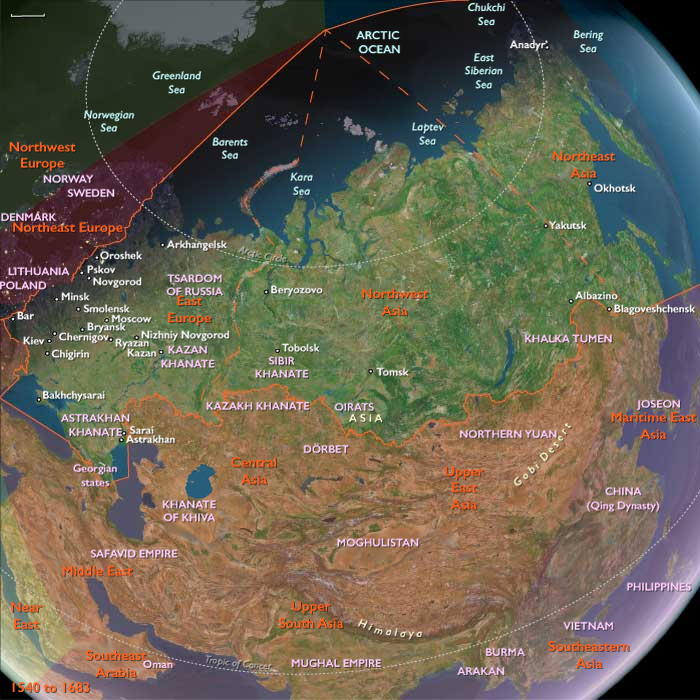
Northeastern Eurasia
View →Subregions
