Contemporary Ottoman sources find in Köprülü Fazıl…
November 1676 CE
Contemporary Ottoman sources find in Köprülü Fazıl Ahmed all the qualities requisite for an Oriental statesman—wide knowledge, wisdom, justice, and generosity.
He has also distinguished himself in Islamic law and Persian literature.
Like other pashas, he maintains a private force of about fifteen hundred sekbans (mercenary soldiers).
Exhausted and for some time ill as a result of long expeditions and excessive use of wine, Ahmed dies in November 1676, leaving a cash fortune of more than three hundred thousand gold pieces.
His successor as grand vizier is his brother-in-law Kara Mustafa, who had been adopted into the powerful Albanian Köprülü family at a young age, and had served as a messenger to Damascus for Ahmed.
He had directed in the name of Köprülü the family's mukata' or tımar fields in Merzifon.
Mustafa had become a vizier in his own right ater having distinguished himself, and by 1663 was commander of the Ottoman Grand Fleet of the Aegean Sea.
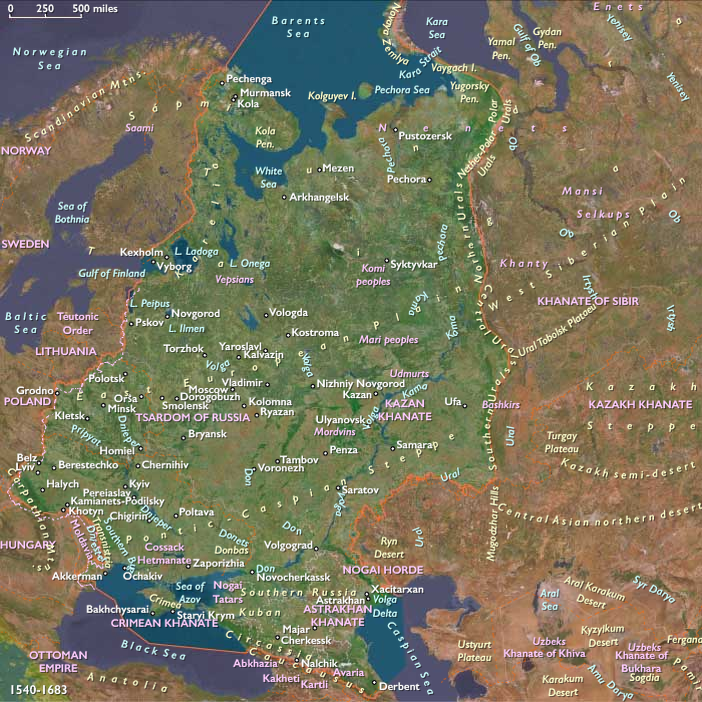
He had served as a commander of ground troops in the war against Poland in 1672, negotiating the settlement that adds the province of Podolia to the empire, enabling the Ottomans to transform the Cossack regions of the southern Ukraine into a protectorate.
Groups
Commodities
Subjects
Regions
Northeastern Eurasia
View →Subregions