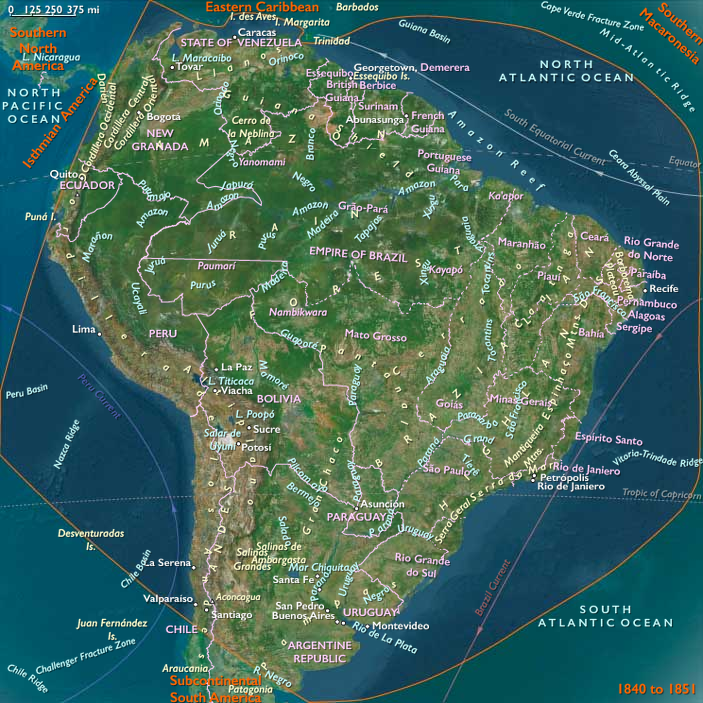
South America Major (1840–1851 CE): Persistent Instability,…
1840 CE to 1851 CE
South America Major (1840–1851 CE): Persistent Instability, Economic Transition, and Rising Social Tensions
Between 1840 and 1851 CE, South America Major—including Peru, Bolivia, Paraguay, Uruguay, Brazil, northern Argentina, northern and central Chile, Colombia (excluding Darién) and Ecuador (excluding the Ecuadoran capelands), Venezuela, Suriname, Guyana, and French Guiana—remained marked by considerable political instability and regional conflicts. Early economic modernization efforts began reshaping national economies, even as slavery debates intensified, shaping profound social changes. Nations continued the process of consolidating their identities, institutions, and territorial control.
Political Developments
Continuing Political Instability
Political volatility persisted across the continent:
-
Argentina saw ongoing conflicts between Unitarians (centralists) and Federalists, epitomized by Juan Manuel de Rosas’ authoritarian regime (1835–1852).
-
Brazil endured the turbulent regency period, transitioning to the personal rule of Emperor Pedro II in 1840, gradually stabilizing but facing regional unrest, notably the Revolução Praieira (1848–1850).
-
Peru and Bolivia experienced multiple short-lived governments, marked by internal divisions and repeated military interventions.
-
Colombia (including Panama) faced challenges consolidating central authority amid regional rivalries, leading to fragmented governance.
Paraguay After Francia
Paraguay transitioned from the isolationist dictatorship of José Gaspar Rodríguez de Francia (died 1840) into the less isolated but still authoritarian rule of Carlos Antonio López (1844 onward), initiating limited openness and modernizing reforms.
Consolidation in Uruguay
Uruguay, newly independent, struggled with factional conflicts between Blancos and Colorados, leading to intermittent civil wars and foreign interventions, notably by Argentina and Brazil.
Economic Developments
Early Economic Modernization
The era witnessed attempts at economic diversification and early modernization:
-
Increased emphasis on export commodities—Brazil’s coffee, Argentina and Uruguay’s cattle ranching, and Peru’s guano exports (beginning in the 1840s)—linked economies closely to international markets.
-
Infrastructure improvements (roads, ports, railways) began, though slowly, to facilitate trade and economic growth.
Decline in Mining Economies
Traditional mining economies (gold in Brazil’s Minas Gerais, silver in Bolivia’s Potosí, emeralds in Colombia) continued declining, forcing shifts toward agriculture, ranching, and export-driven models.
Intensifying Debates Over Slavery
In Brazil, slavery remained economically vital yet increasingly controversial, sparking intense public debates. International abolitionist pressures mounted, highlighting contradictions between economic reliance and moral arguments against enslavement.
Cultural and Technological Developments
Continued National Identity Formation
New nations promoted cultural projects—literature, music, historical narratives—to define distinct national identities. Intellectuals and leaders actively shaped education systems and cultural institutions that reflected republican values.
Urban Growth and Architectural Expansion
Urban centers, including Rio de Janeiro, Buenos Aires, Montevideo, Lima, Bogotá, Santiago, and Caracas, grew significantly. Public architecture, universities, theaters, and infrastructure projects became symbols of republican modernization and national pride.
Social and Religious Developments
Persistent Social Inequalities
Colonial-era inequalities remained deeply entrenched. Indigenous peoples, mestizos, Afro-descendants, and enslaved communities faced systemic marginalization, prompting occasional social unrest and demands for reform.
Catholic Church and Social Stability
The Catholic Church continued balancing tradition with emerging secular pressures. It remained a stabilizing social force but faced increasing tensions regarding educational authority, secular governance, and social reform.
Indigenous Resistance and Frontier Dynamics
Indigenous communities actively resisted encroachments on their territories, especially the Mapuche in southern Chile and indigenous peoples in Andean and Amazonian frontiers. Conflicts shaped national policies toward indigenous groups, affecting frontier governance and military strategies.
Long-Term Consequences and Historical Significance
The era from 1840 to 1851 CE was crucial for consolidating early republican governance, economic modernization, and national identities in South America. Continued political instability, intensified slavery debates, regional conflicts, and persistent social inequalities underscored the complexities of nation-building. Economic transitions toward global markets created patterns of dependency that would influence regional development for decades, while Paraguay’s distinctive authoritarian stability and Uruguay’s struggle for political cohesion marked important contrasts within the region.
People
Groups
Topics
Commodities
Subjects
Regions
South America
View →Subregions