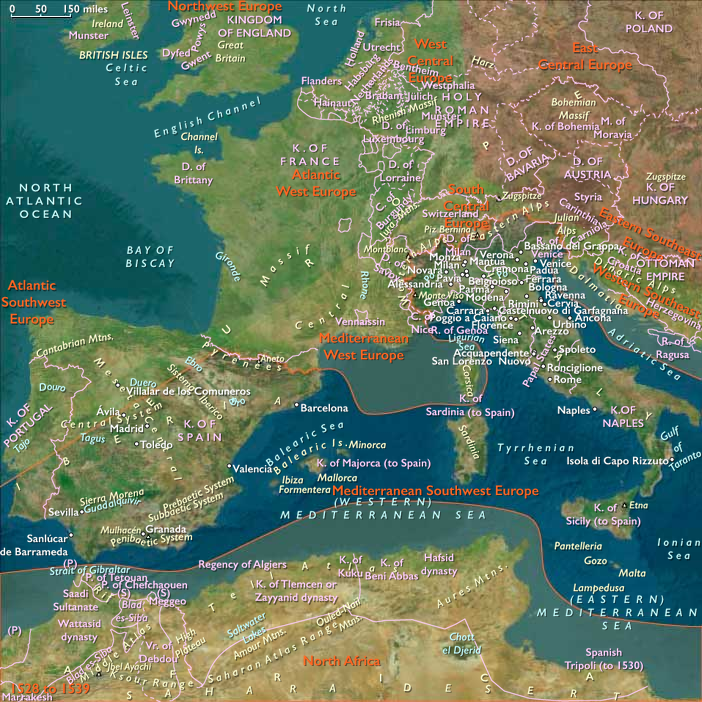
Duke Alessandro’s many enemies among the exiles…
1537 CE
Duke Alessandro’s many enemies among the exiles declare that his rule is harsh, depraved and incompetent, an assessment debated by later historians.
One relic of his rule sometimes pointed out as a symbol of Medici oppression is the massive Fortezza da Basso, today the largest historical monument of Florence.
The Florentine opposition in 1535 had sent his cousin Ippolito to appeal to Charles V against some actions of the Duke, but Ippolito died en route; rumors are spread that he had been poisoned at Alessandro's orders.
In a late replay of the kind of medieval civil politics that had long revolved around pope and emperor, commune and lord, the Emperor supports Alessandro against the republicans.
He marries his natural daughter Margaret of Austria to Alessandro in 1536.
Her mother, Johanna Maria van der Gheynst, a servant of Charles de Lalaing, Seigneur de Montigny, is a Fleming.
Margaret has been brought up by the Douwrin family, under the supervision of two powerful Spanish and Austrian Habsburg Imperial family relatives, her great-aunt, the Archduchess Margaret of Austria, and her aunt Mary of Austria, who are successive governors of the Netherlands from 1507 to 1530 and from 1530 to 1555, respectively.
Margaret had in 1529 been acknowledged by her father and allowed to assume the name Margaret of Austria, and in 1533, the eleven-year-old girl had been brought to live to the north of Italy.
Though she is multi-lingual, she is to prefer the Italian language for the rest of her life.
In 1527, in the year she turned five, she has become became engaged to the Pope's nephew, Alessandro de' Medici, to assist her father's ambition in gaining influence in Italy.
The marriage negotiations had been initiated in 1526, and in 1529 the agreement had been officially signed by her father and the Pope.
She had in 1536 married her betrothed.
For his own inclinations, Alessandro seems to have remained faithful to one mistress, Taddea Malaspina, who will bear his only children: Giulio de' Medici, who also will have illegitimate issue, and Giulia de' Medici, who will marry her cousin Bernardetto de' Medici, Signore di Ottaiano, and have issue.
His distant cousin Lorenzino de' Medici, nicknamed "Lorenzaccio" ("bad Lorenzo"), assassinates him on January 6, 1537. (This event is the subject of Alfred de Musset's play "Lorenzaccio.")
Lorenzino had entrapped Alessandro through the ruse of a promised arranged sexual encounter with Lorenzino's sister Laudomia, a beautiful widow.
For fear of starting an uprising if news of his death got out, Medici officials wrap Alessandro's corpse in a carpet and secretly carry it to the cemetery of San Lorenzo, where it is hurriedly buried.
A solemn funeral is celebrated in Valladolid, Spain, where the imperial court of Charles V is established.
Lorenzino, in a declaration published later, will say that he had killed Alessandro for the sake of the republic.
When the anti-Medici faction failed to rise, Lorenzino fled to Venice, where he will be killed in 1548.
The Medici supporters (called "Palleschi" from the balls on the Medici arms) ensure that power now passes to Cosimo I de' Medici, the first of the "junior" branch of the Medici to rule Florence.
Images

Pontormo: Portrait of Alessandro de Medici (1534-1535); oil on panel; 97 × 79 cm (38.2 × 31.1 in); collection J. G. Johnson, Philadelphia
Locations
People
Groups
Commodities
Subjects
Regions
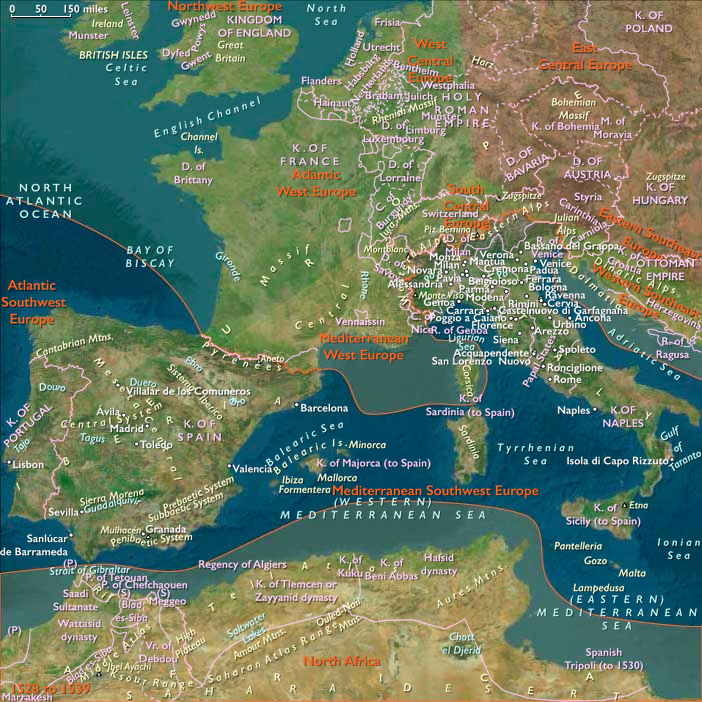
Southwest Europe
View →Subregions