
East Central Europe (1696–1707 CE): Great Northern …
Years: 1696 - 1707
East Central Europe (1696–1707 CE): Great Northern War, Habsburg Consolidation, and Dynastic Realignments
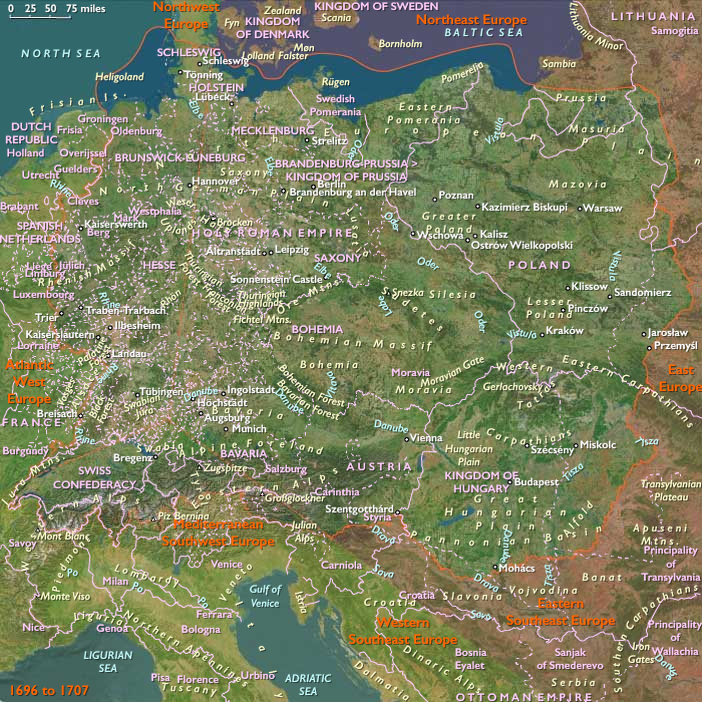
Between 1696 and 1707 CE, East Central Europe—including modern-day Poland, Czechia, Slovakia, Hungary, and eastern parts of Germany and Austria east of 10°E and north of the defined southeastern boundary—witnessed profound geopolitical shifts driven by the outbreak of the Great Northern War (1700–1721), continued Habsburg consolidation in formerly Ottoman-held Hungary, dynastic struggles within Poland-Lithuania, and Brandenburg-Prussia’s elevation as the Kingdom of Prussia.
Political and Military Developments
Outbreak and Early Stages of the Great Northern War
-
The outbreak of the Great Northern War in 1700 pitted a coalition of Denmark-Norway, Saxony-Poland-Lithuania (under King Augustus II the Strong), and Russia against the rapidly expanding Swedish Empire led by the dynamic young king, Charles XII.
-
Early stages saw remarkable Swedish victories, notably the decisive Crossing of the Düna (also known as the Battle of Daugava or Battle of Spilves) on July 19, 1701, near the city of Riga. During this engagement, Charles XII successfully crossed the Düna (Daugava) River, defeating the combined Saxon-Russian forces and compelling Augustus II into retreat, severely crippling Saxon ambitions in the Baltic region. This Swedish triumph profoundly reshaped political and military alliances throughout East Central Europe.
Polish-Lithuanian Instability under Augustus II
-
Augustus II (r. 1697–1706, 1709–1733), Elector of Saxony and King of Poland, aimed to strengthen royal authority and dynastic ambitions but struggled to maintain internal cohesion amid powerful magnate factions and external Swedish pressure.
-
The Swedish victory at the Battle of Kliszów (1702) significantly weakened Augustus’s position, ultimately leading to his temporary deposition in 1704 in favor of the pro-Swedish King Stanisław Leszczyński.
Brandenburg-Prussia’s Ascension as the Kingdom of Prussia (1701)
-
In 1701, Elector Frederick III of Brandenburg crowned himself King Frederick I of Prussia, elevating Brandenburg-Prussia to royal status and significantly increasing its prestige within European politics.
-
This elevation, sanctioned by Holy Roman Emperor Leopold I in exchange for Frederick’s support in the War of the Spanish Succession, substantially reshaped regional political dynamics and established Prussia as a powerful new player on the continental stage.
Habsburg Consolidation and Continued Ottoman Conflict
-
The Habsburg monarchy, under Emperor Leopold I (1658–1705) and his successor Joseph I (1705–1711), continued administrative and political consolidation in newly reclaimed Hungarian territories, systematically integrating these regions into their centralized empire.
-
Despite ongoing resistance from Hungarian nobility, especially Protestant magnates, the Habsburgs effectively solidified their authority, instituting direct imperial administration in key areas like Transylvania and southern Hungary.
Economic and Technological Developments
War-driven Economic Challenges and Opportunities
-
Ongoing conflicts, notably the Great Northern War and localized resistance in Hungary, disrupted trade and agriculture in affected regions, particularly Poland and Hungary, causing temporary economic downturns.
-
Conversely, territories like Brandenburg-Prussia, Bohemia, and Austrian provinces saw accelerated economic and infrastructural growth driven by centralized administrative reforms, expanded trade networks, and wartime manufacturing.
Infrastructure Improvements and Urban Growth
-
Major cities, especially Berlin, Vienna, Prague, Dresden, and Leipzig, continued extensive urban improvements and fortification enhancements, significantly improving regional infrastructure and boosting commercial activity despite broader instability.
Cultural and Artistic Developments
Baroque Splendor and Courtly Culture
-
Courtly culture flourished dramatically, particularly in Vienna, Dresden, and Prague, exemplified by lavish architectural projects and the patronage of music and arts under Habsburg and Saxon rulers. Dresden emerged as a major cultural center under Augustus II, famed for opulent Baroque architecture and vibrant courtly life.
-
The era saw continued prominence of Baroque artistic and architectural styles, which reinforced regional cultural identities and dynastic prestige.
Influence of Intellectual and Educational Institutions
-
Catholic educational institutions expanded significantly across Bohemia, Austria, and Hungary, strongly supporting the Counter-Reformation agenda. Jesuit colleges and seminaries reinforced regional religious and intellectual life.
-
Protestant universities in Brandenburg-Prussia and Saxony remained vibrant centers of scholarship, contributing to regional literacy, scientific inquiry, and theological discourse.
Settlement and Urban Development
Post-War Reconstruction and Expansion
-
Territories impacted by warfare, especially in Hungary and Poland, initiated reconstruction and revitalization efforts, supported by imperial and noble patronage. Infrastructure projects and fortification improvements promoted urban recovery and future resilience.
-
Prussian cities, notably Berlin, experienced substantial urban expansion, reshaping cityscapes and enhancing their political, economic, and cultural significance.
Social and Religious Developments
Protestant-Catholic Tensions and Habsburg Integration
-
Tensions remained pronounced in Habsburg Hungary, where Protestant noble resistance clashed repeatedly with imperial Catholic administrative centralization, fueling persistent social unrest and resistance movements.
-
Religious policies, including intensified Counter-Reformation activities and restrictions on Protestant worship, continued shaping regional demographics and social dynamics significantly.
Aristocratic Dominance and Local Governance
-
Polish magnates retained extensive autonomy, complicating central governance under Augustus II, whose rule was undermined by powerful aristocratic factions, further fragmenting Poland-Lithuania’s political cohesion.
-
In Brandenburg-Prussia and Austria-Bohemia, aristocratic elites aligned more closely with centralizing rulers, consolidating their positions within emerging bureaucratic and military structures.
Long-Term Consequences and Historical Significance
The era 1696–1707 CE profoundly reshaped East Central Europe’s geopolitical landscape. The Great Northern War’s outbreak significantly altered regional alliances and destabilized Poland-Lithuania, highlighting its internal vulnerabilities. Brandenburg-Prussia’s elevation as the Kingdom of Prussia permanently altered the balance of power within the Holy Roman Empire, setting a course toward future German consolidation. Continued Habsburg expansion and centralization in Hungary stabilized the monarchy’s southeastern frontier, despite sparking enduring local resistance. Collectively, these developments laid critical foundations for subsequent eighteenth-century political, economic, and cultural transformations across East Central Europe.
People
- Augustus II the Strong
- Charles XII of Sweden
- Frederick William I of Prussia
- Joseph I
- Leopold I
- Stanisław Leszczyński
Groups
- Holy Roman Empire
- Germany, Kingdom of (within the Holy Roman Empire)
- Christians, Roman Catholic
- Christians, Eastern Orthodox
- Austria, Archduchy of
- Holy Roman Empire
- Salzburg, Archbishopric of
- Saxony, Electorate of
- Ottoman Empire
- Protestantism
- Sweden, (second) Kingdom of
- Hungary, Royal
- Swedish Empire
- Hungary, Kingdom of
- Polish-Lithuanian Commonwealth (Commonwealth of the Two Nations)
- Habsburg Monarchy, or Empire
- Brandenburg-Prussia
- Bohemia, Kingdom of
- Bavaria, Electorate of
- Holy League (Great Turkish War)
- Transylvania, (Austrian) Principality of
- Prussia, Kingdom of
Topics
Commodoties
Subjects
Regions
Subregions

Years: 1696 - 1707
People
- Augustus II the Strong
- Charles XII of Sweden
- Frederick William I of Prussia
- Joseph I
- Leopold I
- Stanisław Leszczyński
Groups
- Holy Roman Empire
- Germany, Kingdom of (within the Holy Roman Empire)
- Christians, Roman Catholic
- Christians, Eastern Orthodox
- Austria, Archduchy of
- Holy Roman Empire
- Salzburg, Archbishopric of
- Saxony, Electorate of
- Ottoman Empire
- Protestantism
- Sweden, (second) Kingdom of
- Hungary, Royal
- Swedish Empire
- Hungary, Kingdom of
- Polish-Lithuanian Commonwealth (Commonwealth of the Two Nations)
- Habsburg Monarchy, or Empire
- Brandenburg-Prussia
- Bohemia, Kingdom of
- Bavaria, Electorate of
- Holy League (Great Turkish War)
- Transylvania, (Austrian) Principality of
- Prussia, Kingdom of
Topics
Commodoties
Subjects
Regions
Subregions