
East Central Europe (1756–1767 CE): Seven Years’ …
Years: 1756 - 1767
East Central Europe (1756–1767 CE): Seven Years’ War, Austro-Prussian Rivalry, and Regional Transformations
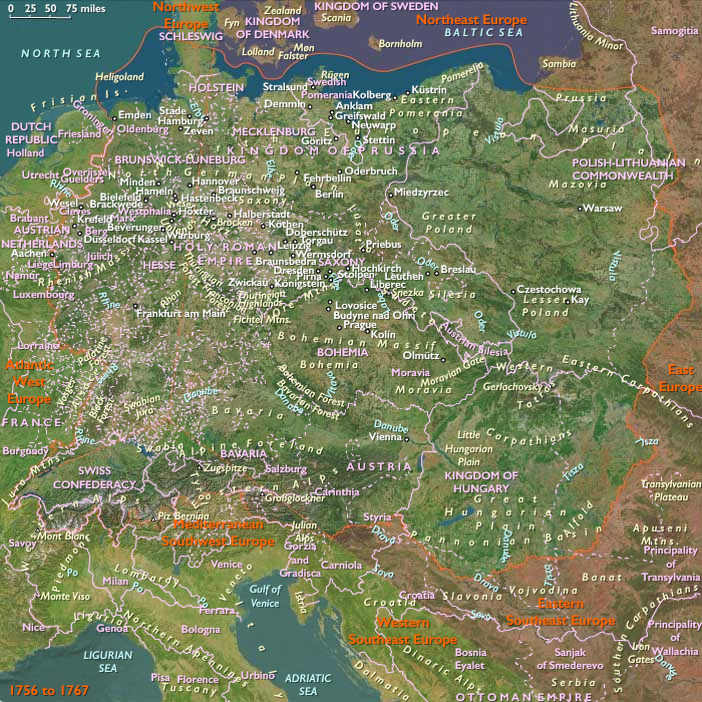
Between 1756 and 1767 CE, East Central Europe—encompassing modern-day Poland, Czechia, Slovakia, Hungary, and eastern Germany and Austria east of 10°E and north of the defined boundary—became a pivotal theater in the broader European conflict of the Seven Years' War (1756–1763). The intense struggle between Habsburg Austria under Maria Theresa and Prussia led by Frederick the Great profoundly influenced regional geopolitics, shaping subsequent political alliances, accelerating military and administrative reforms, and impacting economic, social, and cultural dynamics across the region.
Political and Military Developments
Seven Years’ War and East Central Europe (1756–1763)
-
The Seven Years' War erupted as a coalition—including Austria, France, Russia, Sweden, and Saxony—sought to diminish Prussian dominance, specifically aiming to reclaim Silesia for Austria.
-
East Central Europe experienced intense military engagements, notably in Saxony, Silesia, Bohemia, and Brandenburg, witnessing major battles such as:
-
Battle of Lobositz (1756), initial Prussian-Austrian clash in Bohemia.
-
Battle of Prague (1757), a costly Prussian victory.
-
Battle of Kolín (1757), significant Austrian victory halting Prussian advances toward Vienna.
-
Battle of Kunersdorf (1759), severe defeat for Prussia by Austrian-Russian forces.
-
Battle of Torgau (1760), costly Prussian victory, preserving Frederick’s tenuous control.
-
-
Despite heavy losses and near collapse, Frederick II’s resilience, aided by shifting alliances (notably Russian withdrawal after 1762), enabled Prussia to maintain control of Silesia through the Treaty of Hubertusburg (1763).
Treaty of Hubertusburg (1763) and Aftermath
-
The treaty formally ended hostilities between Austria and Prussia, affirming Prussia’s permanent possession of Silesia but restoring other prewar territorial boundaries.
-
Austria recognized Prussian dominance in Silesia, definitively altering regional power dynamics and cementing Prussia as a primary European power alongside Austria.
Polish-Lithuanian Commonwealth: Increasing Instability
-
Poland-Lithuania, though nominally neutral, was severely affected by war-induced economic disruptions and diplomatic pressures, becoming increasingly vulnerable to interference from neighboring powers, especially Russia and Prussia.
Economic and Technological Developments
Economic Strain and Recovery
-
Wartime devastation significantly strained regional economies, particularly in Saxony, Silesia, and Bohemia, resulting from military requisitions, disruptions to agriculture, and destruction of trade routes.
-
Postwar economic recovery was aided by governmental reforms, investment in industry, trade revitalization, and agricultural productivity, notably in Silesia and Austria’s Bohemian and Moravian provinces.
Continued Infrastructure Investment
-
Austria and Prussia prioritized rebuilding and enhancing infrastructure after 1763, including roads, bridges, waterways, and fortifications, stimulating economic revival and increased connectivity within East Central Europe.
Cultural and Artistic Developments
Enlightenment Influence and Cultural Flourishing
-
Enlightenment ideals continued influencing intellectual, cultural, and scientific life across East Central Europe. Vienna, Berlin, Dresden, and Prague became dynamic centers of Enlightenment thought, art, and architecture.
-
Prominent figures such as composers Franz Joseph Haydn in Austria and Carl Philipp Emanuel Bach in Prussia enriched regional cultural life, contributing significantly to European musical heritage.
Rococo and Early Classicism
-
Artistic patronage thrived despite wartime disruptions. Rococo art and architecture flourished, evolving gradually toward early neoclassical styles evident in palaces, urban residences, and public buildings across Vienna, Dresden, and Berlin.
Settlement and Urban Development
Postwar Urban Reconstruction and Growth
-
Cities heavily impacted by wartime destruction—including Dresden, Leipzig, Prague, and Breslau (Wrocław)—underwent significant postwar reconstruction, resulting in urban renewal and enhanced civic infrastructure.
-
Renewed urban prosperity stimulated trade, industry, and population growth, strengthening major urban centers as economic and cultural hubs.
Social and Religious Developments
Administrative and Military Reforms
-
Austria and Prussia implemented significant administrative reforms inspired by wartime experience, improving bureaucracy, taxation, military organization, and state centralization. These reforms strengthened state authority and social stability, underpinning future modernization efforts.
Religious Diversity and Tolerance
-
Despite ongoing religious tensions, regional states continued promoting policies of religious tolerance. Frederick II notably extended religious freedoms within Prussia, enhancing social cohesion and economic productivity by accommodating diverse religious communities, including Protestants, Catholics, and Jews.
Long-Term Consequences and Historical Significance
The period 1756 to 1767 CE was transformative for East Central Europe, decisively shaped by the Seven Years’ War and the resultant Treaty of Hubertusburg. Prussia’s permanent retention of Silesia dramatically altered regional balance, firmly establishing Prussia as a leading European power and intensifying the Austro-Prussian rivalry. The war-induced administrative and military reforms significantly modernized governmental structures, facilitating enhanced state centralization and efficiency. Postwar economic recovery, infrastructural improvements, and cultural vitality under Enlightenment influence reinforced regional stability and prosperity, laying crucial foundations for subsequent developments in East Central Europe’s political, economic, and cultural trajectory.
People
Groups
- Jews
- Holy Roman Empire
- Germany, Kingdom of (within the Holy Roman Empire)
- Christians, Roman Catholic
- Austria, Archduchy of
- Holy Roman Empire
- Saxony, Electorate of
- Protestantism
- Hungary, Kingdom of
- Polish-Lithuanian Commonwealth (Commonwealth of the Two Nations)
- France, (Bourbon) Kingdom of
- Habsburg Monarchy, or Empire
- Bohemia, Kingdom of
- Moravian Margravate
- Prussia, Kingdom of
- Russian Empire
Topics
- Seven Years' War
- Silesian War, Third
- Lobositz, Battle of
- Prague, Battle of
- Kolín, Battle of
- Kunersdorf, Battle of
- Torgau, Battle of
Commodoties
Subjects
- Commerce
- Architecture
- Painting and Drawing
- Decorative arts
- Conflict
- Faith
- Government
- Scholarship
- Custom and Law
Regions
Subregions
Related Events
Showing 10 events out of 38 total
Years: 1756 - 1767
People
Groups
- Jews
- Holy Roman Empire
- Germany, Kingdom of (within the Holy Roman Empire)
- Christians, Roman Catholic
- Austria, Archduchy of
- Holy Roman Empire
- Saxony, Electorate of
- Protestantism
- Hungary, Kingdom of
- Polish-Lithuanian Commonwealth (Commonwealth of the Two Nations)
- France, (Bourbon) Kingdom of
- Habsburg Monarchy, or Empire
- Bohemia, Kingdom of
- Moravian Margravate
- Prussia, Kingdom of
- Russian Empire
Topics
- Seven Years' War
- Silesian War, Third
- Lobositz, Battle of
- Prague, Battle of
- Kolín, Battle of
- Kunersdorf, Battle of
- Torgau, Battle of
Commodoties
Subjects
- Commerce
- Architecture
- Painting and Drawing
- Decorative arts
- Conflict
- Faith
- Government
- Scholarship
- Custom and Law
Regions
Subregions