
East Central Europe (1684–1827 CE): From Vienna’s …
Years: 1684 - 1827
East Central Europe (1684–1827 CE): From Vienna’s Salvation to the Age of Revolutions
Geography & Environmental Context
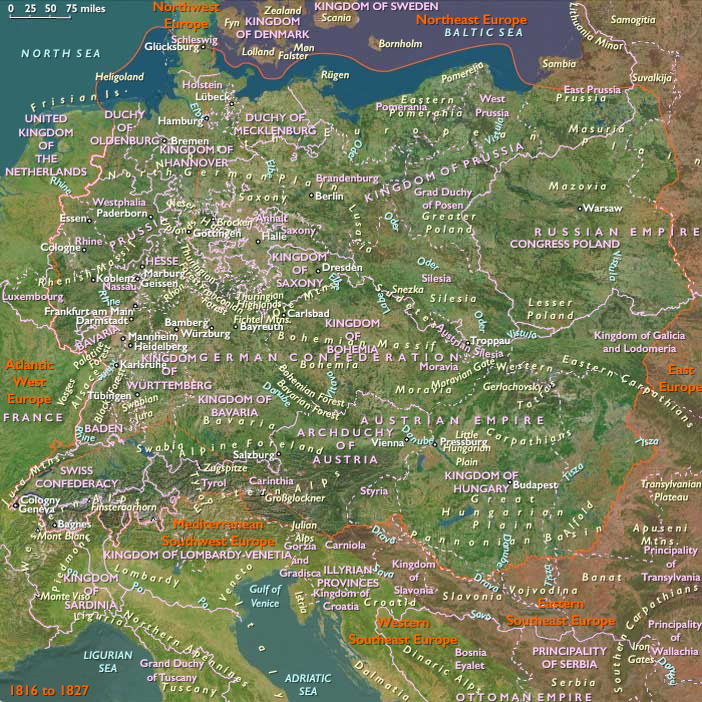
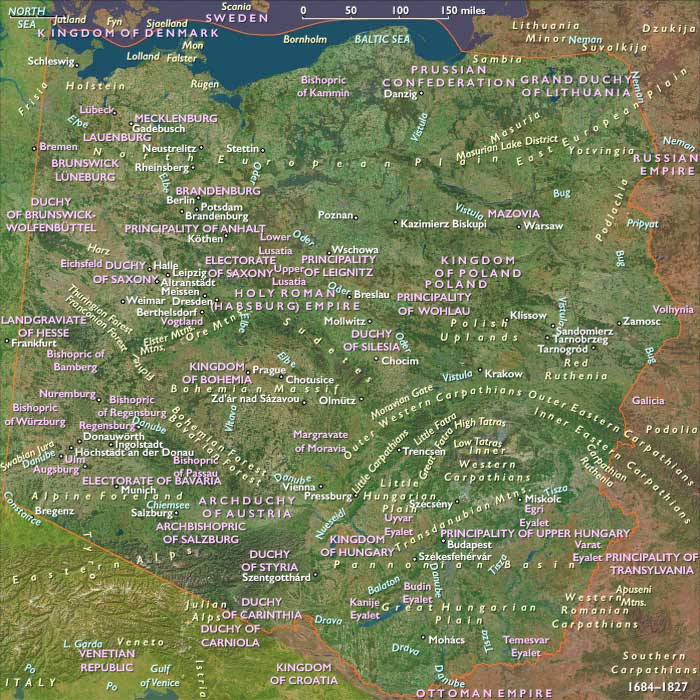
East Central Europe includes the greater part of Germany east of 10°E (Brandenburg, Saxony, Thuringia, Franconia, eastern Bavaria, Silesia), together with Bohemia and Moravia, the Austrian heartlands (Vienna, Lower and Upper Austria, Carinthia, Styria), and parts of the upper Danube basin. Anchors include the Elbe and Oder valleys, the Ore and Sudeten Mountains, the Danube corridor through Vienna, and the Vienna Woods and Alpine forelands. These landscapes connected the Holy Roman Empire’s patchwork of German states with the Habsburg monarchy’s Danubian dominion.
Climate & Environmental Shifts
The end of the Little Ice Age produced climatic instability—harsh winters (notably 1708–09, “the Great Frost”) and drought years interspersed with good harvests. Floods along the Elbe, Oder, and Danube repeatedly damaged fields and towns. The spread of the potato and clover improved food security and fodder supplies, mitigating famine after mid-century. By the early 19th century, agrarian innovation was widespread.
Subsistence & Settlement
-
Agriculture: Rye, oats, and wheat remained staples, with potatoes gradually adopted across Saxony, Bohemia, and Austria. Vineyards revived in Franconia and along the Danube. Sheep grazing supported a wool trade in Silesia and Saxony.
-
Urban centers:
-
Vienna expanded as the Habsburg capital and cultural hub.
-
Prague rebuilt after Thirty Years’ War devastation.
-
Berlin emerged as Brandenburg-Prussia’s capital.
-
Leipzig’s trade fairs tied Central Europe into global commerce.
-
-
Industrial proto-centers: Saxon textiles, Silesian mining, and Austrian ironworks foreshadowed later industrial revolutions.
Technology & Material Culture
-
Transport: The Elbe and Danube carried bulk goods; improved roads supported armies and post coaches. Canals were planned but rarely realized.
-
Industry: Mining of silver, salt, and iron; Saxon porcelain (Meissen, from 1710) became a prestige export.
-
Everyday life: Timber-framed villages and baroque towns persisted; after 1750, rococo and neoclassical styles marked elite culture. New consumer goods—coffee, sugar, porcelain, printed cottons—spread among urban middle classes.
Movement & Interaction Corridors
-
Danube corridor: Vienna to Budapest and Belgrade, supplying grain and military convoys.
-
Elbe corridor: Leipzig and Dresden to Hamburg.
-
Military marches: Repeated campaigns of Habsburg, Prussian, and Saxon armies moved through Silesia, Bohemia, and Austria.
-
Intellectual networks: Universities (Halle, Jena, Vienna, Prague) circulated Enlightenment and Romantic thought.
Cultural & Symbolic Expressions
-
Baroque Catholicism: Habsburg Austria rebuilt monasteries and churches in monumental style, asserting Catholic power.
-
Protestant learning: Saxony and Brandenburg cultivated Pietism and rationalist theology; universities fostered Enlightenment scholarship.
-
Music and arts: Vienna became a musical capital—Haydn, Mozart, and Beethoven transformed European culture. German literature blossomed in Leipzig, Weimar, and Berlin (Goethe, Schiller).
-
National awakenings: Early stirrings of Czech, Slovak, and German romantic nationalism emerged, emphasizing folk traditions and vernacular culture.
Environmental Adaptation & Resilience
-
Potato adoption: Widespread cultivation reduced famine vulnerability after the 1770s.
-
Agricultural reforms: Enclosure, crop rotation, and estate rationalization under enlightened absolutists.
-
Disaster response: Parish granaries and charitable institutions distributed food in bad years.
-
Forest regulation: Habsburg and Prussian forestry codes sought sustainable timber supply.
Political & Military Shocks
-
Ottoman wars: The failed Ottoman siege of Vienna (1683) was followed by Habsburg advances into Hungary and the Balkans.
-
War of the Spanish Succession (1701–1714): Austria gained territories in Italy and the Low Countries.
-
Pragmatic Sanction (1713): Secured Maria Theresa’s succession, contested in the War of the Austrian Succession (1740–1748).
-
Silesian Wars (1740–1763): Frederick the Great seized Silesia, establishing Prussia as Austria’s rival.
-
Seven Years’ War (1756–1763): A global war with East Central Europe as a major theater; Prussia survived against Austria, Russia, and France.
-
Napoleonic Wars (1792–1815): Vienna repeatedly occupied; the Holy Roman Empire dissolved (1806); Austria fought at Austerlitz (1805), Wagram (1809), Leipzig (1813).
-
Congress of Vienna (1815): Austria regained centrality in German affairs, while Prussia expanded in the Rhineland.
-
1820s unrest: Student protests and secret societies (Carlsbad Decrees, 1819) signaled the era of rising nationalism and liberalism.
Transition
From 1684 to 1827, East Central Europe was reshaped by warfare, dynastic rivalry, and cultural efflorescence. The Habsburgs defended Vienna, expanded southward, and patronized Catholic Baroque and Enlightenment reform. Prussia emerged as a disciplined military state, rivaling Austria for dominance in the German lands. Saxony and Bohemia rebuilt as cultural and economic hubs, while peasants adopted potatoes and clover to stabilize food supplies. By 1827, the subregion was firmly part of a Europe redefined by the Napoleonic Wars and the Vienna settlement—its dynasties resilient, but new currents of nationalism and revolution already stirring.
People
- Adam Mickiewicz
- Augustus II the Strong
- Ferenc Kazinczy
- Ferenc Kölcsey
- František Palacký
- Josef Dobrovský
- Joseph Haydn
- Joseph II, Holy Roman Emperor
- Klemens von Metternich
- Maria Theresa
- Wolfgang Amadeus Mozart
Groups
- Hungarian people
- Germany, Kingdom of (within the Holy Roman Empire)
- Poles (West Slavs)
- Czechs [formerly Bohemians] (West Slavs)
- Christians, Roman Catholic
- Austria, Archduchy of
- Saxony, Electorate of
- Holy Roman Empire
- Protestantism
- Hungary, Kingdom of
- Polish-Lithuanian Commonwealth (Commonwealth of the Two Nations)
- Habsburg Monarchy, or Empire
- Bohemia, Kingdom of
- Prussia, Kingdom of
- Russian Empire
- Galicia and Lodomeria, Kingdom of
- Austrian Empire
- Bavaria, Kingdom of
- Saxony, Kingdom of
- Warsaw, Duchy of
- France, constitutional monarchy of
- Poland, Congress Kingdom of
- German Confederation
Topics
- Ostsiedlung (German: Settlement in the East), a.k.a. German eastward expansion
- Enlightenment, Age of
- Silesian War, First
- Silesian War, Second
- Silesian War, Third
- Poland, First Partition of
- Poland, Second Partition of
- Poland, Third Partition of
- Congress of Vienna
Commodoties
Subjects
Regions
Subregions
Related Events
Showing 10 events out of 30218 total
Years: 1684 - 1827
People
- Adam Mickiewicz
- Augustus II the Strong
- Ferenc Kazinczy
- Ferenc Kölcsey
- František Palacký
- Josef Dobrovský
- Joseph Haydn
- Joseph II, Holy Roman Emperor
- Klemens von Metternich
- Maria Theresa
- Wolfgang Amadeus Mozart
Groups
- Hungarian people
- Germany, Kingdom of (within the Holy Roman Empire)
- Poles (West Slavs)
- Czechs [formerly Bohemians] (West Slavs)
- Christians, Roman Catholic
- Austria, Archduchy of
- Saxony, Electorate of
- Holy Roman Empire
- Protestantism
- Hungary, Kingdom of
- Polish-Lithuanian Commonwealth (Commonwealth of the Two Nations)
- Habsburg Monarchy, or Empire
- Bohemia, Kingdom of
- Prussia, Kingdom of
- Russian Empire
- Galicia and Lodomeria, Kingdom of
- Austrian Empire
- Bavaria, Kingdom of
- Saxony, Kingdom of
- Warsaw, Duchy of
- France, constitutional monarchy of
- Poland, Congress Kingdom of
- German Confederation
Topics
- Ostsiedlung (German: Settlement in the East), a.k.a. German eastward expansion
- Enlightenment, Age of
- Silesian War, First
- Silesian War, Second
- Silesian War, Third
- Poland, First Partition of
- Poland, Second Partition of
- Poland, Third Partition of
- Congress of Vienna
Commodoties
Subjects
Regions
Subregions