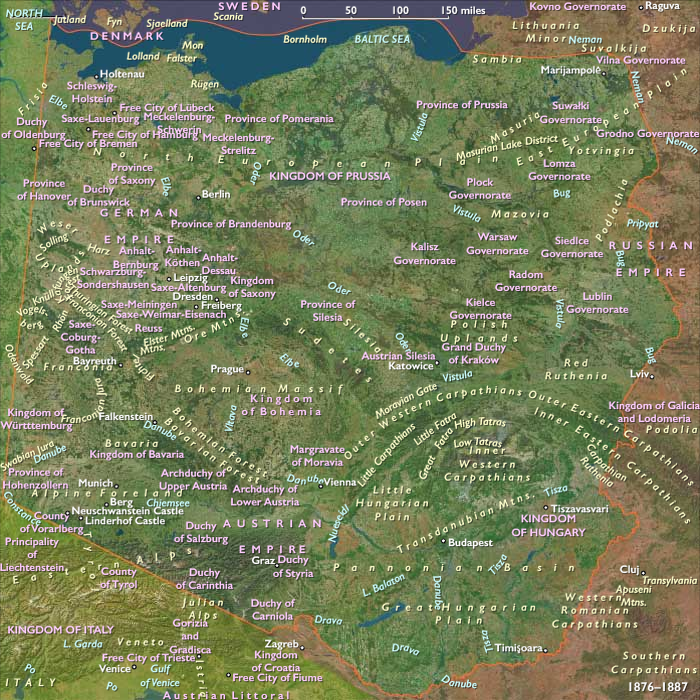
East Central Europe (1876–1887 CE): Imperial Consolidation,…
1876 CE to 1887 CE
East Central Europe (1876–1887 CE): Imperial Consolidation, Nationalist Movements, Economic Modernization, and Social Change
From 1876 to 1887, East Central Europe—including modern-day Poland, Czechia, Slovakia, Hungary, and eastern Germany and Austria east of 10°E and northeast of the defined boundary—experienced a period of political stabilization under dominant empires, intensified nationalist movements, substantial economic modernization, and important social transformations. These developments reinforced the region's complex dynamics, laying foundations for the political tensions and socio-economic challenges of the late 19th century.
Political and Military Developments
Stability and Consolidation in Austria-Hungary
Following the 1867 Austro-Hungarian Compromise, the Dual Monarchy consolidated its internal structures. Emperor Franz Joseph I maintained central authority from Vienna and Budapest, stabilizing the empire administratively and politically. However, tensions with non-German and non-Hungarian minorities, particularly Czechs and Poles, remained persistent and increasingly challenging.
German Empire: Strengthening Under Bismarck
The newly unified German Empire, dominated by Prussia and Chancellor Otto von Bismarck, strengthened politically, economically, and militarily. Bismarck’s policies, including the Kulturkampf (1871–1887), targeted Catholic influence, especially impacting Catholic-majority regions in Silesia and other parts of eastern Germany, exacerbating cultural and political tensions.
Polish National Movement and "Organic Work"
In partitioned Polish lands (under German, Russian, and Austrian rule), the failure of earlier uprisings shifted Polish nationalism toward "Organic Work"—cultural and economic self-strengthening without direct confrontation. This strategy emphasized education, economic development, and cultural activities as foundations for eventual autonomy or independence.
Economic and Technological Developments
Rapid Industrial Growth and Railway Expansion
Industrialization accelerated significantly, with continued expansion of coal mining, iron and steel production, textiles, and manufacturing industries, particularly in Silesia, Bohemia, and Hungary. Extensive railway networks connected cities and industrial regions, stimulating internal trade and facilitating economic integration within Germany and Austria-Hungary.
Agricultural Improvements and Rural Modernization
Agricultural productivity improved through mechanization, new farming methods, and better management practices, especially notable in Hungary, Austria, and German territories. Large estates and commercial agriculture flourished, reshaping rural economies.
Cultural and Artistic Developments
Cultural Flourishing and Nationalist Expressions
The late 1870s and 1880s saw heightened cultural activity, marked by vibrant nationalist expressions across East Central Europe. Literature, music, and visual arts advanced distinct Czech, Polish, Hungarian, and German identities. Prominent figures included Czech composer Antonín Dvořák, Hungarian composer Franz Liszt, Polish writer Eliza Orzeszkowa, and German poet and dramatist Gerhart Hauptmann (from Silesia).
Vienna, Prague, and Budapest as Cultural Capitals
Vienna, Prague, and Budapest thrived culturally, reflected in impressive urban architecture, theatre, opera, and intellectual life. Vienna’s Ringstrasse, Budapest’s architectural grandeur, and Prague’s vibrant Czech cultural renaissance became symbols of national pride and imperial prestige.
Settlement and Urban Development
Significant Urban Expansion
Cities grew rapidly with industrial and commercial prosperity. Major urban centers—Vienna, Budapest, Prague, Dresden, Leipzig, Wrocław (Breslau), and Kraków—expanded significantly, building infrastructure, public transportation, sanitation systems, and cultural institutions, enhancing urban life and governance.
Social and Religious Developments
Growth of Working-Class and Socialist Movements
Social tensions intensified due to rapid industrialization. Working-class populations expanded significantly in industrialized regions, stimulating socialist and labor movements demanding improved conditions, wages, and political representation. Social Democratic parties grew notably, especially in Germany, Bohemia, and Hungary.
Religious Institutions and Social Engagement
Despite tensions (notably the Kulturkampf in Germany), the Catholic Church remained a significant social and cultural institution, influencing education, charity, and social services. Protestant communities, particularly in German regions, similarly contributed to educational and social reform efforts.
Long-Term Consequences and Historical Significance
The era from 1876 to 1887 solidified East Central Europe’s modern political, economic, and cultural structures. Austria-Hungary and Germany stabilized and consolidated their imperial positions, yet underlying nationalist and ethnic tensions persisted, laying foundations for future conflicts. Economic modernization and extensive industrialization reshaped societies profoundly, intensifying class divisions, labor activism, and social movements. Cultural achievements heightened national consciousness, further defining distinct regional identities. Collectively, these developments deeply shaped East Central Europe’s trajectory toward the political and social crises of the early 20th century.
People
Groups
Topics
Subjects
Regions
Central Europe
View →Subregions