
East Central Europe (388–531 CE): Hunnic Empire, …
Years: 388 - 531
East Central Europe (388–531 CE): Hunnic Empire, Germanic Kingdoms, Sarmatian Legacy, and Early Slavic Expansion
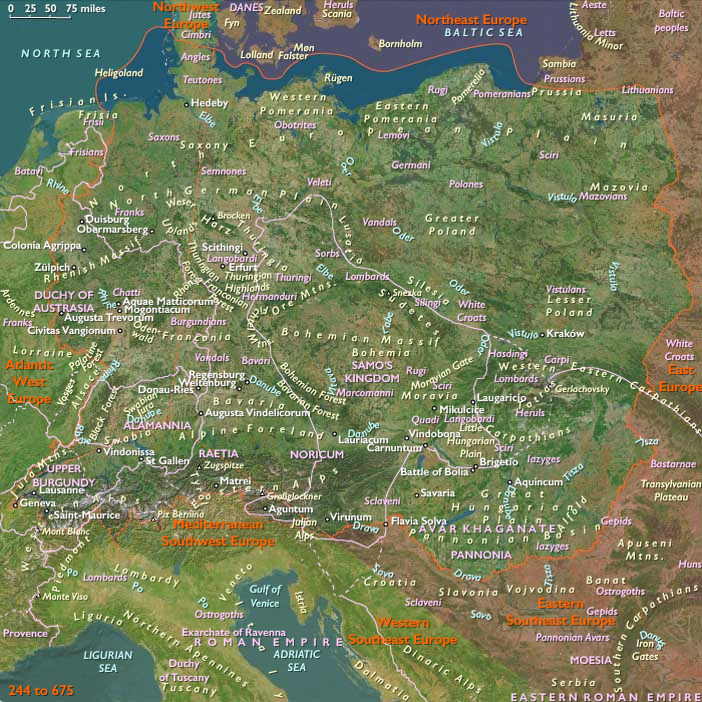
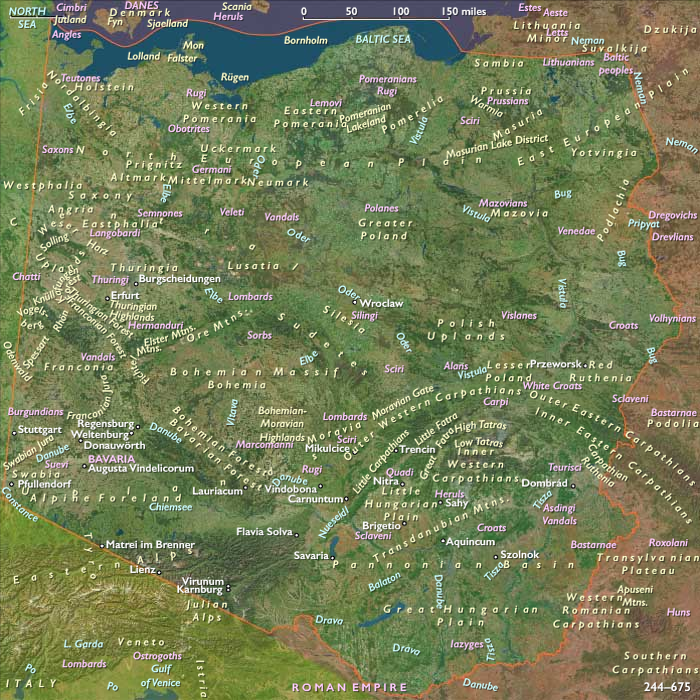
Between 388 and 531 CE, East Central Europe—including modern-day Poland, Czechia, Slovakia, Hungary, and those parts of Germany and Austria east of 10°E and north of the boundary line stretching southeastward from approximately 48.2°N, 10°E to the Austro-Slovenian border near 46.7°N, 15.4°E—underwent significant transformations driven by the powerful Hunnic invasions, extensive Germanic migrations, the collapse of Roman provincial administration, and the continuing influence of Sarmatian populations. These dynamics fundamentally reshaped regional demographics, political alliances, economic patterns, and cultural landscapes, laying foundations for early medieval Europe.
Political and Military Developments
Arrival and Dominance of the Huns
From the late 380s, the Huns, nomadic warriors originally from Central Asia, rapidly dominated East Central Europe. Motivated by environmental pressures, demographic growth, and the pursuit of tribute and conquest, the Huns under Rua, Bleda, and particularly Attila (r. 434–453) established a powerful empire centered on the Carpathian Basin (modern Hungary). Their expansion displaced numerous tribes, destabilized Roman frontier provinces, and profoundly altered regional geopolitics.
Collapse of Roman Provincial Structures
Roman provincial governance, previously divided into Pannonia Prima, Secunda, Savia, and Valeria, crumbled under sustained Hunnic and Germanic pressures. Provinces such as Pannonia Savia and Secunda ceased to exist by the late 5th century, with Roman control of Pannonia Valeria finally dissolving in 496 CE, symbolizing Rome's definitive withdrawal from the region.
Germanic Kingdoms: Ostrogoths, Gepids, Lombards, Thuringians, and Rugii
Following Attila’s death in 453 CE, Germanic tribes filled the ensuing power vacuum, establishing influential kingdoms:
-
Ostrogoths: Initially displaced by Huns, migrated through the region under Theodoric the Great (r. 493–526), ultimately moving into Italy by 488 CE at the invitation of the Eastern Roman Empire, attracted by opportunities for stable governance.
-
Gepids: Originating from Gothic confederations and displaced by Huns, established a strong kingdom in eastern Hungary, Slovakia, and Transylvania after Attila's fall, seizing strategic opportunities in the Carpathian Basin.
-
Lombards (Langobardi): Migrating from northern Germany due to environmental stress and tribal conflicts, controlled areas of modern Austria, western Hungary, Czechia, and later northern Italy.
-
Thuringians: Consolidated power in eastern Germany, forming a stable kingdom and fostering regional stability.
-
Rugii: Originally from the Baltic (Pomerania), migrated southward to escape other migrating tribes and Hunnic pressures, settling around the upper Tisza. They maintained relative autonomy until conflicts around 500 CE with the Ostrogoths and Odoacer led to their collapse.
Sarmatian Continuity and Influence: Iazyges and Alans
Throughout this era, the region experienced continued Sarmatian influence, primarily from the Iazyges and Alans—Iranian-speaking nomadic peoples renowned for their cavalry tactics. Despite Hunnic pressure, significant populations of Sarmatians remained in the plains of modern-day Hungary and adjacent areas, exerting sustained military, political, and cultural influence. Their elite cavalry skills were widely adopted by successor Germanic kingdoms, leaving a lasting imprint on military traditions and noble cultures.
Migration Patterns of Vandals and Alans
Driven westward by Hunnic incursions, the Vandals, accompanied closely by Alans, migrated from regions around modern Poland and Czechia through Gaul and Iberia, eventually establishing a lasting kingdom in North Africa by 429 CE. These movements were emblematic of the broader disruptions and realignments triggered by the Hunnic invasions.
Early Slavic Expansion and Stability
Proto-Slavic and early Slavic populations, initially based in modern-day Poland, western Ukraine, and Czechia, gradually expanded into territories depopulated by earlier Germanic and Hunnic migrations. Demonstrating remarkable cultural stability, these communities laid durable foundations for future Slavic states, gradually shaping the region’s demographic identity.
Economic and Technological Developments
Economic Disruption and Adaptation
Hunnic invasions and Roman administrative collapse severely disrupted established economic networks, prompting decentralized economies focused on local agriculture, animal husbandry, and village-based trade. Subsequent Germanic kingdoms gradually restored economic stability, revitalizing trade along reestablished regional routes.
Technological Resilience
Despite upheaval, ironworking, agricultural technologies, and traditional crafts persisted, blending Roman techniques with Germanic, Slavic, and Sarmatian influences, maintaining productivity and technological continuity amid political turbulence.
Cultural and Artistic Developments
Cultural Hybridization
Extensive interactions among diverse groups—including the Huns, Germanic tribes, Sarmatian Iazyges and Alans, Romans, and early Slavic populations—resulted in rich cultural exchanges and hybridization, evident in artistic motifs, burial customs, pottery styles, and linguistic exchanges.
Germanic and Hunnic Artistic Contributions
Germanic kingdoms and Hunnic artisans produced sophisticated jewelry, metalwork, and weaponry, blending steppe-nomadic, Roman, and traditional Germanic artistic styles, contributing significantly to the region’s material culture.
Sarmatian Artistic Legacy
The continuing Sarmatian presence was strongly reflected in sophisticated metalwork adorned with animal motifs, intricate harness fittings, and rich burial assemblages. Sarmatian cultural and artistic traditions thus influenced the visual and material culture of the broader region, enduring as symbols of noble status and equestrian prowess.
Settlement and Urban Development
Decline of Roman Urban Centers
Roman settlements and military fortifications such as Carnuntum, Vindobona (Vienna), and Aquincum (Budapest)declined significantly, becoming smaller fortified outposts or rural settlements controlled by Germanic and other tribal groups.
Continued Importance of Augusta Vindelicorum (Augsburg)
The city of Augusta Vindelicorum (Augsburg), initially established as a Roman provincial capital, retained regional significance and economic vitality, sustaining continuous settlement and cultural continuity despite regional transformations.
Emergence of Germanic and Slavic Rural Settlements
Germanic and early Slavic populations increasingly favored dispersed agricultural village communities with communal social structures, reshaping settlement patterns into predominantly rural landscapes.
Social and Religious Developments
Tribal Social Hierarchies and Leadership
Germanic kingdoms maintained strong hierarchical structures, centered around warrior aristocracies and kinship-based alliances. The nomadic Hunnic and Sarmatian aristocracies likewise significantly influenced social structures, particularly through equestrian traditions and military prowess.
Religious Continuity and Syncretism
Local Germanic, Slavic, and Sarmatian populations largely retained traditional religious practices—including ancestral worship, nature-based rituals, and communal ceremonies—while Christianity persisted within urban remnants and certain Germanic communities, creating a diverse religious landscape.
Long-Term Consequences and Historical Significance
The period from 388 to 531 CE profoundly reshaped East Central Europe's historical trajectory. Driven by the migrations and conquests of the Huns, Vandals, Ostrogoths, Gepids, Lombards, Rugii, and influential Sarmatian tribes, the political and cultural landscape underwent transformative realignments. The enduring Sarmatian legacy influenced regional military practices, noble identities, and cultural symbolism, especially later adopted by medieval Polish nobility. Economic decentralization, technological resilience, cultural hybridization, and the foundations laid by expanding Slavic populations established essential precursors for the development of medieval kingdoms and societies, decisively shaping the region's subsequent history.
People
Groups
- Slavs, Proto-
- Sarmatians
- Iazyges, or Iazygians
- Hasdingi
- Alans (Sarmatian tribal grouping)
- Vandals (East Germanic tribe)
- Marcomanni (Germanic tribe)
- Lombards (West Germanic tribe)
- Rugii (East Germanic tribe )
- Silingi (East Germanic tribe)
- Germans
- Gepids (East Germanic tribe)
- Quadi (Germanic tribe)
- Goths (East Germanic tribe)
- Mithraic Mysteries
- Christians, Early
- Noricum (Roman province)
- Roman Empire (Rome): Nerva-Antonine dynasty
- Roman Empire (Rome): Severan dynasty
- Roman Empire (Rome): Non-dynastic
- Pannonia Savia (Roman province)
- Pannonia Prima (Roman province)
- Pannonia Secunda (Roman province)
- Pannonia Valeria (Roman province)
- Hunnic Empire
- Ostrogoths, Realms of the
- Slavs, West
- Vandals and the Alans, Kingdom of the
- Gepids, Kingdom of the
Topics
Commodoties
Subjects
Regions
Subregions
Years: 388 - 531
People
Groups
- Slavs, Proto-
- Sarmatians
- Iazyges, or Iazygians
- Hasdingi
- Alans (Sarmatian tribal grouping)
- Vandals (East Germanic tribe)
- Marcomanni (Germanic tribe)
- Lombards (West Germanic tribe)
- Rugii (East Germanic tribe )
- Silingi (East Germanic tribe)
- Germans
- Gepids (East Germanic tribe)
- Quadi (Germanic tribe)
- Goths (East Germanic tribe)
- Mithraic Mysteries
- Christians, Early
- Noricum (Roman province)
- Roman Empire (Rome): Nerva-Antonine dynasty
- Roman Empire (Rome): Severan dynasty
- Roman Empire (Rome): Non-dynastic
- Pannonia Savia (Roman province)
- Pannonia Prima (Roman province)
- Pannonia Secunda (Roman province)
- Pannonia Valeria (Roman province)
- Hunnic Empire
- Ostrogoths, Realms of the
- Slavs, West
- Vandals and the Alans, Kingdom of the
- Gepids, Kingdom of the
Topics
Commodoties
Subjects
Regions
Subregions