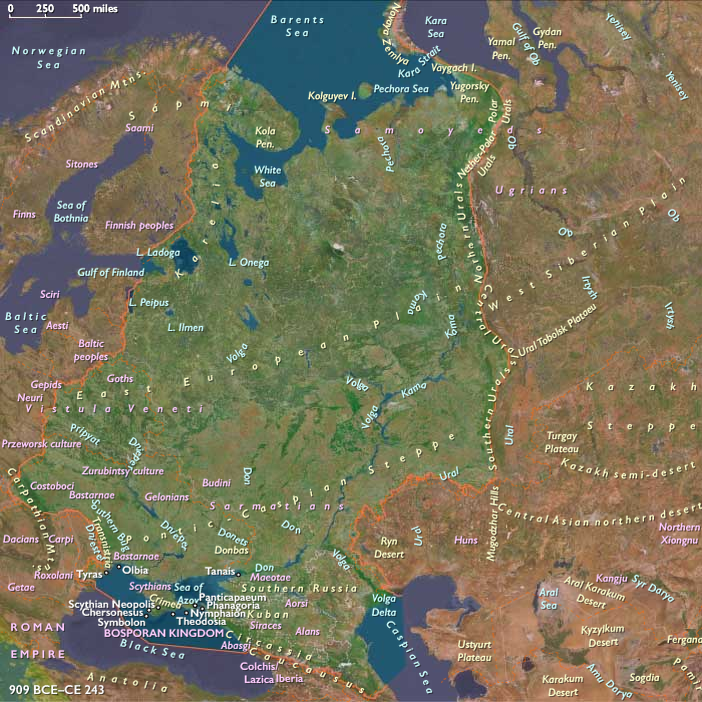
East Europe (765–622 BCE): Emergence of Steppe…
765 BCE to 622 BCE
East Europe (765–622 BCE): Emergence of Steppe Nomads and Chernoles Cultural Expansion
From 765 to 622 BCE, East Europe—comprising modern-day Ukraine, Belarus, and European Russia—experienced notable cultural and demographic transformations characterized by the expanding influence of nomadic pastoralists from the Eurasian steppe and the continued flourishing of settled agricultural communities. The prominent Chernoles culture (1050–500 BCE) significantly evolved during this period, contributing substantially to the region's proto-Slavic foundations.
Political and Military Developments
Emergence of Steppe Nomadism
-
The period saw the steady consolidation of pastoralist societies—precursors to later Scythian groups—across the Pontic-Caspian steppe.
-
Mobile warrior communities intensified interactions with settled agriculturalists, leading to cultural exchanges and occasional conflicts.
Expansion of the Chernoles Culture
-
Chernoles settlements expanded across central Ukraine, signifying increasing socio-political organization among early proto-Slavic agriculturalists.
-
Archaeological evidence indicates organized defensive settlements, hinting at emerging leadership structures in response to external nomadic pressures.
Economic and Technological Developments
Agricultural and Pastoral Economy
-
The mixed agricultural and pastoral economy dominated, characterized by cereal cultivation, cattle-raising, and sheep husbandry.
-
The Chernoles communities improved agricultural techniques, promoting demographic growth and stability.
Ironworking Advances
-
Iron metallurgy gradually improved, providing better tools and weapons, which facilitated agricultural efficiency and military effectiveness.
Cultural and Artistic Developments
Proto-Slavic Cultural Identity
-
The Chernoles culture increasingly exhibited distinct ceramic styles, settlement layouts, and burial practices, solidifying early markers of proto-Slavic cultural identity.
-
Artistic expression remained primarily utilitarian, focused on pottery decoration and everyday tools.
Nomadic Artistic Traditions
-
Steppe nomads contributed distinctive ornamental motifs, reflected in metalwork and decorative arts, later influencing broader regional artistic traditions.
Settlement and Urban Development
Fortified Agricultural Villages
-
Fortified villages and hillforts expanded throughout central and western Ukraine, demonstrating increased concern with defense and territorial organization.
-
Settlement structures showed greater complexity, with clearly defined residential, agricultural, and defensive zones.
Social and Religious Developments
Early Social Stratification
-
Chernoles communities demonstrated early signs of social hierarchy, indicated by burial practices and settlement patterns that differentiated leaders from commoners.
-
Pastoral nomads on the steppe also exhibited clear social distinctions based upon warrior status, livestock wealth, and leadership roles.
Religious Practices and Rituals
-
Ritual practices, including ancestor veneration, nature-based worship, and animal sacrifices, continued to define spiritual life.
-
Religious beliefs likely reflected concerns with fertility, seasonal cycles, and ancestral protection.
Long-Term Consequences and Historical Significance
The era from 765 to 622 BCE represented a formative stage in East Europe's early history, marked by the consolidation of the Chernoles culture's proto-Slavic characteristics and increasing influence from steppe nomads. These interactions laid crucial foundations for future cultural synthesis between sedentary agriculturalists and mobile pastoralists, significantly shaping the demographic and cultural trajectories of the region through subsequent centuries.
Topics
Regions

Northeastern Eurasia
View →Subregions