
Eastern Southeast Europe (1372–1383 CE): Ottoman Consolidation…
1372 CE to 1383 CE
Eastern Southeast Europe (1372–1383 CE): Ottoman Consolidation and Balkan Turmoil
Settlement and Migration Patterns
Ottoman Territorial Expansion
Between 1372 and 1383, the Ottoman Empire continued its aggressive expansion into Eastern Southeast Europe. Portions of Bulgaria were systematically annexed, significantly weakening the remaining Bulgarian principalities. Ottoman administration established new settlements and reinforced existing strongholds, reshaping regional demographics and intensifying Turkish influence throughout the Balkans.
Wallachian Independence
Wallachia solidified its independence from Hungarian dominance during this period. This development further altered regional power dynamics, establishing Wallachia as a critical political entity in the Balkans and a potential bulwark against further Ottoman advances northward.
Political Dynamics and Regional Rivalries
Byzantine Civil Strife
Civil unrest intensified within Constantinople, as internal conflicts severely weakened the Byzantine Empire's central authority. Dynastic disputes and political infighting undermined the empire's capacity to respond effectively to external threats, most notably the expanding Ottoman presence.
Fragmentation and Instability
The weakening and fragmentation of local powers—including the Bulgarian kingdoms of Veliko Tarnovo and Vidin, as well as remnants of the Serbian Empire—further facilitated Ottoman encroachment. Balkan political instability deepened, characterized by shifting alliances and internal rivalries that undermined regional unity.
Economic and Technological Developments
Ottoman Economic Integration
Ottoman administrative reforms increasingly integrated newly conquered Balkan territories into the empire’s economic network. Enhanced trade routes and organized taxation systems improved regional economic stability under Ottoman control, despite the broader turmoil affecting unconquered areas.
Defensive Infrastructure
In response to the ongoing Ottoman threat, regional powers like Wallachia invested in fortifications and defensive infrastructure. Fortified settlements and strategic castles became essential for maintaining sovereignty and limiting Ottoman expansion.
Cultural and Artistic Developments
Ottoman Cultural Influence
The period saw accelerated introduction and integration of Ottoman culture into occupied territories. Urban centers featured mosques, medreses, and caravanserais, reflecting a deliberate Ottoman effort to establish cultural dominance alongside political and economic control.
Preservation of Local Traditions
Despite Ottoman advances, regional cultures—particularly Bulgarian, Serbian, and Wallachian—persisted in maintaining their traditions. Orthodox Christian monasteries and local artistic expressions continued, often becoming symbols of cultural resistance and identity preservation.
Social and Religious Developments
Religious and Ethnic Dynamics
Religious tensions heightened with Ottoman expansion. While some local elites converted to Islam for political and social advantage, broader populations maintained Orthodox Christianity, deepening religious divides that would define the region’s future cultural landscape.
Byzantine Societal Crisis
Internal strife in Byzantium had profound social consequences. Civic structures weakened considerably, exacerbating societal divisions and reducing the empire's capability to resist external threats. The instability significantly accelerated the empire's decline, leaving it vulnerable to further Ottoman conquest.
Long-Term Consequences and Historical Significance
The period from 1372 to 1383 CE was marked by crucial Ottoman territorial gains, significant political upheaval within Byzantium, and the emergence of independent entities like Wallachia. These developments profoundly reshaped the political and cultural landscape of Eastern Southeast Europe, laying critical foundations for the eventual Ottoman hegemony over the entire Balkan Peninsula.
Groups
Subjects
Regions
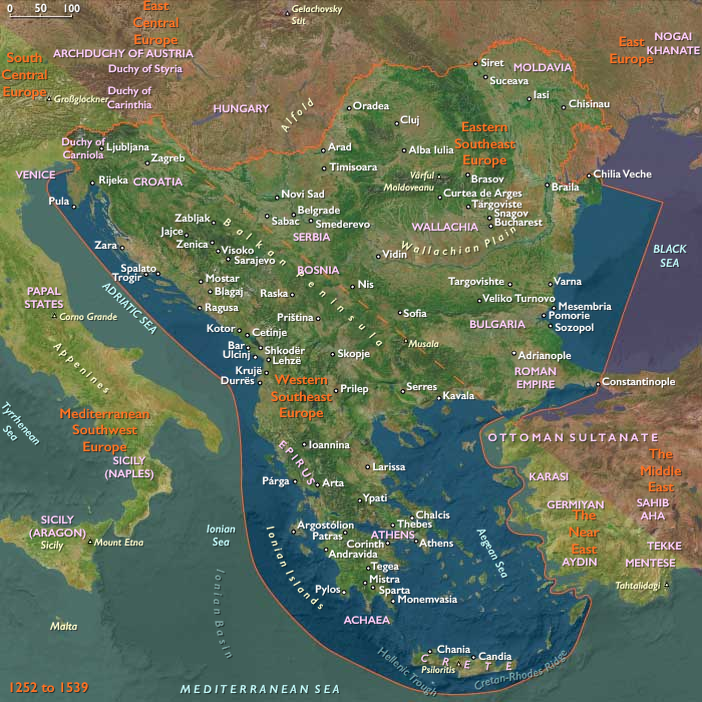
Southeast Europe
View →Subregions
