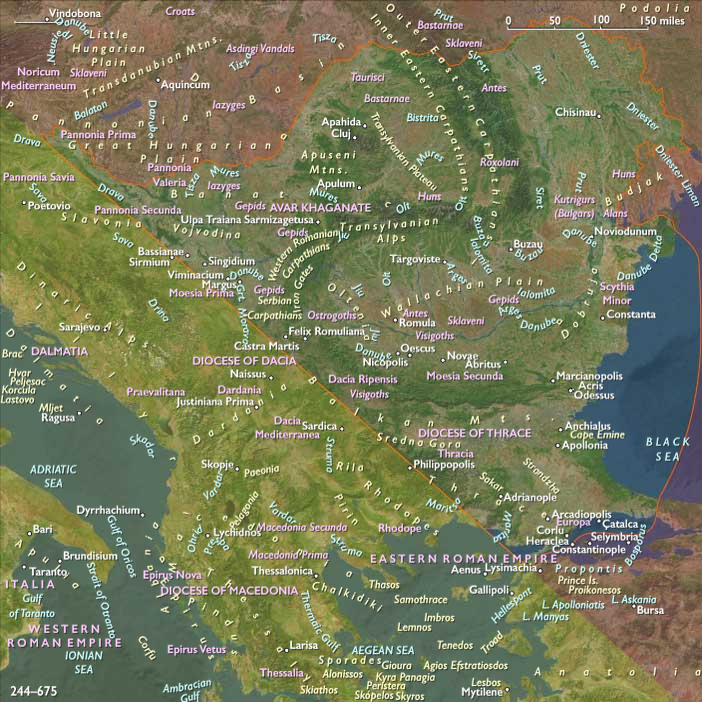
Eastern Southeast Europe (532–675 CE): Plague, Slavic…
532 CE to 675 CE
Eastern Southeast Europe (532–675 CE): Plague, Slavic Settlement, and the Emergence of the Byzantine Balkans
Settlement and Migration Patterns
Plague, Migration, and Demographic Transformation
Between 532 and 675 CE, Eastern Southeast Europe underwent one of the greatest demographic transformations in its history. The Plague of Justinian (541–542 CE) and its recurrent outbreaks devastated urban populations throughout the Balkans and the eastern Mediterranean, reducing both civilian and military manpower while weakening imperial control over the frontier.
At the same time, successive migrations of Slavic communities fundamentally reshaped the countryside. Initially crossing the Danube as raiders, Slavic groups increasingly established permanent agricultural settlements throughout much of the Balkan interior. Their gradual expansion permanently altered the ethnic, linguistic, and cultural geography of Eastern Southeast Europe.
Avars, Bulgars, and the Reorganization of the Frontier
The arrival of the Avars during the later sixth century transformed the political balance north of the Danube. Frequently allied with Slavic groups, Avar military power repeatedly challenged Byzantine authority throughout the Balkans, contributing to the collapse of many long-established frontier systems.
Toward the close of the age, Bulgar groups began appearing along the Lower Danube, establishing the political foundations that would soon produce the First Bulgarian Empire. Meanwhile, many fortified Roman cities survived only as isolated defensive centers amid increasingly Slavic rural landscapes.
Political and Military Developments
Justinian and the Defense of the Balkans
Although Emperor Justinian achieved remarkable reconquests elsewhere in the Mediterranean, his Balkan provinces faced continual pressure from Slavic and Avar incursions. Extensive fortification programs repaired hundreds of cities, forts, bridges, and frontier installations throughout the region, temporarily strengthening imperial defenses despite declining manpower.
These defensive efforts preserved Byzantine authority in key urban centers even as large portions of the countryside gradually slipped beyond effective imperial administration.
Heraclius and the Transformation of the Eastern Empire
The reign of Emperor Heraclius fundamentally reshaped the eastern Roman state. His successful campaigns against the Sasanian Empire restored imperial prestige, while administrative and military reforms increasingly shifted the empire toward its medieval Byzantine character.
Greek gradually replaced Latin as the principal language of imperial administration, reflecting the political and cultural transformation of the Eastern Roman Empire during the seventh century.
Economic and Technological Developments
Economic Adaptation and Commercial Resilience
Despite repeated warfare and demographic decline, Eastern Southeast Europe retained important commercial networks. Constantinople remained the empire's greatest economic center, while Black Sea ports, Danube commerce, agriculture, viticulture, fisheries, forestry, and regional markets continued supporting provincial economies.
Although many rural districts experienced disruption, long-distance trade survived through maritime connections linking the Black Sea, the Aegean, and the eastern Mediterranean.
Fortification and Military Infrastructure
Imperial resources increasingly concentrated upon frontier defense. Existing roads, fortified cities, watchtowers, river patrols, supply depots, and military installations were continually repaired and strengthened where possible.
Rather than expanding imperial territory, Byzantine engineering increasingly emphasized preserving strategic corridors, fortified urban centers, and communications between Constantinople and the remaining Balkan provinces.
Cultural and Artistic Developments
The Emergence of Byzantine Culture
The sixth and seventh centuries witnessed the full maturation of Byzantine artistic traditions. Churches, mosaics, icons, manuscripts, and monumental architecture increasingly reflected a distinctive Christian imperial culture rooted in both classical inheritance and Orthodox theology.
Justinian's construction of Hagia Sophia became the defining architectural achievement of the age, symbolizing the spiritual and political aspirations of the Eastern Roman Empire while influencing artistic traditions throughout the Balkans.
Preservation of Classical Learning
Despite repeated invasions and political instability, Constantinople remained the principal center for preserving classical Greek and Roman learning. Scholars, clergy, administrators, and craftsmen continued transmitting literary, legal, philosophical, and scientific traditions that would shape Byzantine civilization for centuries.
Social and Religious Developments
Administrative Adaptation
Imperial administration adapted to dramatic political change by concentrating authority within surviving provincial centers and strengthening cooperation between military commanders, civil officials, and ecclesiastical leaders. Although imperial control contracted geographically, governance became increasingly resilient within the territories that remained under Byzantine authority.
Orthodox Christianity and Imperial Identity
Christianity became inseparable from imperial government and public life. Bishops, monasteries, churches, and pilgrimage centers increasingly organized both urban and rural communities, while theological controversies—including Monophysitism and Monothelitism—continued influencing imperial politics.
The Patriarchate of Constantinople strengthened its authority throughout the eastern provinces, reinforcing the increasingly distinctive religious identity of the Byzantine Empire.
Long-Term Consequences and Historical Significance
Between 532 and 675 CE, Eastern Southeast Europe completed the transition from the Late Roman Balkans to the medieval Byzantine world. Plague, Slavic settlement, Avar pressure, and repeated warfare fundamentally transformed the countryside, while Constantinople emerged as the unchallenged political, economic, and spiritual center of the eastern Mediterranean.
Although Byzantine authority contracted across much of the interior, the fortified cities, Orthodox Church, and imperial administration survived, providing the institutional foundations upon which medieval Byzantine civilization would endure. At the close of the age, the emergence of Bulgar power signaled the beginning of a new political era that would dominate the Early Middle Ages in Eastern Southeast Europe.
Images

Eastern Southeast Europe in Late Antiquity III
Groups
Commodities
Subjects
Regions
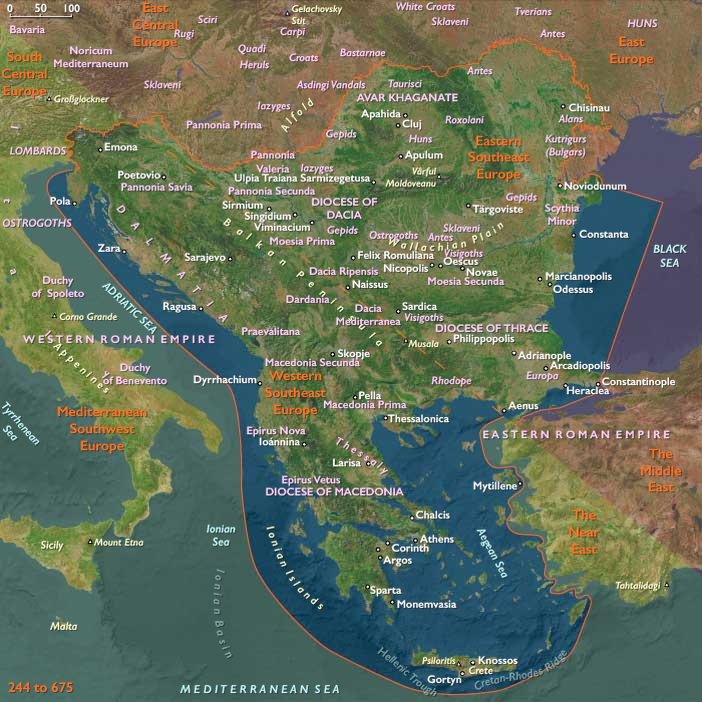
Southeast Europe
View →Subregions