Southeast Europe (6,093 – 4,366 BCE): Middle…
6093 BCE to 4366 BCE
Southeast Europe (6,093 – 4,366 BCE): Middle Holocene — The First Farmers of the Danube and Aegean Worlds
Geographic & Environmental Context
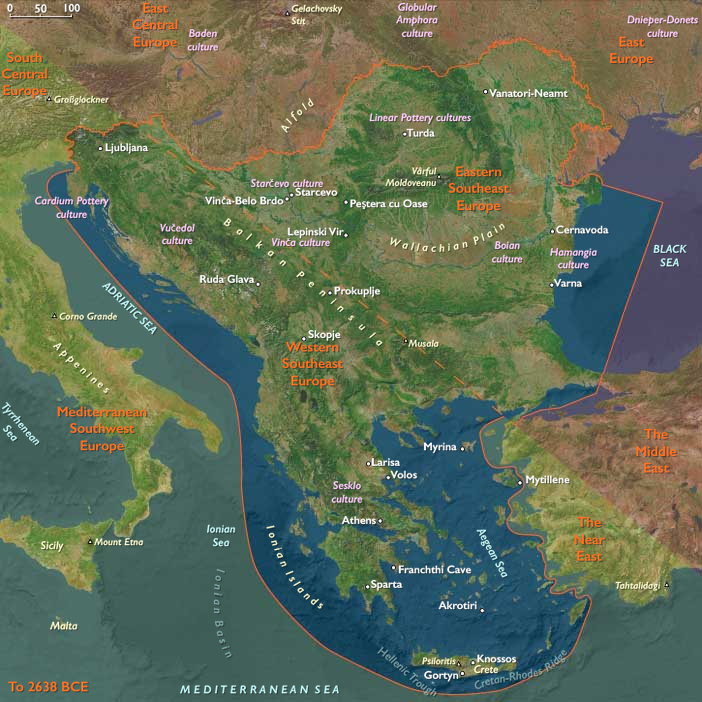
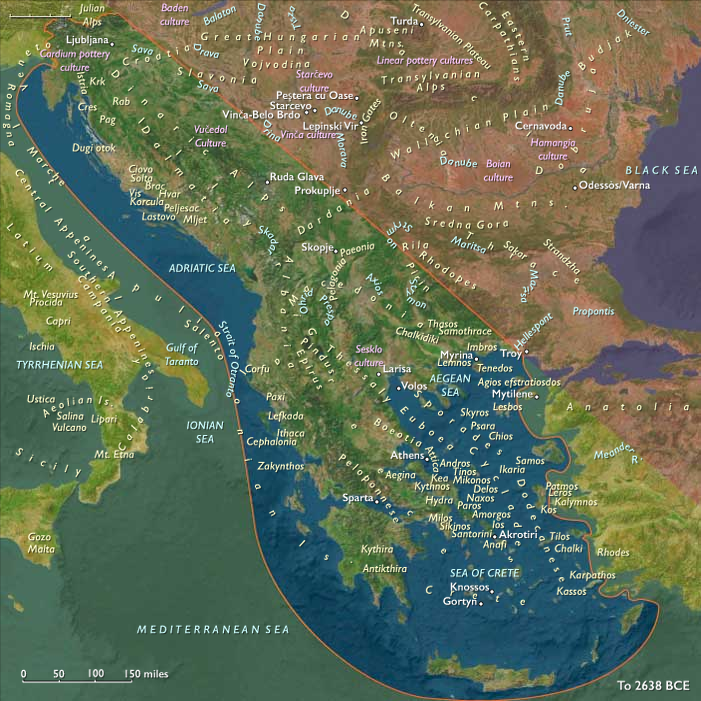
During the Middle Holocene, Southeast Europe—bridging the Aegean, the Balkans, and the lower Danube basin—became one of the key thresholds of the global Neolithic.
Across its two principal zones—Western Southeast Europe (the Adriatic–Aegean karstlands and Macedonian basins) and Eastern Southeast Europe (the Danubian plains, Thrace, and the lower Carpathian forelands)—warm and humid Hypsithermal conditions transformed river valleys and loess terraces into fertile corridors ideally suited for farming.
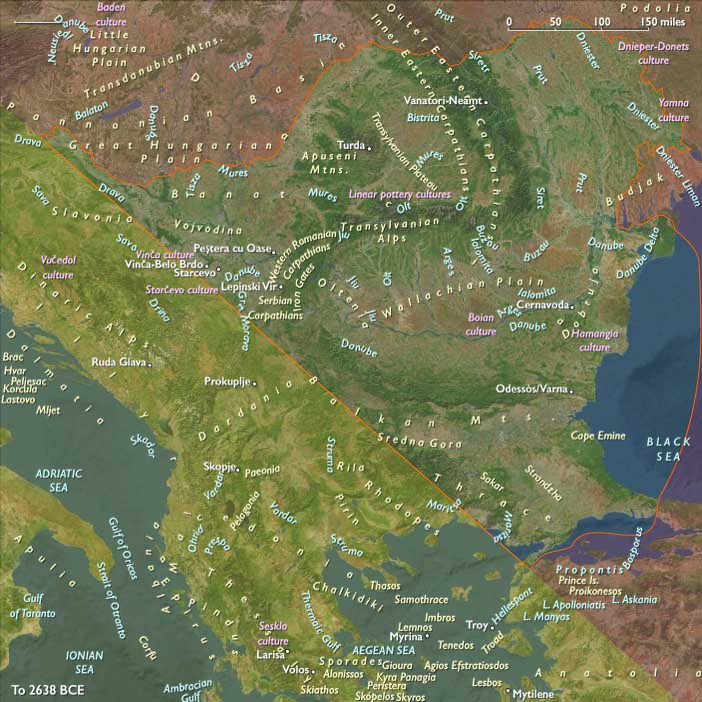
The Danube and Sava–Drava systems carved rich alluvia through the heart of the Balkans, while the Aegean littoral and Thracian Plain supported long-term settlement in tell and flat villages.
By 6000 BCE, the region’s distinctive combination of rivers, plains, and coastal nodes provided a continuous landscape of early agriculture from the northern Aegean to Transylvania.
Climate & Environmental Shifts
The Hypsithermal optimum (c. 7000–4000 BCE) brought mild winters and ample rainfall, stabilizing the Danube’s flood regime and supporting luxuriant forest-steppe and meadow ecologies.
Seasonal flooding renewed the fertility of loess plains; upland forests yielded timber and game; and riverine fisheries remained abundant.
These favorable conditions sustained both forager–farmer coexistence along the Adriatic karst and dense farming villages across the Danubian and Thracian plains.
Subsistence & Settlement
Across the region, Neolithic farming communities—derived from Anatolian and Aegean centers—established enduring footholds between 6200 and 5600 BCE.
-
In Western Southeast Europe, the Starčevo–Körös–Criș horizon spread up the Vardar–Morava and Sava–Drava corridors, producing tell villages and flat settlements with rectangular timber–wattle houses.
Along the Adriatic and Ionian coasts, Impressed Ware farmers cultivated emmer, einkorn, and barley while maintaining contact with coastal foragers. -
In Eastern Southeast Europe, the Karanovo I–III sequence in Thrace and the Criș culture along the Lower Danube anchored continuous habitation.
The same package of wheat, barley, pulses, cattle, sheep, goats, and pigs supported self-sufficient village economies, supplemented by fishing, fowling, and deer hunting.
Settlements formed tell accumulations on floodplains—artificial mounds built from generations of rebuilding—and open hamlets along river terraces. In both east and west, farming and fishing coexisted within tightly integrated local ecologies.
Technology & Material Culture
The Middle Holocene Neolithic revolution in Southeast Europe was marked by major technological milestones:
-
Pottery became ubiquitous—Impressed Ware, painted Karanovo, and Criș–Starčevo–Körös styles defined cultural boundaries.
-
Polished stone adzes, grinding querns, and sickle blades supported intensive cultivation.
-
Loom weights and spindle whorls signaled weaving and textile production.
-
Mudbrick and wattle-and-daub houses with plastered floors reflected permanent settlement, while communal ovens and hearths underpinned domestic production and ritual feasting.
This technological assemblage represents one of the most coherent and widespread Neolithic packages in the Old World.
Movement & Interaction Corridors
Southeast Europe functioned as the primary land bridge between Anatolia and Central Europe.
-
The Vardar–Morava–Danube axis carried Aegean farming traditions northward.
-
The Sava–Drava–Tisza corridor channeled influences westward into the Pannonian Basin.
-
Along the Black Sea coast (Dobruja), contact extended to the Pontic steppe, laying the groundwork for later Eneolithic interactions.
-
Maritime links tied Aegean coastal nodes to Anatolia and the Adriatic, circulating obsidian, pigments, and shell ornaments.
Through these corridors, Southeast Europe became a transmission zone, fusing Near Eastern agricultural know-how with local forager traditions and passing this synthesis onward to the rest of Europe.
Cultural & Symbolic Expressions
Early farming life was infused with ritual and symbolism.
Clay figurines, often female, represented fertility and domestic continuity; house altars and courtyard shrines served as centers of ancestor veneration.
Communal feasting pits and oven complexes in both Starčevo–Körös–Criș and Karanovo sites point to ritualized gatherings tied to planting and harvest cycles.
Decorated pottery carried symbolic motifs—spirals, grids, and animal forms—possibly marking lineage or household identity.
Burials beneath house floors or within settlement precincts reflected the intimate link between home and ancestry, embedding the living community within its own past.
Environmental Adaptation & Resilience
The region’s farmers managed a balanced economy that married innovation with ecological prudence.
-
Mixed crop cultivation and animal husbandry diversified risk.
-
Riverine fishing and wetland resources buffered villages against crop failure.
-
Tell elevation lifted settlements above floodwaters while providing defensible vantage points.
-
Forest clearance was measured and cyclic, allowing regeneration of soils and woodland.
This adaptability produced a long-lived, self-sustaining settlement pattern—dense yet resilient, capable of withstanding both climatic oscillations and demographic pressure.
Long-Term Significance
By 4,366 BCE, Southeast Europe had become Europe’s first fully agricultural landscape.
The Starčevo–Körös–Criș and Karanovo cultures unified the region into a coherent Neolithic world of farming villages, ancestor cults, and craft specialization.
Through its rivers, plains, and maritime nodes, the Balkans transmitted the Neolithic revolution into Central Europe, the Adriatic, and the Carpathian Basin, laying the groundwork for the continent’s later Chalcolithic societies.
This was the age when the Danube became Europe’s first cultural highway—a living artery along which seeds, stock, and stories flowed, turning the landscape of the Balkans into the oldest and most enduring agricultural heartland north of the Aegean.
Topics
Commodities
Subjects
Regions