
Eastern West Indies (1840–1851 CE): Indentured Labor,…
1840 CE to 1851 CE
Eastern West Indies (1840–1851 CE): Indentured Labor, Political Instability, and Dominican Independence
Indentured Labor and Post-Emancipation Economy
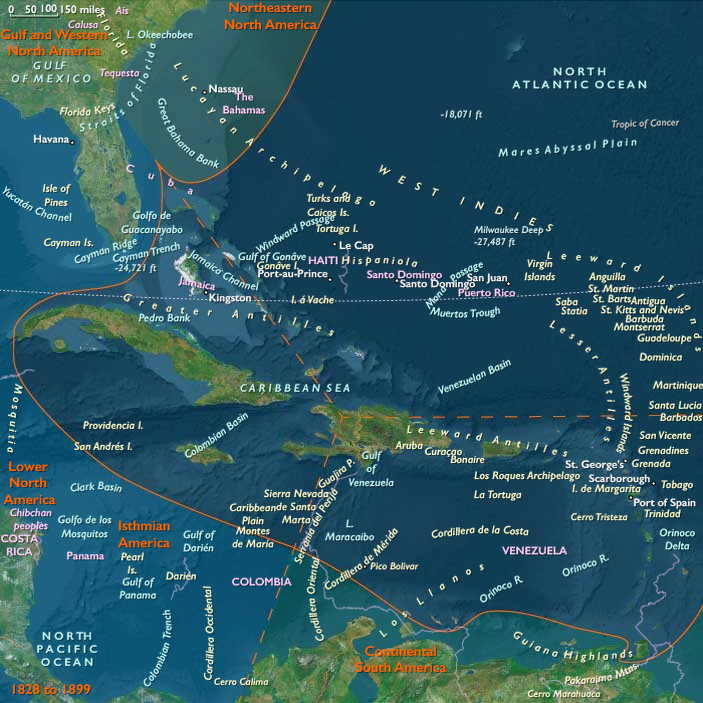
Following emancipation, the Eastern West Indies faced profound labor shortages. To sustain sugar production, British Caribbean assemblies began importing indentured laborers from India, China, and Africa, who, though legally free and contracted for fixed terms, often faced conditions reminiscent of slavery. Between 1838 and 1917, nearly 500,000 East Indians migrated to the British West Indies, notably 145,000 to Trinidad, 21,500 to Jamaica, and smaller numbers to Grenada, St. Vincent, and St. Lucia. Despite nominal freedoms, their harsh living conditions and limited rights highlighted continuing economic exploitation.
Political Turmoil in Haiti
In 1843, Charles Rivière-Hérard overthrew President Jean-Pierre Boyer, marking the start of prolonged instability. Boyer's presidency, notable for its length and internal reunification, had also deepened racial and class divisions, ultimately prompting his downfall. Rivière-Hérard's short-lived rule (1843–1844) succumbed rapidly to internal and external pressures, including failed military campaigns and rural uprisings by piquets led by Louis Jean-Jacques Acaau, emphasizing rural dissatisfaction.
The period that followed was marked by swift political turnovers orchestrated by mulatto elites, notably the Ardouin brothers, who manipulated successive black presidents like Philippe Guerrier (1844–1845), Jean-Louis Pierrot (1845–1846), and Jean-Baptiste Riché (1846–1847). In 1847, they installed Faustin Soulouque, who quickly turned against his backers, establishing a brutal dictatorship maintained through secret police (zinglins) and terror tactics.
Haitian Economic Decline and Social Conditions
Economic stagnation became pervasive as agricultural revenues declined, exacerbated by chronic defaults on payments owed to France. Increasingly desperate Haitian presidents sought foreign loans and relied on German merchant-funded coups led by mercenary cacos. By mid-century, Haiti's poverty deepened drastically, with annual per capita income averaging only US$20 and over 90% illiteracy, compounded by rampant tropical diseases.
Dominican Independence and Early Governance
Haiti’s internal chaos provided the opportunity for Dominican independence. On February 27, 1844, Dominican rebels led by nationalists including Francisco del Rosario Sánchez, Ramon Mella, and inspired by Juan Pablo Duarte, captured the Ozama fortress, marking Dominican Independence Day. Duarte’s return from exile on March 14 briefly inspired optimism, but internal rivalries quickly emerged.
Dominican politics became dominated by strongmen, particularly Pedro Santana Familias and Buenaventura Báez Méndez. Santana, leveraging his military influence, became the dominant figure, sidelining liberal nationalists like Duarte. The 1844 Dominican Constitution, though remarkably liberal, was undermined by Santana's insistence on extraordinary powers, leading to authoritarian governance and violent political cycles.
International Rivalries and Diplomatic Maneuvering
Dominican leaders actively sought foreign protection to safeguard independence from Haitian aggression. Both Santana and Báez approached powers such as France, the United States, and Britain. Báez strongly favored French intervention, while Britain, keen to preserve strategic commercial interests, brokered a treaty between Haiti and the Dominican Republic in 1851, further involving itself in regional politics.
Key Historical Events
-
Arrival of indentured laborers (1838–1917), significantly impacting the post-slavery economy.
-
Overthrow of Jean-Pierre Boyer (1843) and the subsequent political turmoil.
-
Dominican independence declared (February 27, 1844) under leadership figures such as Juan Pablo Duarte, Francisco del Rosario Sánchez, and Ramon Mella.
-
Pedro Santana’s authoritarian rule and manipulation of constitutional powers.
-
Buenaventura Báez’s diplomatic overtures toward foreign powers, particularly France and Britain.
Long-Term Consequences and Historical Significance
The period 1840–1851 solidified complex economic, political, and social transformations in the Eastern West Indies. Indentured labor reshaped demographic and social dynamics, while Haiti and the Dominican Republic experienced intense political instability marked by violent power struggles. Dominican independence and subsequent diplomatic maneuverings underscored ongoing geopolitical significance, highlighting persistent vulnerabilities and external dependencies in Caribbean politics.
People
Groups
Topics
Commodities
Subjects
Regions
West Indies
View →Subregions
