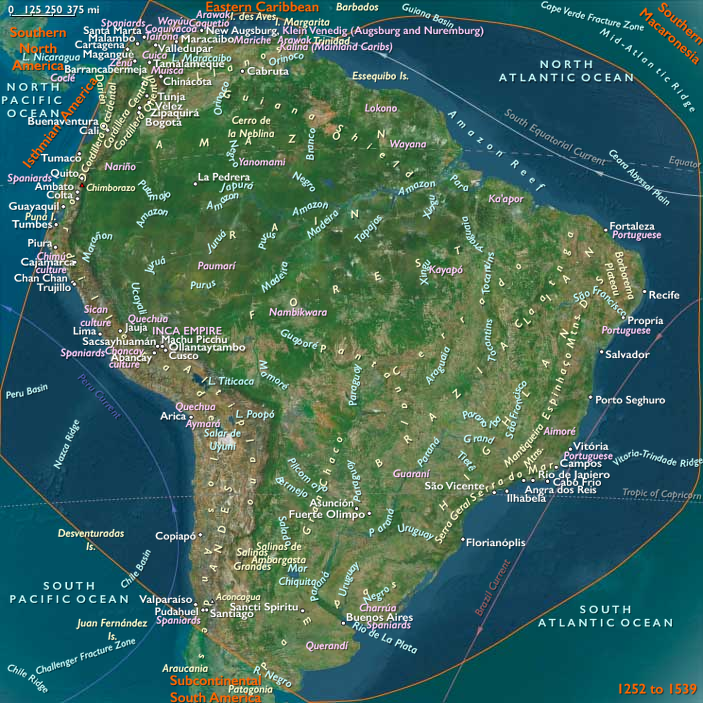
The Inca expansion northward from modern-day Peru…
1516 CE to 1527 CE
The Inca expansion northward from modern-day Peru during the late fifteenth century meets with fierce resistance by several Ecuadorian tribes, particularly the Canari, in the region around modern- day Cuenca; the Cara in the Sierra north of Quito; and the Quitu, occupants of the site of the modern capital, after whom it is to be named.
The conquest of Ecuador begins in 1463 under the leadership of the ninth Inca, the great warrior Pachacuti Inca Yupanqui.
In this year, his son Topa takes over command of the army and begins his march northward through the Sierra.
After defeating the Quitu, he moves southward along the coast, from there launching an extensive ocean journey that takes him, depending on the account, to the Galapagos Islands or to the Marquesas Islands in Polynesia.
Upon his return, he tries unsuccessfully to subdue the populations around the Gulf of Guayaquil and the island of Puna.
By 1500 Topa's son, Huayna Capac, overcomes the resistance of these populations and that of the Cara, and thus incorporates all of modern-day Ecuador into Tawantinsuyu, as the Inca empire is known.
The influence of these conquerors based in Cuzco (modern-day Peru) is limited to about a half century, or less in some parts of Ecuador.
During this period, some aspects of life remain unchanged.
Traditional religious beliefs, for example, persist throughout the period of Inca rule.
In other areas, however, such as agriculture, land tenure, and social organization, Inca rule has a profound effect despite its relatively short duration.
Farming remains the major form of subsistence, but the Inca introduce a variety of new crops, including yucca, sweet potatoes, coca, and peanuts.
The use of llamas and irrigation is expanded considerably.
Largely in private hands previously, land becomes, in theory at least, the property of the Inca emperor.
In practice, most land is held collectively by the ayllu, an agrarian community group headed by a curaca, which is the basic social grouping under the Inca.
Within the ayllu, each domestic family unit is allotted a small plot of arable land to grow food for its own consumption.
The state and the clergy also hold a substantial amount of land, which is worked by the emperor's subjects as part of their obligatory public service.
Emperor Huayna Capac becomes very fond of Quito, making it a secondary capital of Tawantinsuyu and living out his elder years there before his death in about 1527.
He prefers to rule through local curacas as long as they are willing to accept the divine authority of the Inca and to pay tribute.
When he meets opposition, the emperor disperses large parts of local populations to other areas of the empire and replaces them with colonists who are brought from as far away as Chile.
This wholesale movement of populations helps spread Quechua, the language of Cuzco, into Ecuador.
A standing army, a large bureaucracy, and a temporally important clergy further enforce the rule of the emperor.
Locations
Commodities
Regions
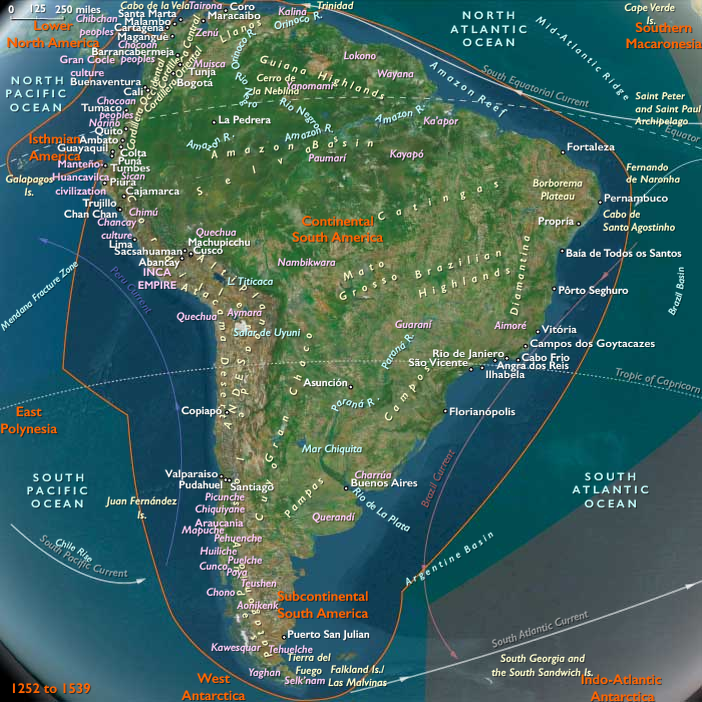
South America
View →Subregions