
Empedocles also plays an important role in…
434 BCE
Empedocles also plays an important role in the development of the Western or Sicilian school of Greek medicine.
He articulates the notion that the human body has four humors: blood, bile, black bile, and phlegm, a belief which is to dominate medical thinking for centuries.
He had cured a plague at the Sicilian city of Selinus and claimed he was a god. (One legend, which forms the basis of Matthew Arnold's poem Empedocles on Etna, held that Empedocles, tired of life and wanting people to believe that the gods had taken him with them, committed suicide by leaping into the crater of Mount Etna, but he may actually have died in Greece.)
Locations
People
Groups
Subjects
Regions
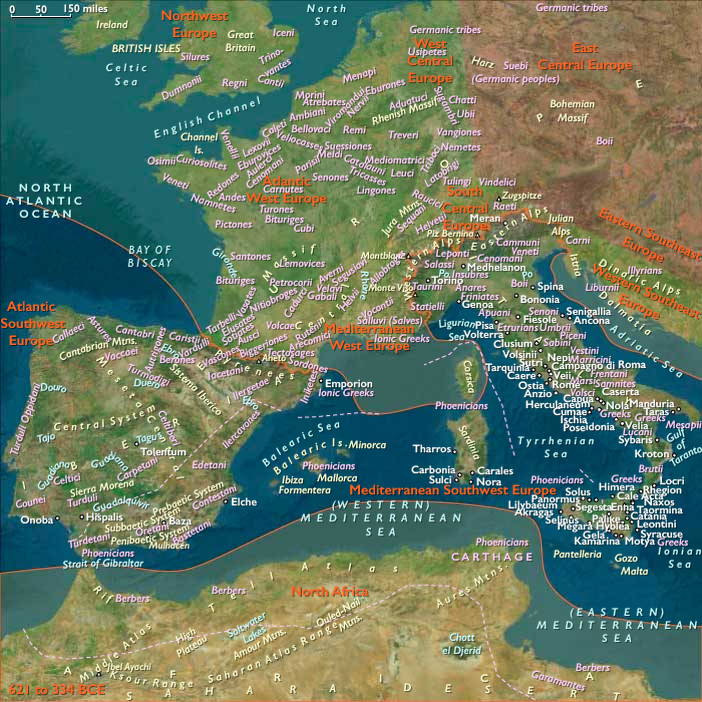
Southwest Europe
View →Subregions
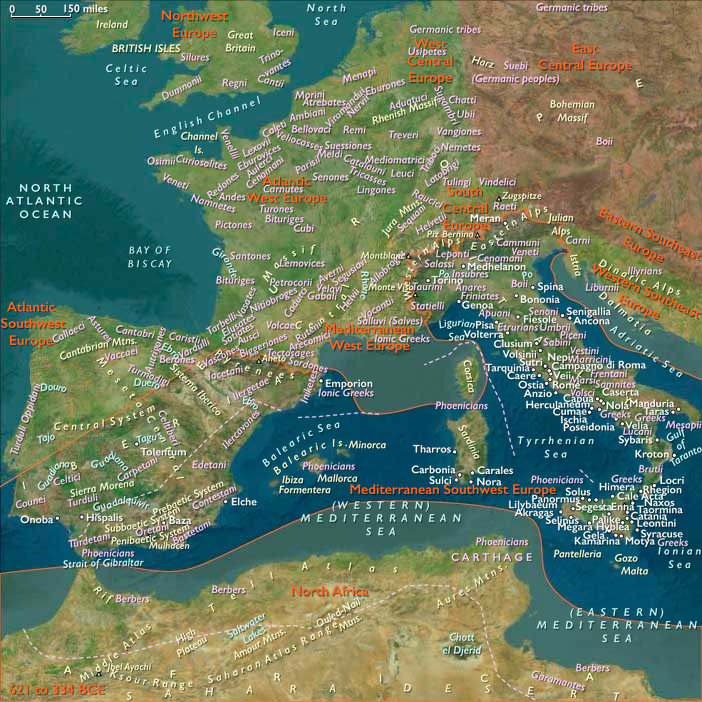
Mediterranean Southwest Europe
View →Related Events
No active filters.
Showing 10 events out of 65272 total
Philip, having enlisted the support of Athens and King Derdas of Elimea, is challenging his older brother Perdiccas for the Macedonian throne by 434 BCE.
Perdiccas responds by stirring up rebellion in a number of Athenian tribute cities, including Potidaea.
Athens responds with force, sending one thousand hoplites and thirty ships to Macedonia where they capture Therma.
They go on to besiege Pydna, where they are met by reinforcements of a further two thousand hoplites and forty ships.
However, as the Athenians are besieging Pydna, they receive news that Corinth has sent a force of sixteen hundred hoplites and four hundred light troops to support Potidaea.
In order to combat this new threat, Athens makes an alliance with Perdiccas, and proceeds to Potidaea.
Perdiccas immediately breaks the treaty and marches to Potidaea, while the Athenians are eventually victorious, the battle (along with the Battle of Sybota) directly leads to the Peloponnesian War.
Anaxagoras, a native of Clazomenae, had brought philosophy and the spirit of scientific inquiry from Ionia to Athens.
His observations of the celestial bodies have led him to form new theories of the universal order.
Anaxagoras describes the cosmos as a continuous field in which different qualities flow and mingle.
He suggests that are not four but possibly thousands of elements and that, as no element can become another, there is no real change but only the illusion of change manifested by the combination, separation and recombination of elements.
He attempts to give a scientific account of eclipses, meteors, rainbows and the sun, which he describes as a mass of blazing metal, larger than the Peloponnese.
The heavenly bodies, he asserts, are masses of stone torn from the earth and ignited by rapid rotation.
However, these theories bring him into collision with the popular faith; Anaxagoras' views on such things as heavenly bodies are considered "dangerous."
This new Ionian science is not well-received by the Athenian public, who view Anaxagoras’ teachings—that the divine mind in this system does not have a human body, and that the Luminaries are not gods but rocks—as deeply irreligious.
Anaxagoras is arrested by Pericles' political opponents on a charge of contravening the established dogmas of religion (some say the charge was one of Medism).
It takes Pericles' power of persuasion to secure his release.
Even so he is forced to retire from Athens to Lampsacus in Ionia in about 434-433 BCE.
Empedocles assumes that there must be more than one kind of matter.
To account for real change, he postulates four roots as elements: earth, air, fire, and water.
Love and hate are considered principles of attraction and repulsion that alternately dominate the universe in a recurring cycle.
A Greek doctor, poet, and philosopher residing in Agrigentum, in Sicily, Empedocles presents a kind of biological theory of natural selection in an imaginative poem, On Nature.
The humiliated Corinthians have meanwhile constructed a larger fleet while …
…the Corcyrans, with the second largest navy in Greece at this time, appeal to the Athenians, …
…who, taking very seriously the western dimension to its foreign policy (it is about this time that the alliances with Rhegium and Leontini are renewed), vote at first for a purely defensive alliance and after a debate, fully recorded by Thucydides, sent a small peacekeeping force of ten ships to reinforce the Corcyraean fleet, with instructions not to fight the Corinthian fleet unless they attempted to land on the island.
In so doing, Pericles, convinced of the inevitability of war with Sparta and the Peloponnesians, risks the escalation of armed hostilities.
The situation by 433 is serious enough for Athens' finances to be put on a war basis, and, hereafter, the drift to war will continue.
Corinth, meanwhile, assembles a fleet of ships under the command of Xenoclides and prepared to sail to Corcyra, while Corcyra gathers a fleet under Miciades, Aisimides, and Eurybatus, who make the Sybota islands their base of operations.
The Athenian commanders, Lacedaimonius (the son of Cimon), Diotimus, and Proteas, sail with them.
Corcyra has one hundred and ten ships, plus the additional ten provided from their ally Athens, while Corinth has one hundred and fifty ships.
When the Corinthian ships arrive, the Corcyraeans form their line of battle, with the Athenians on the right and their own ships making up the rest of the line in three squadrons.
The Corinthian ships are lined up with the Megarans and Ambraciots on the right, the Corinthians on the left, and the remainder of their allies in the center.
Both sides fight with hoplites on their ships, along with archers and javelin-throwers, in a manner Thucydides calls "old-fashioned."
Instead of ramming and sinking the other ships, both sides attempt to board their opponents' ships and fight what is essentially a land battle at sea.
The Athenian ships, although they are part of the line, do not at first join the battle, as the Corinthians had not attempted to land.
The Corcyraean ships on the left rout the Corinthian right wing, chasing them all the way back to their camp on the coast, which they then burn.
The Corinthian left wing, however, is more successful, and the Athenians are forced to come to the aid of their allies.
Nevertheless, the Corinthians are victorious, and sail through the wreckage of defeated ships, often killing survivors rather than taking prisoners (including, although they did not know it, some of their own allies who had been defeated on the right-wing).
They do not kill everyone, however, and capture a number of prisoners.
The Corcyraeans and Athenians head back to Corcyra to defend the island, but when the Corinthians arrive, they almost immediately retreat, as more Athenian ships under the command of Glaucon are on their way.
The next day, the new Athenian ships threaten a second battle if the Corinthians attempt to land on Corcyra.
The Corinthians retreat completely rather than risk another battle.
Both the Corinthians and Corcyraeans claim victory, the Corinthians having won the first battle, and the Corcyraeans having avoided a Corinthian occupation of their island.
Increased taxation and discontent have marked the reign of Persia’s king Artaxerxes, but through diplomacy the king maintains the Achaemenid empire in peace during the latter years of his rule.
Nehemiah, Artaxerxes' cupbearer, had begun the rebuilding of Jerusalem "in the 20th year of King Artaxerxes" (Nehemiah 2:1) or 445 BCE.
Nehemiah has apparently served as governor of the small district of Yehud (Judea) for twelve years, during which he has undertaken various religious and economic reforms, including extensive moral and liturgical reforms in rededicating the Jews to Yahweh, before returning to Persia.
He undertakes a second mission to Jerusalem in 432.
Olynthus, now the chief Greek city west of the Strymon (modern Struma) River, in 432 founds and becomes the chief city of the Chalcidian League, a confederation of the Greek cities of the Chalcidice Peninsula.