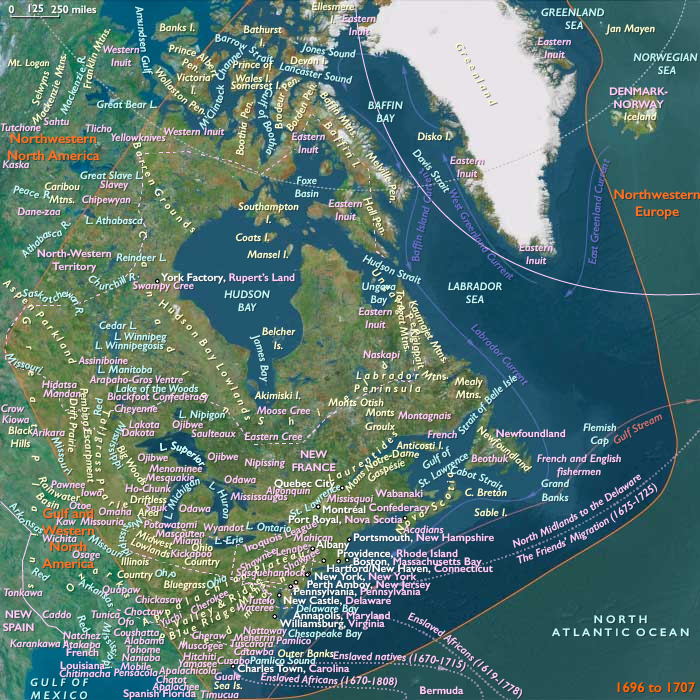
English and Spanish colonization efforts in southeastern…
1701 CE
English and Spanish colonization efforts in southeastern North America had begun coming into conflict as early as the middle of the seventeenth century.
The founding in 1670 by the English of Charles Town (present-day Charleston, South Carolina) in the recently established (1663) Province of Carolina had heightened tensions with the Spanish in Florida.
Traders, raiders, and slavers from the new province have penetrated into Florida, leading to raiding and reprisal expeditions on both sides.
Carolina's governor, Joseph Blake, had threatened the Spanish in 1700 that English claims to Pensacola, established by the Spanish in 1698, would be enforced.
Blake's death later that year had interrupted these plans, and he had been replaced by James Moore.
The Spanish population of Florida at this time is fairly small compared to that of the nearby English colonies.
Since its founding in the sixteenth century, the Spanish have set up a network of missions whose primary purpose is to pacify the local native population and convert them to Roman Catholicism.
In the Apalachee Province (roughly present-day western Florida and southwestern Georgia), there were fourteen mission communities with a total population in 1680 of about eight thousand.
Many but not all of these communities are populated by the Apalachee; others are inhabited by other tribes that had migrated southward to the area.
By the early eighteenth century, Apalachee has become a major source of food for the principal towns of St. Augustine and Pensacola, which are situated near lands not well suited for agriculture.
The native populations of Florida are not happy with Spanish rule; there had been several uprisings against the Spanish in the seventeenth century.
The natives are often forced to do work for the Spanish military garrisons and plantation owners, including the labor of hauling goods to St. Augustine, about one hundred miles (one hundred and sixty kilometers) away.
These policies, and mistreatment by overbearing Spanish masters, have led some Apalachees to flee to the English in Carolina.
Spanish policy also forbids natives the possession of muskets, which makes them dependent on the Spanish for protection against the English-armed Creeks.
People
Groups
Commodities
Subjects
Regions

Northern North America
View →Subregions