
Eric of Pomerania, Denmark's king, appears in…
1424 CE
Eric of Pomerania, Denmark's king, appears in contemporary sources as intelligent, visionary, energetic and a firm character.
That he is also a charming and well-spoken man of the world is shown by a great European tour of the 1420s.
Negatively, he seems to have had a hot temper, a lack of diplomatic sense, and an obstinacy that borders on mulishness.
Almost the whole of Eric’s sole rule is affected by his long-standing conflict with the Counts of Holstein.
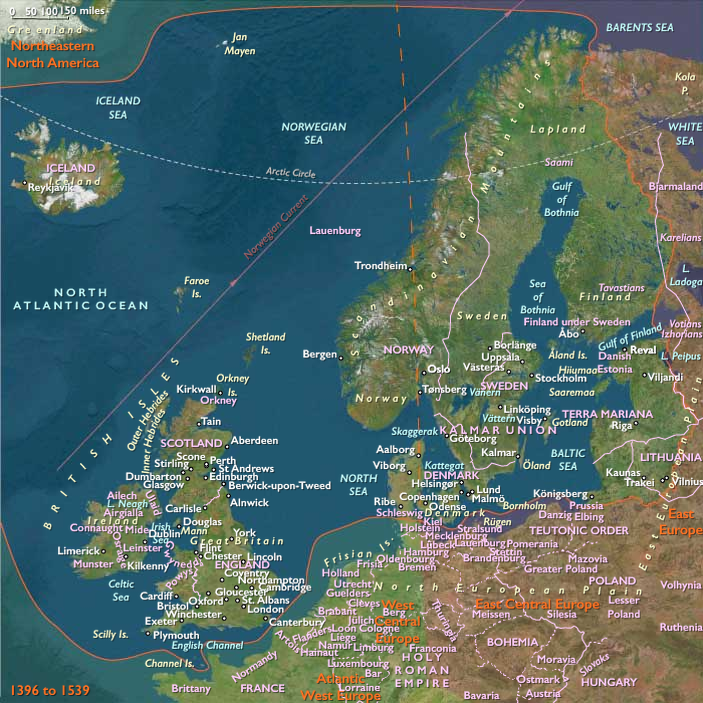
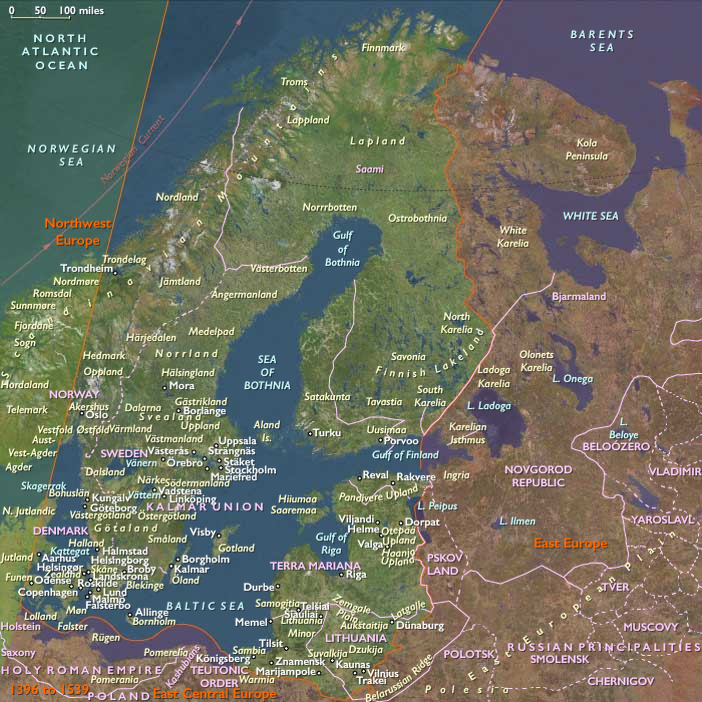
He tries to regain South Jutland (Schleswig) which Margaret had been winning but he has chosen a policy of warfare instead of negotiations.
The result is a devastating war that will not only end without conquests but also lead to the loss of the South Jutlandic areas that he had already obtained.
During this war he shows much energy and steadiness, but also a remarkable lack of adroitness.
The long war is a strain on the Danish economy as well as on the unity of the north.
Sigismund, King of Germany, issues a verdict of the Holy Roman Empire in 1424 recognizing Eric as the legal ruler of South Jutland.
The Holsteiners ignore it.
Groups
Commodities
Subjects
Regions
North Europe
View →Subregions
Northeast Europe
View →Related Events
Showing 10 events out of 99 total
East Central Europe (1456–1467 CE): Siege of Belgrade, Ascendancy of Matthias Corvinus, Bohemian Kingship of George of Poděbrady, and the Thirteen Years' War
Between 1456 and 1467 CE, East Central Europe experienced pivotal developments marked by critical Ottoman confrontations, significant shifts in Hungarian leadership under Matthias Corvinus, dynastic consolidation in Bohemia under George of Poděbrady, and crucial transformations resulting from the Thirteen Years' War between the Teutonic Order and the Polish-Lithuanian Union. These events dramatically reshaped regional politics, fortifying defenses against external threats while significantly altering internal power dynamics and political alliances.
Political and Military Developments
Siege of Belgrade and Rise of Matthias Corvinus in Hungary (1456–1458)
-
In 1456, the Ottoman Empire, led by Sultan Mehmed II, launched a massive siege against the strategic Hungarian stronghold of Belgrade. The siege was famously repelled by Hungarian noble John Hunyadi, who died shortly after his remarkable victory, deeply mourned and celebrated as a national hero.
-
Following internal struggles and political maneuvering after Hunyadi’s death, his young son, Matthias Corvinus, was elected King of Hungary in 1458, initiating one of Hungary’s most prosperous and culturally influential reigns. Matthias effectively reorganized military and administrative structures, vigorously defending Hungary’s frontiers while enhancing internal stability.
Bohemian Stability under George of Poděbrady (1458–1471)
-
In 1458, George of Poděbrady ascended peacefully to the Bohemian throne, becoming the first non-dynastic, native Czech king since the Přemyslid dynasty. His reign emphasized political stability, economic recovery, religious moderation (balancing Catholic and moderate Hussite factions), and diplomatic outreach throughout Europe, notably proposing a pan-European league for peace against Ottoman expansion.
Polish-Lithuanian Triumph in the Thirteen Years’ War (1454–1466)
-
The protracted Thirteen Years' War between the Teutonic Order and the Polish-Lithuanian Union reached critical phases during this period. Polish forces steadily gained control, supported by cities and nobility within the Prussian Confederation, an alliance formed by Prussian towns and nobles in opposition to Teutonic domination.
-
This conflict decisively weakened the Teutonic Order, setting the stage for significant territorial realignments and bolstering Polish-Lithuanian influence over vital Baltic territories, notably the crucial trade hubs around Gdańsk (Danzig) and Toruń (Thorn).
Internal and Dynastic Tensions in the Holy Roman Empire Territories
-
Within imperial territories such as Brandenburg, Saxony, and Austria, local and regional dynastic tensions persisted. The Duchies of Saxony, Mecklenburg, Bavaria, and Brandenburg underwent internal consolidation and realignment, managing political competition and negotiating external alliances, significantly influencing East Central Europe’s broader geopolitical balance.
Economic and Technological Developments
Economic Recovery and Urban Prosperity under Matthias Corvinus
-
Under Matthias Corvinus, Hungary experienced substantial economic revitalization, driven by improved agricultural output, commercial trade networks, and increased mining activities, especially silver mining in Upper Hungary (modern Slovakia).
-
Bohemia under George of Poděbrady and Poland under Kazimierz IV experienced similar economic recoveries, significantly improving regional trade networks, infrastructure, and urban prosperity.
Baltic Trade Realignments Following the Thirteen Years' War
-
With Polish-Lithuanian victory and territorial gains, cities like Gdańsk, Toruń, and Elbląg thrived economically, deepening integration into Baltic maritime trade networks and significantly strengthening Poland-Lithuania’s economic foundations.
Cultural and Artistic Developments
Cultural Renaissance under Matthias Corvinus (Hungarian Renaissance)
-
Matthias Corvinus actively patronized arts, science, and scholarship, fostering the Hungarian Renaissance’s cultural flourishing. His royal court in Buda became a vibrant center of Renaissance humanism, attracting notable Italian scholars, artists, and architects.
-
Corvinus’s renowned Bibliotheca Corviniana emerged as one of Europe’s finest Renaissance libraries, significantly enhancing Hungary’s cultural prestige.
Bohemian Cultural Resurgence
-
Under George of Poděbrady, Bohemian culture flourished, blending traditional Czech influences with evolving Renaissance trends. Prague sustained its reputation as a major cultural and intellectual center, marked by architectural projects, literature, and intellectual discourse promoting peace and European unity.
Settlement and Urban Development
Fortifications and Defensive Urbanization
-
Hungary significantly strengthened urban defenses, particularly border cities like Belgrade, Esztergom, and Temesvár, fortifying them against Ottoman threats.
-
Polish-Lithuanian cities, notably Gdańsk and Toruń, expanded rapidly, fortified defenses, and improved civic infrastructure, driven by post-war economic growth.
Social and Religious Developments
Continued Religious Diversity and Moderate Hussitism in Bohemia
-
George of Poděbrady maintained religious tolerance, upholding moderate Hussite traditions alongside traditional Catholic practices. This policy fostered Bohemia’s distinctive cultural and religious pluralism.
Social Strengthening of Nobility and Urban Classes
-
In Hungary, Poland-Lithuania, and Bohemia, aristocratic privileges and noble autonomy strengthened, particularly in territories acquired from the Teutonic Order. Urban elites also gained considerable economic and political influence through expanded commerce and civic development.
Long-Term Consequences and Historical Significance
The era 1456–1467 CE was a critical juncture in East Central Europe, decisively shaping the region’s medieval trajectory. Matthias Corvinus’s reign established a strong Hungarian monarchy, culturally vibrant and militarily resilient, deeply influencing subsequent Hungarian history. The Bohemian kingship of George of Poděbrady solidified internal peace, cultural vitality, and diplomatic innovations, impacting broader European political thought. Polish-Lithuanian triumph in the Thirteen Years' War profoundly reconfigured Baltic geopolitical dynamics, bolstering Polish regional dominance and significantly diminishing Teutonic power. Collectively, these developments transformed East Central Europe’s political landscape, fortifying regional resilience against external threats and laying essential foundations for future stability, cultural flourishing, and political complexity.
Ladislaus’s beheading of the the young László Hunyadi had raised such a storm in Hungary that the king has had to flee to Prague, where he is to spend the last months of his life.
He dies suddenly in Prague on November 23, 1457, while preparing for his marriage to Magdalena of Valois, daughter of Charles VII of France.
It is rumored at the time that his political opponents in Bohemia, including Hussite leader George of Poděbrady, had poisoned him; but in 1985 research will prove that Ladislaus had died of acute leukemia, not a recognized disease in this period.
Ladislaus's cousins Frederick V and Albert VI succeed him in Austria.
Soon.
Hungary will soon elect Matthias Corvinus, the brother of László Hunyadi, as king; and Bohemia will elect George of Poděbrady, fated to be the only Hussite ruler of that kingdom.
The death, amid rumors of poisoning, of the young Habsburg king, Ladislaus Posthumus in November of 1457 had ended the two-year struggle between Hungary's various barons and its king.
George of Poděbrady, governor of Bohemia and friend of the Hunyadis who aims to raise a national king to the Magyar throne, has taken hostage Janos Hunyadi’s younger son Matthias Corvinus.
Knighted at the siege of Belgrade in 1456, Matthias had married Elizabeth of Celje, the only known daughter of Ulrich II of Celje and Catherine Cantakuzina; her maternal grandparents were Đurađ Branković and Eirene Kantakouzene.
But the young Elizabeth had died in 1455, before the marriage was consummated, leaving Matthias a widower at the age of fifteen.
Poděbrady has treated Matthias hospitably and affianced him with his daughter Kunhuta, but still detains him, for safety's sake, in Prague, even after a Magyar deputation has hastened thither to offer the youth the crown.
Matthias takes advantage of the memory left by his father's deed, and by the general population's dislike of foreign candidates; most of the barons, furthermore, consider that the young scholar will be a weak monarch in their hands.
An influential section of the magnates, headed by the palatine Ladislaus Garai and by the voivode of Transylvania, Miklós Újlaki, who had been concerned in the judicial murder of Matthias's brother László, and hates the Hunyadis as semi-foreign upstarts, are fiercely opposed to Matthias's election; however, they are not strong enough to resist against Matthias's uncle Mihály Szilágyi and his fifteen thousand veterans.
Thus, over the elections of Emperor Frederick II, who seeks to retain Habsburg control of Bohemia, Matthias is elected king by the Diet on January 20, 1458.
Poděbrady releases him under the condition of marrying his daughter (later to be known as Catherine).
On January 24, 1458, forty thousand Hungarian noblemen, assembled on the ice of the frozen Danube, unanimously elect Matthias Hunyadi king of Hungary, and on February 14 the new king makes his state entry into Buda.
This is the first time in the medieval Hungarian kingdom that a member of the nobility, without dynastic ancestry and relationship, mounts the royal throne.
The Ottomans and the Venetians threaten Hungary from the south, the emperor Frederick III from the west, and Casimir IV of Poland from the north, both Frederick and Casimir claiming the throne.
The Czech mercenaries under Giszkra hold the northern counties and from thence plunder those in the center.
Meanwhile Matthias's friends have only pacified the hostile dignitaries by engaging to marry the daughter of the palatine Garai to their nominee, whereas Matthias refuses to marry into the family of one of his brother's murderers, and on February 9 confirms his previous nuptial contract with the daughter of Poděbrady, …
…who, chosen unanimously on February 27 by the estates of Bohemia, ascends the throne on March 2, 1458.
The struggle in Bohemia of the Hussites against the papal party has continued without interruption.
Podebrady’s position had become a very difficult one when the young king Ladislaus, who was crowned in 1453, had expressed his pro-Roman sympathies, though he had recognized the compacts and the ancient privileges of Bohemia.
Even the adherents of the papal party had voted for him, however, some in honor of his moderate policies, and some in deference to popular feeling, which had opposed the election of a foreign ruler.
The international situation is becoming increasingly complicated.
The new Prince-Bishop of Ermeland, Cardinal Eneas Silvio Piccolomini, known for his pro-Teutonic sympathies, is in 1458 elected Pope Pius II.
Another complication is the death of Ladislas the Posthumous and the election of the Hussite leader George of Podebrady as the new king of Bohemia, and Matthias Corvinus as king of Hungary.
One positive sign is peace with Denmark.
King Christian I of Denmark has finally conquered Sweden, but the Swedish king Charles VIII has escaped to Poland and started supporting the Polish cause financially.
Danzig and Charles VIII begin hiring more privateers, which seriously damages Baltic trade, and finally Christian I decides to sign a ceasefire in July 1458.
In the spring, Casimir had again called for a levée en masse which included the Masovians.
Ignoring the mediation of John Giskra (Jan Jiskra), a Czech mercenary who hopes for an end to war with Prussia and the start of a new conflict with Hungary, the Polish army has slowly marched into Prussia, crossing the Vistula via a pontoon bridge near Thorn in June.
Again, the army is supported by Tatar auxiliary forces from the Crimea and by the king's own army, commanded by Piotr of Szamotuly, the castellan of Poznań.
The Polish army marches directly to Marienburg, reaching the city on August 10.
This time it is well-equipped with artillery sent by Danzig and Elbing.
The siege, however, is another fiasco, due partly to lengthy negotiations, and partly to Piotr's lack of aggression on the battlefield.
His inept leadership allows Fritz Raweneck to take yet another castle.
The nobles demand the storming of the castle, and when this does not happen, they start deserting and returning to Poland.
Peasants in Lower Prussia rebel against Polish rule, capture a few castles, and give them to the Teutonic Knights, declaring that they are ready to fight on the Teutonic Order's side against Poland.
In the meantime, the king, using John Jiskra as mediator, negotiates with the Teutonic Knights.
The Poles again propose that the Teutonic Order should leave Prussia for Podolia.
The crusaders agree on a mission to Podolia, but refuse to leave Prussia.
Danzigers propose a compromise that would leave part of Prussia for the Teutonic Order.
At one point there is a signed cease fire lasting nine months—there is even a signed treaty, and John Jiskra as the mediator is to keep Marienburg—and peace appears certain, but the Prussian estates decide to persuade the king to break off negotiations.
The struggle between Hungary’s young king and the magnates, reinforced by Matthias's own uncle and guardian Szilágyi, has been acute throughout 1458, but Matthias, who began by deposing Garai and dismissing Szilágyi, and then proceeded to levy a tax, without the consent of the Diet, in order to hire mercenaries, has easily prevailed, recovering the Golubac Fortress from the Ottomans, successfully invading Serbia, and reasserting the suzerainty of the Hungarian crown over Bosnia.
There is a fresh rebellion in Hungary when the emperor Frederick is actually crowned king by the malcontents at Vienna-Neustadt on March 4, 1459; Matthias, however, drives him out, and Pope Pius II intervenes so as to leave Matthias free to engage in a projected crusade against the Ottomans, which subsequent political complications, however, are to render impossible.
Ţepeş writes in a letter to Corvinus, dated February 2, 1462, that Hamza Pasha had been captured close to the former Wallachian fortress of Giurgiu.
He then disguises himself as a Turk and advances with his cavalry towards the fortress where he orders the guards in Turkish to have the gates open.
This they do and Ţepeş attacks and destroys the fortress.
Ţepes’ next move is a campaign to slaughter enemy soldiers and populations that might have sympathized with the Turks; first in southern Wallachia, then, in Bulgaria by crossing the frozen Danube.
While in Bulgaria, he divides his army into several smaller groups, which in the space of two weeks kill over twenty-three thousand Turks and Muslim Bulgarians.
In a letter to Corvinus, dated February 11, 1462, he states: I have killed men and women, old and young, who lived at Oblucitza and Novoselo, where the Danube flows into the sea, up to Rahova, which is located near Chilia, from the lower Danube up to such places as Samovit and Ghighen.
We killed 23,884 Turks and Bulgars without counting those whom we burned in homes or whose heads were not cut by our soldiers....Thus your highness must know that I have broken the peace with him [the sultan].
Because of his sadistic cruelty toward subjects and Turkish prisoners alike, the Wallachian monarch becomes known as Vlad the Impaler (and, as Dracula—or son of the Devil—will become the source of the Dracula legend).