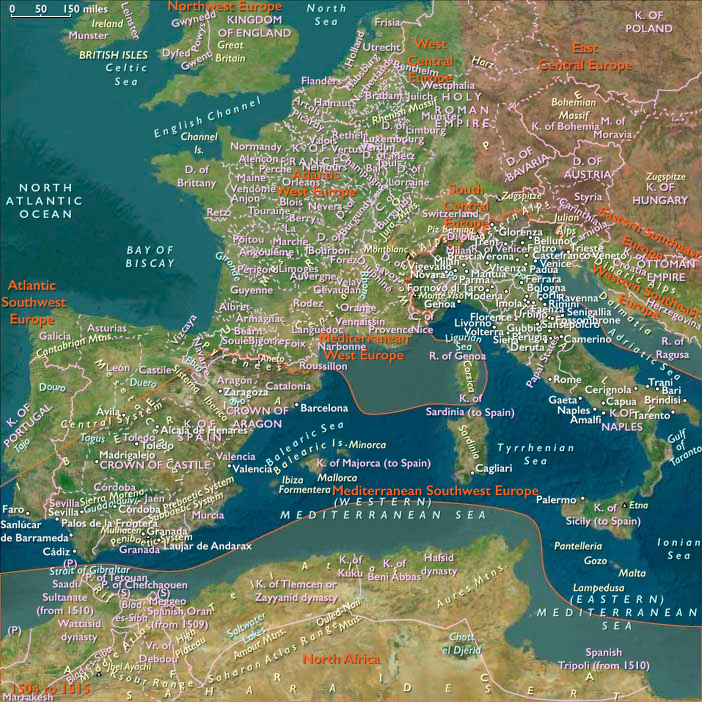
Ferdinand of Aragon, following the death of…
September 1506 CE
Ferdinand of Aragon, following the death of his wife, Isabella of Castile, had had to yield the government of Castile to his son-in-law Phillip of Burgundy, who had assumed power in the name of his wife Joanna, Isabella's heiress.
Ferdinand objects to Philip's policies and to prevent Philip from gaining Aragon through Joanna, he seeks to have a male heir with a new wife.
A new male heir would displace Joanna (and by extension her husband) from the line of succession.
He negotiates with King Louis XII of France for a marriage, hoping to gain accession to the throne of Navarre.
At the Treaty of Blois, Louis agrees to have Germaine of Foix, the daughter of John of Foix, Viscount of Narbonne and son of Queen Eleanor of Navarre, marry Ferdinand; Germaine is Louis' niece (daughter of his sister) and Ferdinand's grandniece (granddaughter of his half-sister).
Louis XII also cedes in the treaty his weak claim to the Kingdom of Naples (already controlled by Aragon) and Kingdom of Jerusalem (controlled by neither) to his niece, conditional on a male child being produced.
The marriage, between Ferdinand (aged fifty-four) and Germaine (aged eighteen), takes place in March 1506.
A short truce and brief alliance between the two kings results, despite several wars before and after the Treaty.
Philip of Burgundy dies on September 25, 1506, and Ferdinand becomes regent of Castile for his mentally unstable daughter Joanna.
Ferdinand has finally gained his prize but now directs his efforts against the succession of Philip's four-year-old eldest son, Charles.
As Aragon does not recognize descent in the female line, Ferdinand attempts to conceive a son by Germaine in the hope of detaching his ancestral kingdom from Charles' inheritance.
Locations
People
Groups
Topics
Subjects
Regions
Southwest Europe
View →Subregions