
The elderly and infirm Giovanni briefly rules…
October 887 CE
The elderly and infirm Giovanni briefly rules Venice following the battle death of Pietro I Candianoi, until a successor can be found in Pietro Tribuno, his great-nephew.
His son, Pietro II Candiano, will also later become Doge.
Locations
Commodities
Subjects
Regions
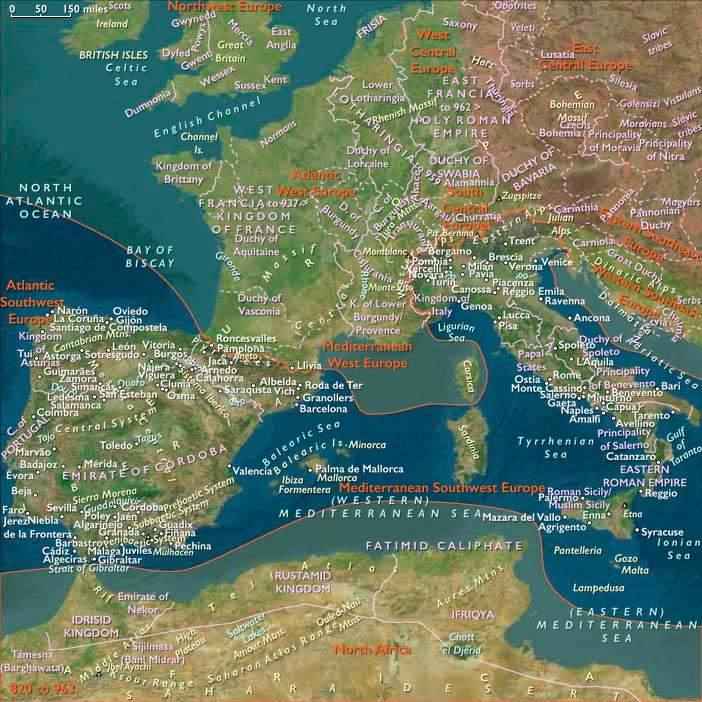
Southwest Europe
View →Subregions

Mediterranean Southwest Europe
View →Related Events
No active filters.
Showing 10 events out of 53753 total
The Viking Withdrawal and the Final Decline of Charles the Fat (887)
By spring 887, the Vikings withdraw from France, taking with them the 700 pounds of silver promised by Emperor Charles the Fat. His decision to pay off the Norse invaders rather than fight them is widely seen as an act of weakness, further diminishing his already fragile prestige in West Francia.
Charles’ Actions in Paris During and After the Siege
- During and after the Siege of Paris (885–886), Charles remains in the city, issuing several charters to West Frankish recipients.
- These charters confirm previous rights and privileges granted by his predecessors, particularly in:
- Neustria, where Viking incursions remain a pressing issue.
- The Spanish March, reaffirming Frankish control over border territories.
- Provence, ensuring continued governance of the southern frontier of the empire.
- His contact with Nantes suggests that Charles recognizes the growing influence of Alan I, Duke of Brittany, in the region.
Recognition of Alan I of Brittany as “Rex”
- It is probable that Charles the Fat grants Alan I the right to be titled rex (king) of Brittany, a privilege that only an emperor could bestow.
- Alan I was already the most powerful ruler in Brittany, successfully resisting Viking invasions and expanding his control.
- His claim to the title appears legitimate, as later Breton sources acknowledge it, and a charter dating between 897 and 900 mentions prayers being said at Redon Abbey for the soul of Karolus (likely Charles the Fat), ordered by Alan.
Consequences of Charles’ Rule and the Aftermath
- Charles’ failure to protect France from Viking threats leads to his deposition in 887, marking the final collapse of Carolingian imperial unity.
- Alan I’s rise as King of Brittany reinforces Breton autonomy and weakens West Francia’s territorial control over its westernmost regions.
- The events of 887 contribute to the increasing fragmentation of the Carolingian world, paving the way for the rise of local feudal rulers and dynastic change.
The Viking withdrawal in 887 marks the end of Charles the Fat’s reign, as his failure to defend the realm leads to his downfall, while Alan I’s recognition as King of Brittany cements the region’s growing independence.
Having set about to try again after the failure of his first attempt, Charles has had the term proles (offspring) inserted into his charters as it had not been in previous years, probably because he desires to legitimize Bernard.
Charles had met the new Pope, Stephen V, in early 886 and had probably negotiated for the recognition of his son as his heir.
An assembly had been planned for April and May of the next year at Waiblingen.
Pope Stephen cancels his planned attendance on April 30, 887.
Berengar, who by a brief feud with Liutward had lost the favor of the emperor, arrives at Waiblingen in early May 887, makes peace with the emperor, and compensates for the actions of the previous year by dispensing great gifts.
Charles the Fat had probably abandoned his plans for Bernard and instead adopted Louis of Provence as his son at an assembly at Kirchen in May.
It is possible, however, that the agreement with Louis was only designed to engender support for Bernard's subkingship in Lotharingia.
In June or July, Berengar arrived in Kirchen, probably pining to be declared Charles's heir; he may in fact have been so named in Italy, where he will be acclaimed (or make himself) king immediately after Charles's deposition in 887.
Odo, Count of Paris, may have had a similar purpose in visiting Charles at Kirchen.
On the other hand, the presence of these magnates at these two great assemblies may merely have been necessary to confirm Charles' illegitimate son as his heir (Waiblingen), a plan which failed when the pope refused to attend, and then to confirm Louis instead (Kirchen).
Liutward, Bishop of Vercelli, had in 886 taken the sister of Berengar of Friuli, the chief secular magnate, from the nunnery of San Salvatore at Brescia in order to marry her to a relative of his; whether or not by force or by the consent of the convent and Charles the Fat, her relative, is uncertain.
Berengar and Liutward had had a feud that year, which involved his attack on Vercelli and plundering of the bishop's goods.
Berengar's actions are explicable if his sister was abducted by the bishop, but if the bishop's actions were justified, then Berengar appears as the initiator of the feud.
Whatever the case, bishop and margrave are reconciled by 887, when Charles appears to have succumbed to fits of madness.
During this crisis, Richardis has attempted to rule in her husband's stead, but is unsuccessful.
In an effort to bring down the over-powerful and hated Liutward, Charles' archchancellor, he and Richardis are accused by Charles and his courtiers of adultery.
Charles asserts that their marriage is unconsummated and demands a divorce.
The empress successfully undergoes the ordeal of fire, but Liutward is banished form court.
Richardis, protected by her family, withdraws to Andlau Abbey, which she had founded on her ancestral lands in 880, and where her niece Rotrod is abbess.
(Richardis herself was previously lay abbess of religious houses at Säckingen and Zurich.)
Pietro I Candiano follows Orso I Participazio and Giovanni II Participazio as Doge of Venice, elected to the throne in about April 887at the side of the elderly, and beloved, Giovanni.
He launches a military attempt against the Narentines in Dalmatia, who have since 886 been hostile to Venetia.
As soon as he becomes Doge, he advances with a fleet of twelve galleys to the port of Makarska (Mokro), where he sinks five Narentine ships.
He lands near Mokro and advances deeper inland, but the Narentines crush his forces on September 18, 887, killing him in open battle.
He is the first Doge to die in a battle.
The Venetians begin paying prince Branimir of Croatia an annual tribute for the right to travel and trade in the Croatian part of the Adriatic.
The failure of Emperor Charles III to halt the Viking raids on the East Frankish kingdom results in his overthrow by the East Frankish magnates.
Arnulf takes the leading role in the deposition of his uncle.
With the support of the nobles, Arnulf holds a Diet at Tribur and deposes Charles in November 887, under threat of military action.
Charles peacefully goes into his involuntary retirement, but not without first chastising his nephew for his treachery and asking only for a few royal villas in Swabia, which Arnulf mercifully grants him, on which to live out his final months.
Arnulf, having distinguished himself in the war against the Slavs is elected by the nobles of the realm (only the eastern realm, though Charles had ruled the whole of the Frankish lands) and assumes his title of King of East Francia.
Varangian (Scandinavian) military leaders and merchants had during the 860s established outposts in Northern Russia at Novgorod and in Ukraine at Kiev.
Prince Oleg, kinsman of Rurik of Jutland, the semilegendary founder of the Rurik dynasty of Kievan Rus’, expands control of the territory along the Dnieper River, joining Novgorod via Smolensk with Kiev, which henceforth will serve as the political and cultural center of the Kievan Rus’.
(In the early chronicles the Varangians are also called Rus’, and this corporate name becomes as well a territorial designation for the Kievan region—the basic territory of the Rus’; later, by extension, it will be applied to the entire territory ruled by members of the Kievan dynasty.)
The disciples of Cyril and Methodius are credited with preparing more than three thousand priests.
With the active assistance and material support of Boris, they establish centers of Slavic learning at Pliska, …
…Preslav, and Ohrid in the West.
Dacia's Christians had adopted the Slavonic rite, subject to the Bulgarian metropolitan at Ohrid, soon after the conversion of the Bulgars to Christianity. (It will be maintained until the seventeenth century, when Romanian becomes the liturgical language).