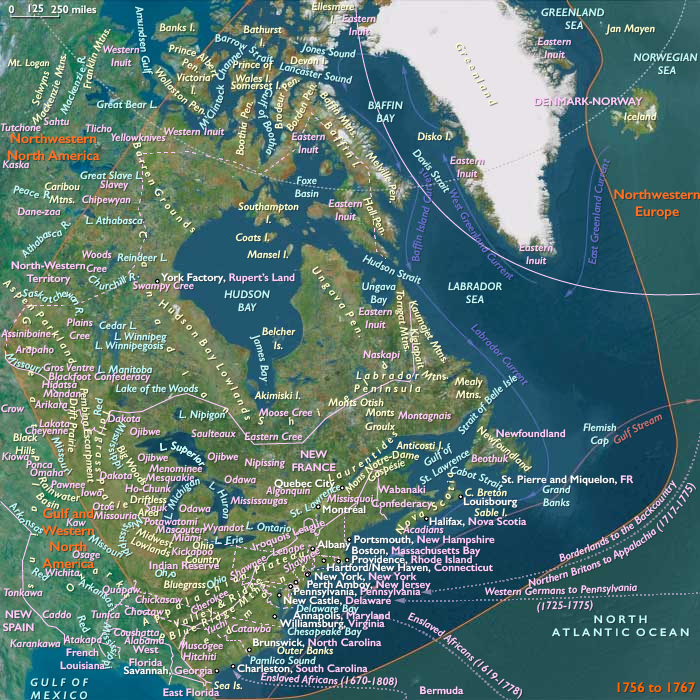
Natives involved in Pontiac's Rebellion live in…
1763 CE
Natives of the pays d'en haut are from many different tribes.
At this time and place, a "tribe" is a linguistic or ethnic group rather than a political unit.
No chief speaks for an entire tribe, and no tribe acts in unison.
For example, Ottawas do not go to war as a tribe: some Ottawa leaders choose to do so, while other Ottawa leaders denounce the war and stay clear of the conflict.
The tribes of the pays d'en haut consists of three basic groups.
The first group is composed of tribes of the Great Lakes region: Ojibwe, Odawa, and Potawatomi, who speak Algonquian languages; and the Huron, who speak an Iroquoian language.
They have long been allied with French habitants, with whom they live, trade, and intermarry.
Great Lakes natives are alarmed to learn that they are under British sovereignty after the French loss of North America.
When a British garrison takes possession of Fort Detroit from the French in 1760, local natives caution them that "this country was given by God to the Indians."
People
Groups
Iroquois (Haudenosaunee, also known as the League of Peace and Power, Five Nations, or Six Nations)
View →
Wyandot, or Wendat, or Huron people (Amerind tribe)
View →
Miami (Amerind tribe)
View →
Lenape or Lenni-Lenape (later named Delaware Indians by Europeans)
View →
Ojibwa, or Ojibwe, aka or Chippewa (Amerind tribe)
View →
Odawa, or Ottawa, people (Amerind tribe)
View →
Seneca (Amerind tribe)
View →
Mascouten (Amerind tribe)
View →
Kickapoo people (Amerind tribe)
View →
Potawatomi (Amerind tribe)
View →
Wea (Amerind tribe)
View →
Piankeshaw (Amerind tribe)
View →
Shawnees, or Shawanos (Amerind tribe)
View →
Ohio Country
View →
Illinois Country
View →
Britain, Kingdom of Great
View →
Mingo (Seneca-Cayuga Tribe of Oklahoma)
View →
Topics
Commodities
Regions
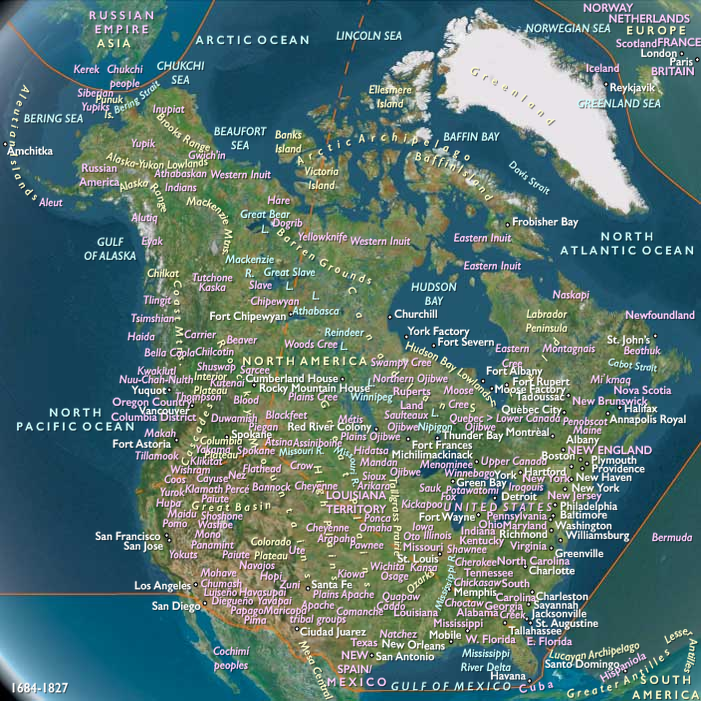
Northern North America
View →Subregions