Land is also an issue in the…
1763 CE
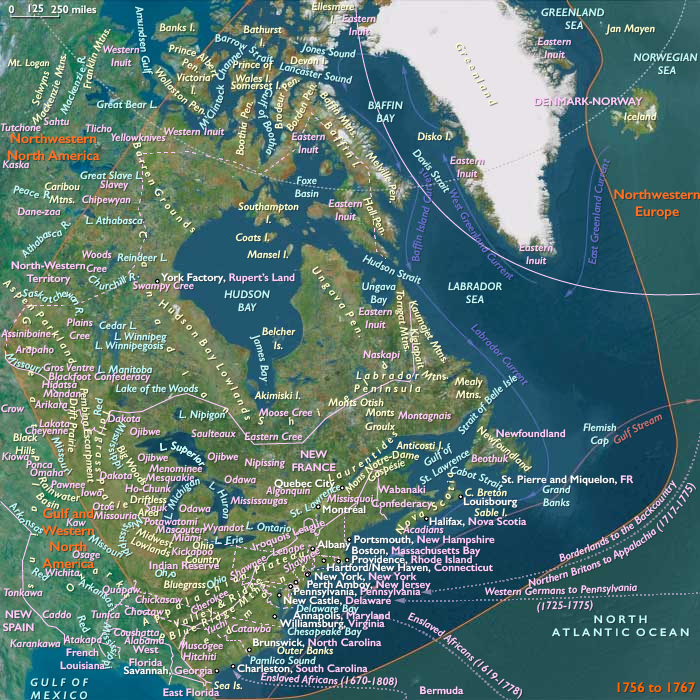
While the French colonists—most of whom are farmers who seasonally engage in fur trade—have always been relatively few, there seem to be no end of settlers in the British colonies, who want to clear the land of trees and occupy it.
Shawnees and Delawares in the Ohio Country have been displaced by British colonists in the east, and this motivates their involvement in the war.
On the other hand, natives in the Great Lakes region and the Illinois Country have not been greatly affected by white settlement, although they are aware of the experiences of tribes in the east.
Historian Gregory Dowd will argue that most natives involved in Pontiac's Rebellion were not immediately threatened with displacement by white settlers, and that historians will therefore overemphasize British colonial expansion as a cause of the war.
Dowd believes that the presence, attitude, and policies of the British Army, which the natives find threatening and insulting, are more important factors.
Also contributing to the outbreak of war is a religious awakening that swept through Native settlements in the early 1760s.
The movement is fed by discontent with the British as well as food shortages and epidemic disease.
The most influential individual in this phenomenon is Neolin, known as the "Delaware Prophet", who calls upon natives to shun the trade goods, alcohol, and weapons of the whites.
Merging elements from Christianity into traditional religious beliefs, Neolin tells listeners that the Master of Life is displeased with the natives for taking up the bad habits of the white men, and that the British pose a threat to their very existence.
"If you suffer the English among you," said Neolin, "you are dead men. Sickness, smallpox, and their poison [alcohol] will destroy you entirely."
It is a powerful message for a people whose world is being changed by forces that seem beyond their control.
People
Groups
Iroquois (Haudenosaunee, also known as the League of Peace and Power, Five Nations, or Six Nations)
View →
Wyandot, or Wendat, or Huron people (Amerind tribe)
View →
Miami (Amerind tribe)
View →
Lenape or Lenni-Lenape (later named Delaware Indians by Europeans)
View →
Ojibwa, or Ojibwe, aka or Chippewa (Amerind tribe)
View →
Odawa, or Ottawa, people (Amerind tribe)
View →
Seneca (Amerind tribe)
View →
Mascouten (Amerind tribe)
View →
Kickapoo people (Amerind tribe)
View →
Potawatomi (Amerind tribe)
View →
Wea (Amerind tribe)
View →
Piankeshaw (Amerind tribe)
View →
Shawnees, or Shawanos (Amerind tribe)
View →
Ohio Country
View →
Illinois Country
View →
Britain, Kingdom of Great
View →
Mingo (Seneca-Cayuga Tribe of Oklahoma)
View →
Topics
Regions
Northern North America
View →Subregions