Gulf and Western North America (909 BCE–819…
909 BCE to 819 CE
Gulf and Western North America (909 BCE–819 CE): Diverse Landscapes, Regional Exchange, and Agricultural Adaptation
Geographic Parameters
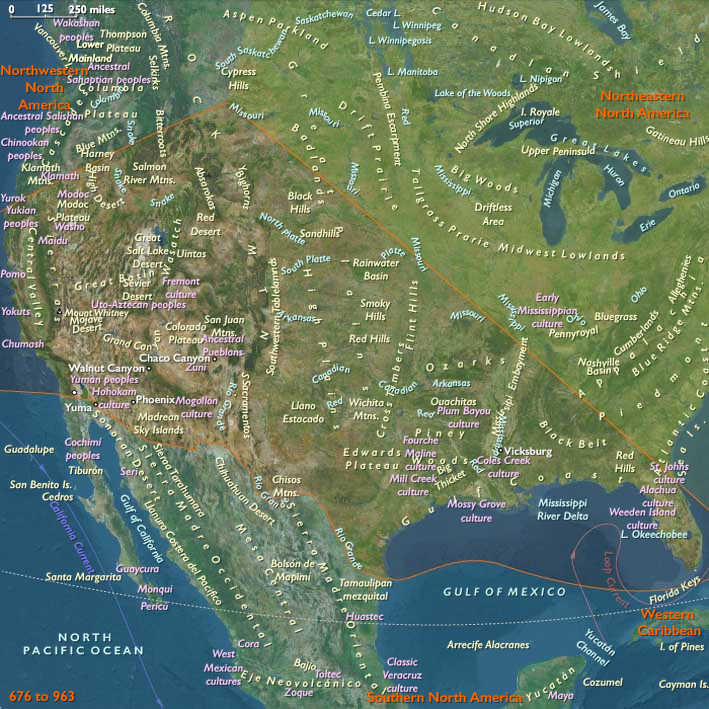
The subregion includes the Lower Mississippi Valley, Gulf Coastal Plain, Great Plains, Southern Rockies, Colorado Plateau, Great Basin, Sonoran and Chihuahuan Deserts, Rio Grande Valley, lower Colorado River, California coast and Central Valley, Florida Peninsula, and adjacent interior regions extending from the Gulf of Mexico to the Pacific Ocean.
Major environmental anchors include the Mississippi River system, Rio Grande, lower Colorado River, Gila River, Gulf Coast estuaries, California coastal ranges, Sierra Nevada foothills, Colorado Plateau mesas, Great Basin valleys, and the Sonoran and Chihuahuan deserts.
Environmental Continuity
Throughout the epoch, extraordinary environmental diversity remained the defining characteristic of the subregion. Humid river floodplains, coastal marshes, Mediterranean woodlands, vast grasslands, canyon systems, deserts, volcanic plateaus, mountain forests, and extensive coastlines supported highly varied but locally productive ways of life. Seasonal flooding, hurricanes, droughts, wildfire, and highly variable rainfall continually shaped settlement, agriculture, and mobility.
Human Adaptation
Communities developed remarkably different adaptations to local environments. Agricultural villages flourished along major rivers and desert irrigation systems, while fishing communities occupied productive Gulf and Pacific coasts. Elsewhere, mixed farming, hunting, gathering, acorn processing, riverine fisheries, and seasonal mobility remained essential. Irrigation canals, floodplain agriculture, dry farming, and managed woodlands reflected careful adaptation to highly contrasting ecological zones.
Economic Organization
Exchange increasingly linked diverse environments rather than politically unified societies. Rivers, coastlines, desert corridors, and mountain passes carried obsidian, turquoise, marine shells, salt, copper, pottery, textiles, foodstuffs, and other regional products between agricultural villages, coastal fisheries, desert communities, and mobile peoples. The Lower Mississippi, Rio Grande, lower Colorado, Gulf Coast, and Pacific coast became especially important interaction corridors.
Institutions and Society
Communities remained highly diverse in scale and organization. Mound centers emerged across portions of the Lower Mississippi Valley, irrigation villages expanded within desert river valleys, pueblos gradually developed across portions of the Southwest, while coastal villages and seasonal settlements remained characteristic elsewhere. Ceremonial centers, communal architecture, and regional gathering places developed within productive local landscapes rather than replacing them.
Belief and Sacred Landscapes
Religious traditions remained closely tied to local environments. Rivers, springs, mesas, caves, mountains, deserts, forests, and coastlines possessed enduring spiritual importance. Mound complexes, rock art, ceremonial plazas, kivas, and sacred landscapes reflected diverse regional traditions while reinforcing relationships between communities and the ecological systems upon which they depended.
Regional Interaction
Although political systems remained regionally varied, communication steadily expanded across ecological boundaries. Canoes moved along major rivers and coastlines, desert trails connected irrigation communities with neighboring regions, and mountain passes linked plateau settlements with surrounding valleys. Exchange fostered broad interaction without producing widespread political unification.
Long-Term Significance
By CE 819, Gulf and Western North America formed one of the most environmentally diverse cultural landscapes of the Americas. Agricultural villages, irrigation communities, mound centers, coastal fisheries, pueblos, and mobile societies remained interconnected through extensive exchange networks while preserving the distinct adaptations that emerged from the subregion's remarkable ecological diversity.
Groups
Regions
Northern North America
View →Subregions