The Grande Armée, despite all these preparations,…
June 1812 CE
Napoleon already faces difficulties providing for his six hundred and seventy-five thousand-man, one hundred and eighty thousand-horse army on friendly territory in Poland and Prussia.
The standard heavy wagons, well-suited for the dense and partially paved road networks of Germany and France, will prove too cumbersome for the sparse and primitive Russian dirt tracks.
The supply route from Smolensk to Moscow will therefore be entirely dependent on light wagons with small loads.
The heavy losses to disease, hunger and desertion in the early months of the campaign will be in large part due to the inability to transport provisions quickly enough to the rapidly advancing combat forces.
A large portion of the army consists of partially-trained, unmotivated recruits that lack training in the field craft and foraging techniques that had proven so successful in earlier campaigns, and will be paralyzed without a constant stream of supplies.
Some exhausted soldiers will throw away their reserve rations in the summer heat.
Forage will be scarce after a late, dry spring, leading to great losses of horses.
A great storm will kill ten thousand horses in the opening weeks of the campaign.
Many of the commanders lack the operational and administrative skills and apparatus to efficiently move so many troops across such large distances of hostile territory.
The supply depots established by the French in the Russian interior, while extensive, will be too far behind the main army
The Intendance administration will fail to distribute with sufficient rigor the supplies that have been built up or captured.
Some of the administrative officials will flee prematurely from their depots during the retreat, leaving them to be used up indiscriminately by the starving soldiers.
The French train battalions will move forward huge amounts of supplies during the campaign, but the distances and speed required, a lack of discipline and training in the newer formations and reliance on defective, requisitioned vehicles that break down easily will mean that the demands Napoleon has placed on them are too great.
Of the seven thousand officers and men in the train battalions, fifty-seven hundred will become casualties.
Napoleon intends to trap and destroy the Russian army on the frontier or before Smolensk.
He will fortify Smolensk and Minsk, establish forward supply depots in Lithuania and winter quarters at Vilnius and wait for either peace negotiations or a continuation of the campaign in the spring.
Aware of the vast distances that can undo his army, Napoleon's original plan does not have him continuing beyond Smolensk in 1812.
However, the Russian armies cannot stand singularly against the main battle group of two hundred and eighty-five thousand men and will continue to retreat and attempt to join one another.
This will demand an advance by the Grande Armée over a network of dirt roads that dissolves into deep mires, where ruts in the mud will freeze solid, killing already exhausted horses and breaking wagons.
The Grande Armée will incur the majority of its losses during the march to Moscow during the summer and autumn.
Starvation, desertion, typhus and suicide will cost the French Army more men than all the battles of the Russian invasion combined.
People
Groups
Austria, Archduchy of
View →
Denmark-Norway, Kingdom of
View →
Portugal, Bragança Kingdom of
View →
Russian Empire
View →
Britain (United Kingdom of Great Britain and Ireland)
View →
Switzerland
View →
France, (first) Empire of
View →
Italy, Bonapartist Kingdom of
View →
Naples, Bonapartist Kingdom of
View →
Rhine, Confederation of the (Rhine Confederation)
View →
Warsaw, Duchy of
View →
Spain, Bonapartist Kingdom of
View →
Regions
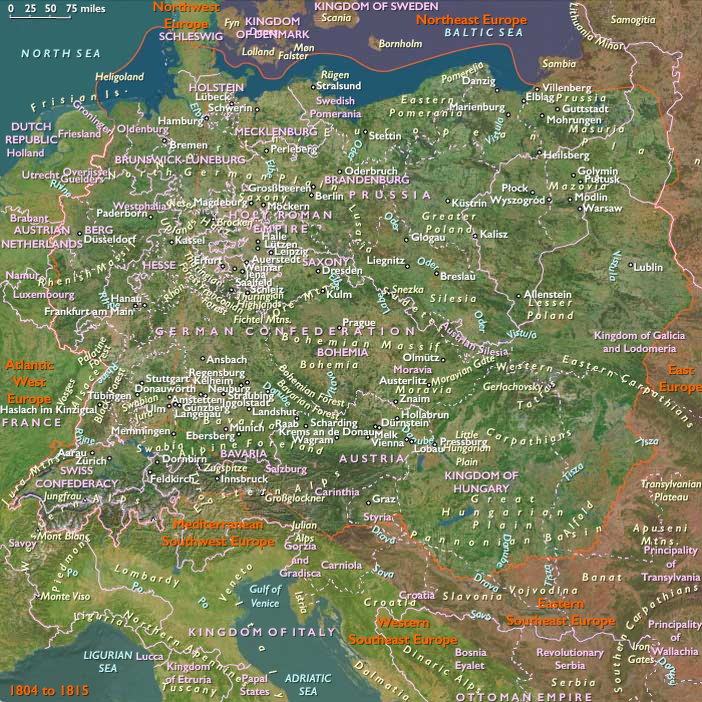
Central Europe
View →Subregions