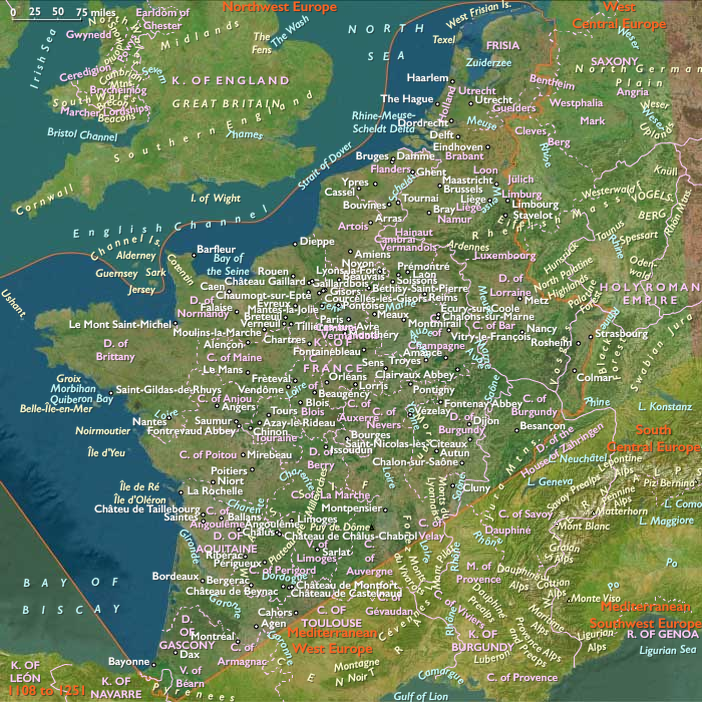
The Revolt of 1173–1174: Henry II’s Sons…
March 1173 CE
The Revolt of 1173–1174: Henry II’s Sons Rebel
By 1173, Henry II of England ruled England, Normandy, and Anjou, while his wife, Eleanor of Aquitaine, controlled the vast Duchy of Aquitaine. Their four legitimate sons—Henry the Young King, Richard (later "the Lionheart"), Geoffrey, and John ("Lackland")—all stood to inherit parts of this empire, creating tensions over succession and power.
When Henry II decided to bequeath three castles—which were supposed to be part of Henry the Young King’s inheritance—to his youngest son John, tensions within the Plantagenet family erupted into open rebellion.
The Young King's Grievances and the Spark of Rebellion
- Henry the Young King, 18 years old in 1173, was widely admired for his charm and good looks, but he lacked real power or resources, despite being officially crowned King of England in 1170.
- He had been married for years to Margaret of France, the daughter of Louis VII, making him the son-in-law of the French king.
- However, Henry’s father refused to grant him any real authority, keeping him in a ceremonial role without independent rule.
- The final insult came when Henry II granted three castles to his youngest son, John, as part of John’s proposed marriage to the daughter of the Count of Maurienne.
Encouraged by discontented nobles, the Young King fled to the court of Louis VII in March 1173, seeking support to forcibly claim his inheritance.
Formation of the Anti-Henry II Alliance
- Louis VII of France immediately backed his son-in-law, seizing the opportunity to weaken Henry II.
- Henry's younger brothers, Richard and Geoffrey, soon joined the rebellion, hoping to secure their own inheritances.
- Their mother, Eleanor of Aquitaine, who had long feuded with Henry II, attempted to join her sons but was captured by Henry II and imprisoned.
- The rebels forged a broad alliance, promising lands and wealth to powerful nobles:
- The Counts of Flanders, Boulogne, and Blois were promised land and revenues in England and Anjou.
- William the Lion, King of Scotland, was promised Northumberland, giving him a reason to invade England.
This rebellion effectively sought to break apart Henry II’s empire, dividing it among his sons and their allies.
The Stakes and Consequences
- This was not just a family dispute—it became a major European conflict, as it involved:
- The King of France.
- The rulers of Flanders, Boulogne, Blois, and Scotland.
- A large number of discontented English and Angevin barons.
- The rebels aimed to carve up Henry II’s realm, redistributing power among his sons and their allies.
- The rebellion would rage across England and France, marking one of the greatest challenges to Henry II’s rule.
Though Henry II would eventually suppress the revolt, it exposed the fragility of his empire and foreshadowed further conflicts among his sons, culminating in decades of internal Plantagenet strife.
Locations
People
Groups
Commodities
Subjects
Regions
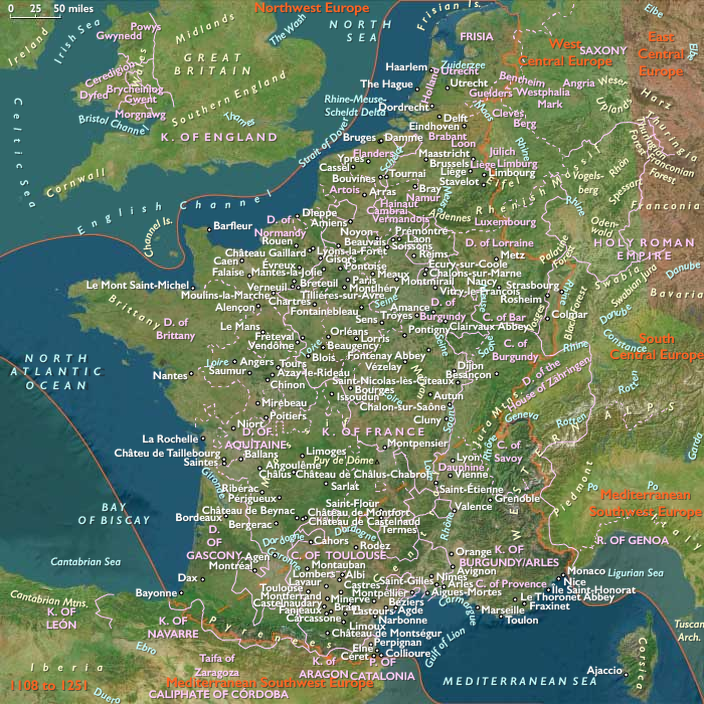
West Europe
View →Subregions