
The German crown passes to the Salians,…
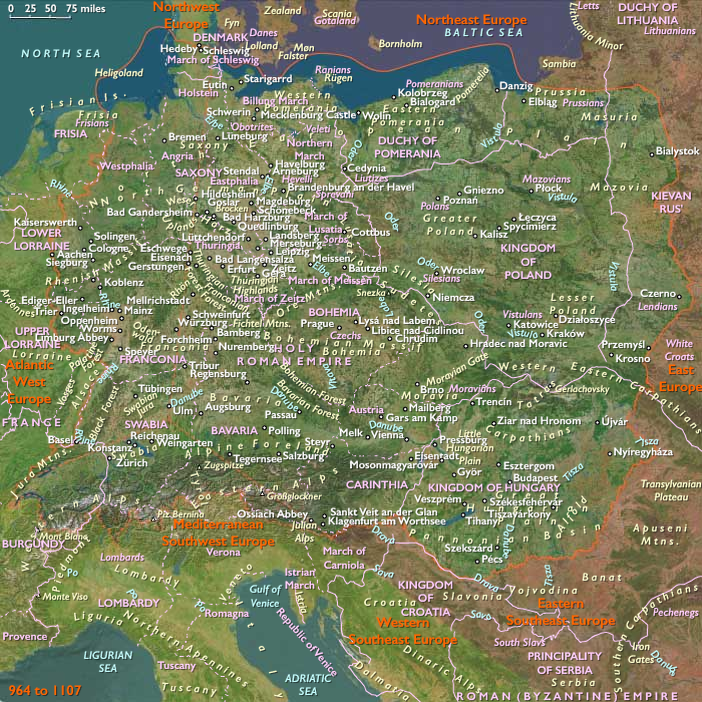
964 CE to 1107 CE
The German crown passes to the Salians, a Frankish tribe, after the death of the last Saxon king in 1024.
The four Salian kings—Conrad II, Henry III, Henry IV, and Henry V—who ruled Germany as kings from 1024 to 1125, establish their monarchy as a major European power.
Their main accomplishment is the development of a permanent administrative system based on a class of public officials answerable to the crown.
A principal reason for the success of the early Salians is their alliance with the church, a policy begun by Otto I, which gives them the material support they need to subdue rebellious dukes.
In time, however, the church comes to regret this close relationship.
The relationship breaks down in 1075 during what comes to be known as the Investiture Controversy, a struggle in which the reformist pope, Gregory VII, demands that Henry IV (r. 1056-1106) renounce his rights over the German church.
The pope also attacks the concept of monarchy by divine right and gains the support of significant elements of the German nobility interested in limiting imperial absolutism.
More important, the pope forbids church officials under pain of excommunication to support Henry as they had so freely done in the past.
In the end, Henry journeys to Canossa in northern Italy in 1077 to do penance and to receive absolution from the pope.
However, he resumes the practice of lay investiture (appointment of religious officials by civil authorities) and arranges the election of an antipope.
People
Groups
Regions
Central Europe
View →Subregions
