
Daun's battle plan surprises the Prussians. The…
October 1758 CE
The east side of Frederick's line is the first to be attacked.
Using the starless night and fog as cover, and grouped into small shock units for easier control and stealth, the Austrians fall on the Prussian battery when the church bell signals 5:00, catching the Prussians completely off guard.
Many men are still sleeping, or just waking up, when the Austrians attack.
The Austrians cut tent ropes, collapsing the tents on sleeping soldiers, then bayonet the men as they struggle to free themselves from canvas and cords.
At first Frederick thinks the sounds of the battle are either an outpost skirmish or the Croats in the Austrian army, who apparently start their days with regular firing of their weapons.
His staff has trouble rousing him from bed, but he is soon alerted when his own cannons, captured by the Austrians, start to fire on his own camp.
While his adjutants are trying to wake Frederick, his generals, most of whom had not slept and had kept their horses saddled and weapons ready, organize the Prussian resistance.
Keith, anticipating an Austrian attack, organizes a slashing counterattack on the Austrians holding the Prussian battery.
Maurice von Anhalt-Dessau, another of Frederick's able generals, funnels the awakening troops to Keith.
This combined action briefly retakes the Prussian battery south of Hochkirch, but they cannot hold it in the face of Austrian muskets.
At 6:00, three more Prussian regiments rush Hochkirch itself, while Prince Maurice continues directing stragglers and reinforcements into the counterattack.
The Prussians sweep through the village, out the other side, and fall on the battery at bayonet point.
By this point, though, most Prussian order and cohesion has been lost.
The Austrians, supported by their appropriated Prussian guns, which had not been spiked, wreak havoc on the attackers.
Keith is hit mid-body and knocked out of his saddle, dead as he falls into his groom's arms.
When the early morning fog lifts, the soldiers can make out friend from foe.
Prussian cavalry, which had remained saddled and ready throughout the night, launches a series of regimental counterattacks.
A battalion of the 23rd Infantry charges, but withdraws as it is surrounded flank and rear.
The church yard, a walled stronghold, diverts the Austrians; Major Siegmund Moritz William von Langen's musketeers of the 19th regiment hold it with sheer determination and provide safety for retreating Prussians.
Most importantly, Langen buys time.
Frederick, by this time fully awake, dressed and ready to fight, hopes that the battle can be retrieved and returns to the village to take command.
At 7:00, finding his infantry milling about in the village, Frederick orders them to advance, sending reinforcements commanded by Prince Francis of Brunswick-Wolfenbüttel, his brother-in-law, with them.
As Francis approaches the village, Austrian cannon-fire sheers his head off his shoulders; his troops falter, demoralized by the sight of the prince's headless body atop his spooked horse.
Frederick himself helps to rally Francis' shaken troops.
Led by the King, they advance against five Austrian companies of horse grenadiers commanded by Franz Moritz von Lacy; they march into an alleyway still known today as Blood Alley (Blutgasse).
Apparently, the soldiers are so tightly packed into the alley they cannot fall when shot; they die where they stand and their blood runs from the holes in their bodies through the gutters.
By 7:30, the Austrians have possession of the burning village.
Keith and Prince Francis are dead.
General Karl von Geist laies among the injured.
Maurice von Anhalt-Dessau had been injured and captured.
By 9:00, the Prussian left wing collapses under the weight of the Austrian assault; the last Prussian battery is overrun and turned against them.
Frederick establishes a fighting line north of the village, but it ends up as a rallying point for stragglers and survivors.
By mid-morning, around 10:00, the Prussians retreat to the north-west.
Frederick and his surviving Prussians are out of range of the Austrian army by the time they have reorganized.
Ziethen and Friedrich Wilhelm von Seydlitz, who had remained alert all night, organize a rear guard action that prevents the Austrians from falling upon the retreating Prussians.
Frederick has lost ninety-four hundred men, more than thirty percent of his army, including five generals, one hundred and one guns, and nearly all the tents.
Frederick requires his generals to set an example of courage and leadership: they lead from the front.
The same rate of attrition applies throughout the officer corps, which had lost half of its strength in the first three campaigns of the war.
In addition to human losses, they have lost valuable horses and draft animals, seventy munitions wagons, and, a blow to morale, twenty-eight flags, and two standards.
On the positive side, though, Retzow's corps, which had not arrived in time to participate in the fighting, remain intact; Frederick has pulled his troops together for an orderly retreat; and the King retains the confidence of his soldiers.
The Austrians suffer casualties and losses at about three percent.
According to the military historian Gaston Bodart, there were fewer troops participating than most modern sources suggest: he places Austrian participants at sixty thousand, losses in casualties at fifty-four hundred, approximately eight point three percent, but other losses (to injuries, desertions and capture) at about twenty-three hundred, or three point six percent.
Locations
People
Groups
Austria, Archduchy of
View →
Brunswick-Wolfenbüttel, Duchy of
View →
Saxony, Electorate of
View →
Holy Roman Empire
View →
Sweden, (second) Kingdom of
View →
Hesse-Kassel, Landgraviate of
View →
France, (Bourbon) Kingdom of
View →
Bavaria, Electorate of
View →
Brunswick-Lüneburg, Electorate of (Electorate of Hanover)
View →
Spain, Bourbon Kingdom of
View →
Prussia, Kingdom of
View →
Britain, Kingdom of Great
View →
Pomerania, Swedish
View →
Russian Empire
View →
Subjects
Regions
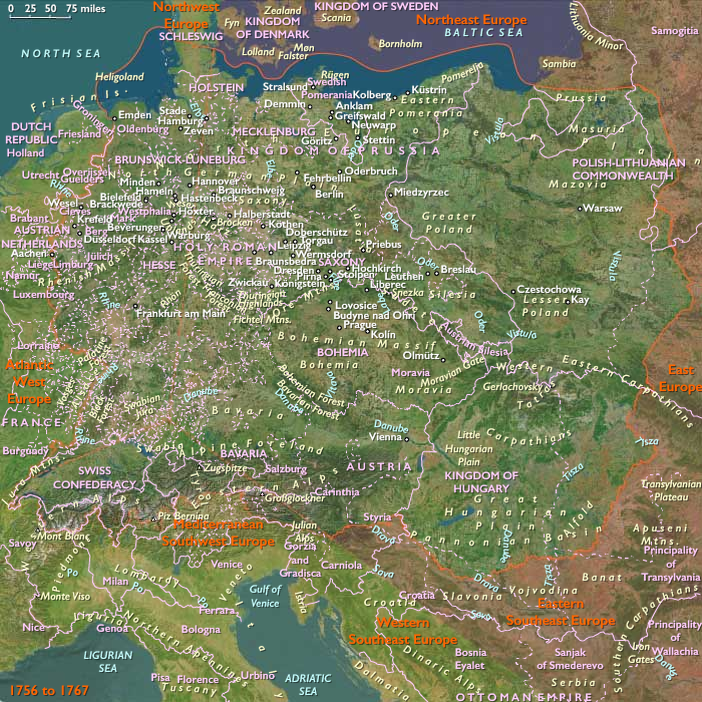
Central Europe
View →Subregions
