Hungary water (sometimes called "the Queen of…
1360 CE to 1371 CE
Hungary water (sometimes called "the Queen of Hungary's Water") is the first (European) alcohol-based perfume, claimed to date to about the late fourteenth century.
According to legend it was first formulated at the command of a Queen of Hungary, sometimes identified as Isabella but usually as Elisabeth, or in one document "Saint Elisabeth, Queen of Hungary" (this may be a conflation of multiple individuals).
These legends, and the documented references to this preparation, mostly date to the early to mid-seventeenth century, so the details may have become confused in the intervening centuries.
The queen in question is frequently assumed to be Elizabeth of Poland (1305–1380), although the particulars of her life do not match those in the more common legends; it is even more unlikely that it could be Saint Elisabeth of Hungary (1207–1231), who is additionally too early and not a queen (note that the technique of distillation only became well known in Europe between about 1150 and 1250).
The only plausible Queen Isabella (late thirteenth century) likewise seems to be too early to be a strong candidate.
The exact date of the invention of Hungary water is lost to history.
It is equally unclear who in particular created it.
Some sources say that a monk-recluse who first gave it to Elizabeth, though most likely it was made by court alchemist (who could also have been a monk, thus reconciling the two traditions).
The oldest surviving recipes call for distilling fresh rosemary (and possibly thyme) with strong brandy, while later formulations contain lavender, mint, sage, marjoram, costus, orange blossom and lemon.
According to these same legends Hungary water first appeared outside of Hungary in 1370 when the French Charles V le Sage, who was famous for his love of fragrances, received some.
Locations
Groups
Commodities
Regions
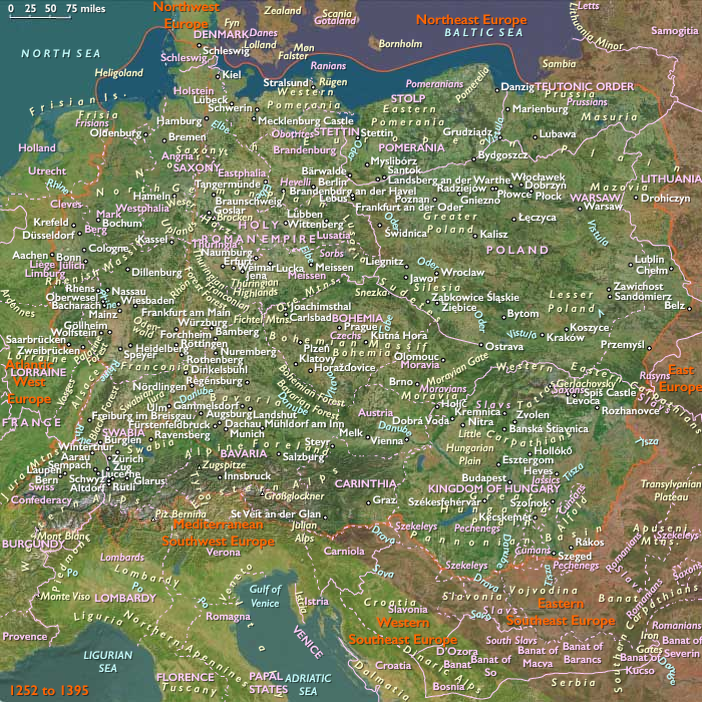
Central Europe
View →Subregions