
Hongi Hika had traveled to England on…
July 1821 CE
Hongi Hika had traveled to England on board the whaling ship New Zealander in 1820, spending five months in London and Cambridge where his facial tattoos had made him something of a sensation.
During the trip, he had met King George IV, who had presented him with a suit of armor.
He had continued his linguistic work, assisting professor Samuel Lee ,who is writing the first Māori–English dictionary.
Written Māori maintains a northern feel to this day as a result—for example the sound usually pronounced "f" in Māori is written "wh" because of Hongi Hika's soft aspirated northern dialect.
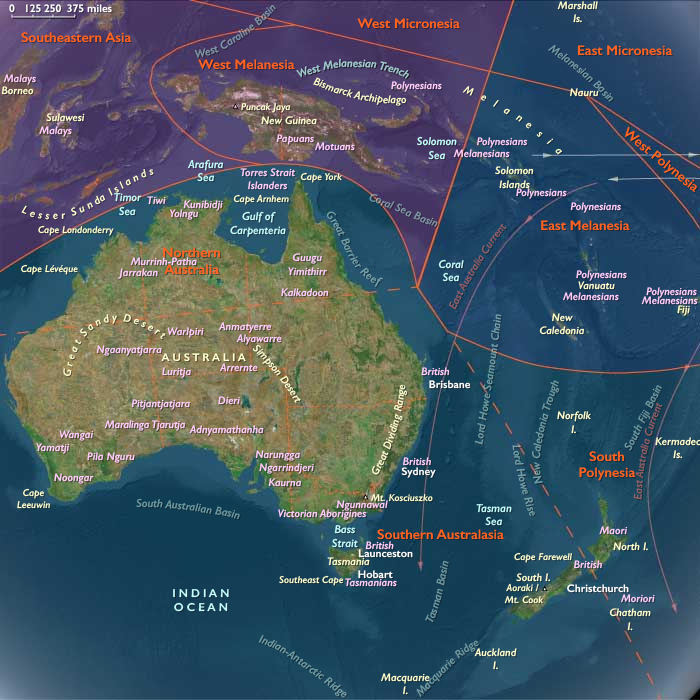
Hongi Hika returns to the Bay of Islands in July 1821, after four hundred and fifty-seven days away, via Sydney, Australia, where he had picked up an estimated five hundred muskets that awaited him.
The muskets had been ordered by Baron Charles de Thierry, whom Hongi had met at Cambridge.
De Theirry has traded the muskets for land in the Hokianga, although De Theirry's claim to the land is later disputed.
Hongi had been able to take possession of the guns without them being paid for.
Locations
Groups
Topics
Commodities
Subjects
Regions
Australasia
View →Subregions
