
Gorm the Old (also called Gorm the…
820 CE to 963 CE
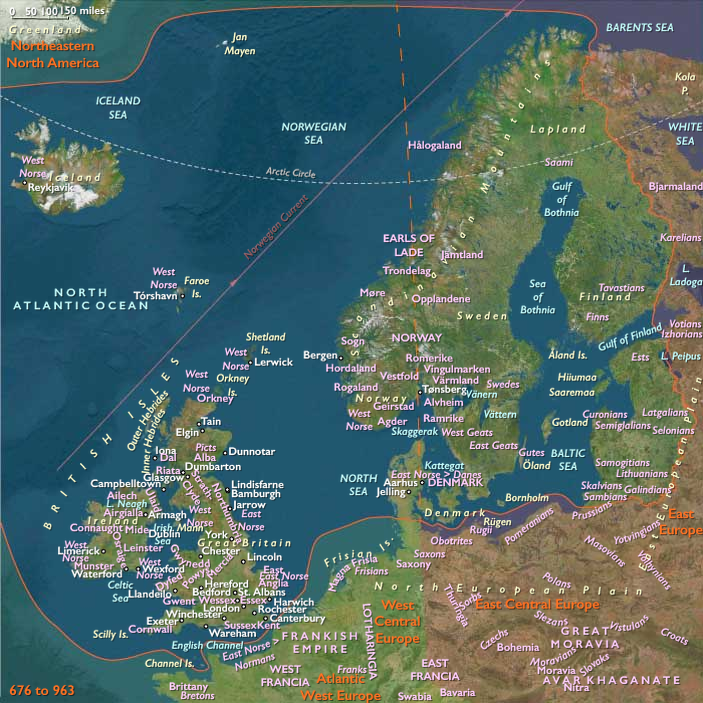
He rules from Jelling, and makes the oldest of the Jelling Stones in honor of his wife Thyra.
Gorm was born before 900 and dies around 958.
His rule marks the start of the Danish monarchy and royal house.
Locations
People
Subjects
Regions
North Europe
View →Subregions
Northwest Europe
View →Related Events
Showing 10 events out of 185 total
Middle America (820 – 963 CE): Terminal Classic Transformations, Isthmian Gateways, and the Renewal of Trade
Geographic and Environmental Context
Middle America stretched from the Valley of Mexico to the Panamanian isthmus, encompassing a dense gradient of highlands, coasts, and tropical lowlands.
-
Southern North America: Mexico, Guatemala, Belize, Honduras, El Salvador, and Nicaragua.
-
Isthmian America: Costa Rica, Panama, the Darién corridor, the San Andrés Archipelago, and the Ecuadorian Capelands (Manta–Santa Elena–Esmeraldas–Guayas headlands).
This was the land bridge of the Americas—linking Andean, Caribbean, and Mesoamerican civilizations—bounded by the Gulf of Mexico, Caribbean Sea, and Pacific Ocean. Its ecological range—from Yucatán’s dry forests to Panama’s rainforests—made it one of the world’s most diversified cultural regions.
Climate and Environmental Shifts
The centuries around 820–963 CE bridged drought and recovery:
-
Terminal Classic droughts (c. 800–930) destabilized the southern Maya lowlands, thinning populations in Petén and Belize forests.
-
Highlands and coastal belts—the Puuc hills, Yucatán littoral, and Pacific cacao coasts—remained stable, attracting migrants and trade.
-
Central America and the Ecuadorian Capes enjoyed reliable rainfall, while El Niño–La Niña cycles intermittently disrupted Pacific fisheries.
-
The approach of the Medieval Warm Period (after 950) restored agricultural productivity and reinvigorated canoe navigation along the coasts.
Societies and Political Developments
Southern North America: From Classic Collapse to Epiclassic Innovation
-
Maya lowlands: many Classic centers in the Petén Basin collapsed, but continuity towns such as Lamanai (Belize) and Comayagua (Honduras) persisted with reduced hierarchy.
-
Northern Yucatán: the Puuc cities (Uxmal, Kabah, Labná) and the rising power of Chichén Itzá reoriented the Maya world northward; their stone columns and water temples reflected a new, open political order.
-
Central Mexico: fortress-shrines like Xochicalco and painted sanctuaries at Cacaxtla dominated the Epiclassic landscape, mediating trade between coasts and highlands after the fall of Teotihuacan.
-
Oaxaca: Monte Albán declined; Mixtec hilltop polities (e.g., Tilantongo) consolidated power, producing early genealogical codices.
-
Guatemalan highlands: dispersed K’iche’ and Kaqchikel ancestors occupied defensible ridges, preserving maize and ritual continuity.
-
Ulúa–Sula and Soconusco coasts of Honduras and El Salvador thrived as cacao exporters tied to obsidian and jade markets.
Isthmian America: The Cape-to-Isthmus Exchange Sphere
-
Costa Rica and Panama: regional chiefdoms administered maize, manioc, and cacao production, channeling gold ornaments, cotton textiles, and ceramics through isthmian portages.
-
Darién corridor: a Chibchan–Cariban interface that relayed goods between the Caribbean and Pacific; rainforest villages navigated by canoe and river paths.
-
Ecuadorian Capelands (Manta–Santa Elena): coastal communities specialized in spondylus shell diving, cotton weaving, and maritime trade, connecting the Andes with Central America.
-
San Andrés Archipelago: served as seasonal fishing and turtle-harvesting grounds.
-
Galápagos Islands: uninhabited but ecologically influential in regional seafaring and mythic geography.
Economy and Trade
-
Staples: milpa maize, beans, and squash in Mesoamerica; manioc, cacao, and maize along the Isthmus; irrigated plots in lake basins.
-
Prestige goods: obsidian (Pachuca, El Chayal), jade (Motagua Valley), spondylus shells, painted ceramics, and gold ornaments.
-
Canoe corridors:
-
Pacific chain: Soconusco ⇄ Nicaragua ⇄ Costa Rica ⇄ Panama ⇄ Ecuadorian Capes.
-
Caribbean–Isthmus link: Darién portages connected the two oceans.
-
Highland routes: Mixteca–Guatemalan paths funneled obsidian, cacao, and feathers into coastal markets.
-
-
Epiclassic central places: Chichén Itzá and Xochicalco prospered as redistributors of tropical goods northward to central Mexico and beyond.
Subsistence and Technology
-
Irrigation and terraces expanded in Yucatán and central Mexico; canal systems in the Valley of Mexico and Hohokam–Mesoamerican corridors paralleled one another in complexity.
-
Cacao horticulture enriched Pacific and isthmian societies; cotton cultivation fed weaving industries.
-
Metallurgy: Isthmian smiths pioneered gold-alloy casting by the 9th century.
-
Canoe design: large dugouts and sewn-plank hulls enabled open-coast navigation; raft and outrigger traditions likely connected Ecuadorian and Panamanian ports.
-
Ceramics: fine polychrome and incised wares carried ritual and exchange value.
Belief and Symbolism
-
Rain and maize renewal: cenote offerings in Yucatán, hilltop shrines in Oaxaca, and cave rituals throughout the highlands sustained agrarian cosmologies.
-
Ballgame sanctuaries remained focal—at Copán’s successors, Ulúa Valley courts, and Isthmian plazas—representing fertility and political alliance.
-
Gold and spondylus in Costa Rica and Ecuador embodied solar–marine power; offerings at elite burials affirmed chiefs’ connection to sea and sky.
-
Hybrid art styles—as at Cacaxtla and Chichén Itzá—merged Maya, Central Mexican, and Isthmian motifs into a shared sacred vocabulary.
Adaptation and Resilience
-
Ecological diversification: combining dryland maize, humid cacao, and riverine manioc stabilized food supplies.
-
Population mobility: migration from collapsing lowlands to coasts and uplands sustained continuity of language and ritual.
-
Trade redundancy: dual Caribbean and Pacific corridors prevented economic collapse when drought or war disrupted one route.
-
Ritual integration: ballgame leagues, pilgrimage circuits, and feasting networks renewed interregional bonds after the disintegration of Classic hegemonies.
Long-Term Significance
By 963 CE, Middle America had transformed into a maritime and highland nexus of renewed innovation:
-
The Maya north (Puuc–Chichén) and Mixtec highlands revived monumental and literary traditions.
-
The Epiclassic central plateau bridged cultures from Oaxaca to the Gulf, blending artistry and warfare into new syncretic forms.
-
The Costa Rica–Panama isthmus and Ecuadorian capes matured into a gold-and-shell corridor, linking Mesoamerica and the Andes for the first time.
-
Cacao, gold, and spondylus became the symbolic currencies of the age—binding river, coast, and sea into one of the ancient world’s most intricate exchange systems.
Isthmian America (820 – 963 CE): Coastal Migrations, River Gateways, and Cape-to-Isthmus Exchange
Geographic and Environmental Context
Isthmian America includes Costa Rica, Panama, the Darién corridor, the San Andrés Archipelago, the Galápagos Islands (uninhabited but ecologically significant), and the Ecuadorian Capelands (Manta; coastal Esmeraldas–Manabí–Guayas–Santa Elena and headlands Cabos Manglares, de San Francisco, Pasado, San Lorenzo, Punta Santa Elena).
-
Anchors: Panama Isthmus & Chagres–Bayano rivers, Costa Rica’s Central Valley & Nicoya, Darién rainforests, San Andrés fishing stations, Manta–Santa Elena capes and ports, and the Galápagos offshore.
Climate and Environmental Shifts
-
Warm tropical regimes with reliable rainy seasons; Pacific fisheries responded to El Niño–La Niña fluctuations.
-
Caribbean storms occasionally affected San Andrés.
Societies and Political Developments
-
Costa Rica & Panama: village chiefdoms organized around maize, manioc, cacao, and cotton; goldworking traditions established.
-
Darién: forest polities mediated between Chibchan north and Cariban south.
-
Ecuadorian Capelands: coastal communities at Manta and adjacent capes specialized in canoe trade, spondylus shell gathering, and cotton textiles; linked with highland Andean networks.
-
San Andrés: seasonal fishing/turtle stations used by mainlanders.
-
Galápagos: uninhabited.
Economy and Trade
-
Staples: maize, manioc, beans, cacao; marine fish, turtles, shellfish.
-
Prestige goods: gold ornaments, spondylus shells, cotton cloth.
-
Canoe corridors: Manta–Santa Elena ⇄ Panama–Costa Rica ⇄ San Andrés, with Darién river portages between Caribbean and Pacific.
Belief and Symbolism
-
Gold and spondylus symbolized solar–marine power; ancestor shrines and feasting legitimized chiefs.
Long-Term Significance
By 963, Isthmian America formed a coastal–riverine web: capes of Ecuador fed prestige goods north, while Costa Rica–Panama chiefdoms organized tribute and isthmian portages.
Middle America (964 – 1107 CE): Goldworking Chiefdoms, Toltec Horizons, and Maritime Cities of the Itzá
Geographic and Environmental Context
Middle America during the Lower High Medieval Age bridged the tropical isthmus and the Mesoamerican highlands, encompassing Mexico, Guatemala, Belize, Honduras, El Salvador, Nicaragua, Costa Rica, Panama, and the adjacent coasts of Colombia and Ecuador, along with the uninhabited Galápagos and San Andrés islands.
It was a region of volcanic highlands, fertile valleys, and dual coasts, divided by forested mountains but united by trade—linking Tula and Chichén Itzá in the north with the goldworking chiefdoms of Costa Rica and Panama in the south.
Canal-like portages across the Isthmus of Panama allowed goods, ideas, and people to move rapidly between the Pacific and Caribbean, making Middle America one of the most interconnected regions of the pre-Columbian world.
Climate and Environmental Shifts
The Medieval Warm Period (c. 950–1250) brought generally stable warmth and regular monsoon rains.
-
Mexican highlands and Yucatán north enjoyed reliable maize harvests.
-
Pacific Soconusco coast and Belize–Bay of Honduras lagoons maintained year-round cacao and salt production.
-
Costa Rica–Panama valleys alternated between dry-season maize and wet-season manioc and cacao.
-
ENSO cycles produced occasional droughts, but regional diversity of crops and coastlines buffered disruption.
-
Pacific upwellings supported rich fisheries, while Caribbean mangroves yielded abundant shellfish.
Societies and Political Developments
Central Mexican and Yucatán Realms
The Toltec capital of Tula (Tollan) rose around 980 CE as a militarized and mercantile hub of the Valley of Mexico.
-
Toltec artisans standardized bronze, obsidian, and ceramic production; its Atlantean columns symbolized a new warrior–sun ideology.
-
Highland–Gulf routes distributed metal ornaments, turquoise, and cacao north and east.
In the Yucatán, Chichén Itzá flourished as a maritime thalassocracy, projecting power from its walled city and coastal ports like Isla Cerritos. -
Its temples and ballcourts, adorned with serpents and Kukulcan imagery, became centers of diplomacy and ritual trade linking the Caribbean to the Mexican plateau.
To the south, the Mixtec hill states of Oaxaca, such as Tilantongo, and the Zapotec ceremonial center of Mitlarefined dynastic statecraft recorded in painted codices, marrying artistry with politics.
Highland and Coastal Peripheries
In Guatemala and western Honduras, fortified hilltop towns controlled obsidian passes and river valleys; inter-lineage warfare alternated with trade alliances.
The Belize–Bay of Honduras coast maintained lagoon towns and ports (e.g., Lamanai), serving as entrepôts for cacao and cotton textiles.
Along the Pacific slope—from Soconusco to Nicaragua—fertile volcanic plains supported cacao plantations and coastal markets connecting Mexico to the Isthmus.
Isthmian Chiefdoms and Canal Routes
Further south, the chiefdoms of Costa Rica and Panama reached their apogee.
-
Caciques ruled villages built around plazas, earthen mounds, and ballcourts.
-
The Diquís culture continued producing monumental stone spheres, symbols of cosmic order and lineage prestige.
-
Skilled goldsmiths perfected lost-wax casting, creating intricate tumbaga (gold–copper) pectorals and pendants depicting jaguars, crocodiles, and birds of prey.
In the Darién and Capes of Ecuador, Cueva and ancestral Emberá–Wounaan groups practiced mixed horticulture and fishing, bridging Andean and Isthmian networks.
The Galápagos and San Andrés archipelago remained uninhabited but ecologically familiar to voyagers who occasionally sighted their shores.
Economy and Trade
Middle America’s prosperity lay in its dual networks of land and sea.
-
Agriculture: maize, beans, squash, and chile in uplands; manioc, cacao, and pejibaye (peach palm) in humid lowlands.
-
Metals and luxury goods: gold and tumbaga from Costa Rica and Panama; obsidian from Pachuca and El Chayal; jade from the Motagua Valley; turquoise from northern Mexico.
-
Cacao and salt circulated as currency and tribute; cotton textiles and jade ornaments functioned as prestige items.
-
Trade corridors:
-
Tollan–Yucatán–Gulf circuits blended highland craft goods with Caribbean shells and salt.
-
Isthmian portages funneled shells, gold, and ceramics between coasts.
-
Canoe fleets moved Spondylus shells, cacao, and gold from Ecuador–Colombia to Nicaragua–Honduras, linking South and Mesoamerica.
-
These arteries made Middle America the commercial hinge between the continents, sustaining cultural and economic integration across thousands of kilometers.
Subsistence and Technology
-
Irrigation and terracing: Toltec and Mixtec systems optimized rainfall in highlands; Isthmian chiefdoms used raised beds and canal gardens in lowlands.
-
Metallurgy: lost-wax casting and alloying of gold, copper, and silver; ornaments used as tribute and ritual offerings.
-
Architecture: columned temples and walled precincts at Tula and Chichén; mounds and ballcourts in Costa Rica and Panama; open plazas for markets and ceremonies.
-
Navigation: dugout canoes on both coasts; Toltec and Itzá maritime routes connected the Yucatán with Panama and Ecuador.
-
Ceramics: polychrome pottery of Nicoya and Gran Coclé reflected cross-cultural aesthetics between Mesoamerica and the Isthmus.
Belief and Symbolism
Religion unified the region’s diversity through ancestor worship, cosmological dualities, and ballcourt ritual.
-
Toltec and Itzá theology fused the sun–war god (Quetzalcoatl–Kukulcan) with notions of cyclical creation.
-
Mixtec codices immortalized lineage founders and divine marriages as cosmic dramas.
-
Isthmian gold and stone art depicted hybrid beings—jaguar-men, crocodile–eagles—symbolizing shamanic transformation.
-
Ballcourts, present from Tula to Diquís, reenacted the balance of life and death, politics and the cosmos.
-
Ancestor burials, accompanied by gold pectorals and jade ornaments, expressed kin-based authority; stone spheres embodied harmony and world order.
Movement and Interaction Corridors
-
Overland highways: Tula to Oaxaca and Soconusco; Mixtec roads over the Sierra Madre to Pacific cacao ports.
-
Maritime routes: Chichén Itzá’s ports (Isla Cerritos) to Belize and Honduras; canoe trade from Panama to Nicaragua and onward to Mexico.
-
Isthmian portages: Chagres, Bayano, and Reventazón rivers served as proto-canal routes linking Pacific and Caribbean economies.
-
Capes of Ecuador and Darién tied the Isthmus into Andean trade, passing gold and Spondylus shells northward.
Adaptation and Resilience
-
Ecological diversity—from highland terraces to rainforest gardens—insured against climatic stress.
-
Dual-coast economies used Pacific fisheries and Caribbean trade to offset agricultural shortfalls.
-
Political plurality maintained resilience: multiple city-states and chiefdoms prevented single-point collapse.
-
Artisanal prestige economies—centered on gold, jade, and cacao—stabilized alliances through ritual and exchange rather than coercion.
Long-Term Significance
By 1107 CE, Middle America had become a continental crossroads of power and artistry:
-
Toltec Tollan and Chichén Itzá anchored the northern highlands and maritime Yucatán as twin centers of innovation and trade.
-
Mixtec and Zapotec hill states codified dynastic histories and expanded sacred architecture.
-
Costa Rica–Panama chiefdoms reached the zenith of goldworking sophistication, linking the Isthmus with both the Andes and Mesoamerica.
-
Canoe and portage routes unified the Caribbean and Pacific for the first time, prefiguring the region’s enduring role as a global transit zone.
This age defined Middle America as a land of metal, maize, and myth—where jade, gold, and cacao flowed together through networks of pilgrimage, trade, and ritual that bound the American continents into one dynamic cultural sphere.
Isthmian America (964 – 1107 CE): Goldworking Chiefdoms, Canal-Route Traders, and Island Edges
Geographic and Environmental Context
Isthmian America includes Costa Rica, Panama, the Galápagos Islands, the San Andrés Archipelago, and the northeastern edge of South America (the Darién of Colombia and the capes of Ecuador).
-
Costa Rica & Panama: volcanic highlands, fertile valleys, and humid lowland forests between two coasts.
-
Darién (Colombia): swampy forests and river basins bridging the Andes and isthmus.
-
Galápagos & San Andrés: oceanic outposts, still uninhabited, but ecologically rich with seabirds and turtles.
Climate and Environmental Shifts
-
The Medieval Warm Period (c. 950–1250) brought reliable rainfall to Caribbean and Pacific slopes, favoring agriculture.
-
Seasonal dry forests in Guanacaste (Costa Rica) and parts of Panama encouraged maize farming, while wetter Caribbean lowlands supported manioc and cacao.
-
Pacific upwellings enriched fisheries; Caribbean mangroves remained vital for shellfish harvests.
Societies and Political Developments
-
Costa Rica & Panama:
-
Chiefdoms matured into elaborate ranked polities, with chieftains (caciques) presiding over villages clustered around plazas, mounds, and ballcourts.
-
The Diquís tradition continued to produce monumental stone spheres and elaborate gold ornaments.
-
-
Darién (Colombia): Cueva ancestors practiced mixed horticulture and fishing, organized into kin-based chiefdoms with regional alliances.
-
Capes of Ecuador: linked to coastal chiefdoms that interacted with Isthmian traders.
-
Galápagos & San Andrés: remained uninhabited, beyond the reach of regular voyaging.
Economy and Trade
-
Agriculture:
-
Maize, beans, squash in drier valleys.
-
Manioc, cacao, and pejibaye (peach palm) in humid lowlands.
-
-
Goldworking: lost-wax casting reached new refinement, producing pectorals, pendants, and animal-figure ornaments.
-
Trade:
-
Canoe crossings between Caribbean and Pacific coasts carried shells, cacao, gold, and ceramics.
-
Costa Rican jade, Panamanian gold, and Ecuadorian Spondylus shells circulated widely.
-
Links extended north to Nicaragua and Honduras, and south into Colombia and Ecuador.
-
Subsistence and Technology
-
Terrace farming in volcanic valleys; raised beds in wetlands.
-
Fishing technologies: nets, spears, and dugout canoes on both coasts.
-
Metallurgy: gold and tumbaga (gold–copper alloy) worked into prestige goods for ritual and political display.
-
Ceramics: polychrome pottery in Costa Rica and Panama showed both local style and Mesoamerican influence.
Movement and Interaction Corridors
-
Isthmian portages enabled rapid transfer of goods between Pacific and Caribbean villages.
-
Coastal canoe routes tied Panama to Colombia, Ecuador, and Central America.
-
River networks (Chagres, Reventazón, Bayano) integrated hinterlands with trade routes.
-
Maritime edges: Galápagos and San Andrés remained ecological waypoints, though not yet entered into human networks.
Belief and Symbolism
-
Ancestor veneration: burials accompanied by gold pectorals, jade ornaments, and ceramics.
-
Animal symbology: jaguar, eagle, shark, and crocodile motifs reinforced chiefly authority and spiritual power.
-
Ballcourts and ritual games: echoed Mesoamerican influence, fusing sport with political and cosmic meaning.
-
Stone spheres: continued as emblems of order, balance, and lineage prestige.
Adaptation and Resilience
-
Agricultural diversity: maize in dry valleys, manioc and cacao in wetter zones, buffered harvests against climate stress.
-
Dual-coast access: reliance on both Caribbean and Pacific resources reduced vulnerability.
-
Metallurgical prestige: gold and tumbaga items consolidated chiefly power and secured alliances.
-
Kinship and ritual exchange maintained networks across fragmented ecologies.
Long-Term Significance
By 1107 CE, Isthmian America had become a regional crossroads of the Americas:
-
Goldworking chiefdoms in Costa Rica and Panama projected wealth and ritual authority.
-
Portage corridors across the isthmus allowed rapid movement of goods between seas, foreshadowing its later global role.
-
Trade webs carried jade, shells, cacao, and gold north into Mesoamerica and south into Colombia–Ecuador.
-
Offshore islands (Galápagos, San Andrés) remained untouched, but mainland societies flourished as both cultural and commercial intermediaries.
Middle America (1108 – 1251 CE): Gold, Jade, and the Two-Ocean Highway
Between 1108 and 1251 CE, Middle America stood at the crossroads of two continents and two oceans.
From the golden chiefdoms of Costa Rica and Panama to the fortified cities of Yucatán, Oaxaca, and the Valley of Mexico, societies fused metallurgy, jade, cacao, and ritual power into a luminous network of trade and faith.
The region’s peoples—Maya, Mixtec, Zapotec, Tarascan, Mexica, and Cueva—shared a vision of the cosmos as a living order sustained by craftsmanship, sacrifice, and exchange.
This was the age of Mayapán’s ascendency, Mexica migration, and the flourishing of the Two-Ocean Highway that bound the Caribbean and the Pacific together.
Geographic and Environmental Context
Middle America spanned the volcanic highlands of Mexico and Central America, the tropical lowlands of the Caribbean and Pacific coasts, and the narrow Isthmian bridge of Panama and Costa Rica.
-
Northern sphere: the Valley of Mexico, Oaxaca, and Yucatán, where temple–plaza cities presided over irrigated and terraced landscapes.
-
Southern sphere: the isthmus of Panama–Costa Rica and the Darién forests, bridging the Andes and the Mesoamerican world.
-
Maritime sphere: the Caribbean and Pacific coasts, where canoe fleets navigated cacao estuaries and jade-bearing rivers.
This geography formed a continental hinge — a bridge of volcanoes, rainforests, and reefs uniting both hemispheres.
Climate and Environmental Shifts
The Medieval Warm Period brought alternating intervals of warmth and dryness.
-
Yucatán drought cycles spurred population shifts from inland cities to cenote-linked settlements and coastal markets.
-
Guatemalan and Oaxacan highlands maintained stability through terracing and canal irrigation.
-
Isthmian tropics remained humid, sustaining cacao and forest cultivation, while the Pacific slopes enjoyed reliable dry seasons for maize.
Environmental variation encouraged regional specialization and intensified trade between highland farmers, lowland horticulturalists, and maritime traders.
Societies and Political Developments
The Isthmian Chiefdoms:
In Costa Rica and Panama, hereditary caciques ruled multi-village chiefdoms from plaza centers with mounds, ballcourts, and ceremonial goldworks.
Power rested on control of goldworking, cacao estates, and portage routes between the Caribbean and the Pacific.
The Cueva chiefdoms of Darién connected the isthmus with northern Colombia, while Ecuador’s coastal polities shared in maritime trade networks.
These societies represented the southern threshold of Mesoamerican influence and the northern reach of Andean metallurgy.
The Highland States of Mexico and Guatemala:
Across the Valley of Mexico, city-states (altepetl)—Azcapotzalco, Texcoco, Culhuacan—vied for supremacy.
The Mexica, newly arrived migrants, served as mercenaries under the Tepanec lords, awaiting the foundation of their own capital.
In Michoacán, Tarascan elites consolidated, advancing copper metallurgy and developing a unique state structure distinct from the Aztec pattern.
In Oaxaca, Mixtec and Zapotec dynasties ruled Mitla and Tututepec through elaborate marriage alliances and codified genealogy, their painted manuscripts chronicling divine ancestry.
The Maya Realms:
The Mayapán League emerged in northern Yucatán after the decline of Chichén Itzá (~1200), centralizing tribute and diplomacy through shared temples and merchant guilds.
In the Guatemalan Highlands, the K’iche’ and Kaqchikel formed fortified hilltop capitals, uniting clans under sacred lineages later immortalized in the Popol Vuh.
The southern Pacific slope (Soconusco to El Salvador) prospered as a cacao-exporting corridor linking Maya and central Mexican trade.
Economy and Trade
Agriculture and Artisanship:
-
Maize, beans, and squash formed the subsistence triad from Mexico to Panama.
-
Cacao, cotton, and manioc supported lowland wealth and luxury economies.
-
Copper and gold metallurgy flourished in Michoacán and the Isthmus.
-
Terraced and raised fields intensified production in volcanic valleys.
Trade Networks:
-
Two-ocean portages across Panama and Costa Rica funneled gold, jade, Spondylus shell, and cacao between the Caribbean and Pacific.
-
Canoe fleets linked Nicaragua and Honduras with Colombia and Ecuador.
-
Overland corridors connected Oaxaca and Michoacán to Gulf and Pacific coasts.
-
Maritime Yucatán–Belize–Honduras route carried obsidian, cotton mantles, and copper bells to Maya and highland markets.
Trade served not merely economic but ritual ends—each transaction an offering in the maintenance of cosmic balance.
Belief and Symbolism
Ritual Power and the Sacred Cosmos:
Across Middle America, rulers were divine intermediaries between celestial and underworld forces.
-
Feathered Serpent cults expressed renewal and cosmic movement.
-
Ballcourts symbolized the struggle of life and death, the sun’s passage through the underworld.
-
Maya temples and Zapotec tombs embodied mountain–cave cosmology, centers of fertility and ancestry.
-
Isthmian metallurgy reflected the transformation of matter into spirit—gold as sunlight, jade as breath, Spondylus shell as blood.
Astral and Codical Knowledge:
Postclassic scholars maintained Venus calendars, eclipse tables, and ritual almanacs, merging timekeeping with prophecy.
Deities of war, rain, and maize governed the agricultural and political cycles alike.
Subsistence and Technology
-
Terraces and irrigation canals in highland valleys sustained maize and beans.
-
Raised fields and chinampas enhanced lowland and lake agriculture.
-
Dugout canoes and balsa rafts enabled long-distance maritime trade.
-
Lost-wax casting in the isthmus and hammered sheet-gold ornaments adorned elites.
-
Codex painting, stucco relief, and obsidian blade production reflected unmatched artistic precision.
Innovation was continuous and integrated—hydraulic, metallurgical, and aesthetic.
Movement and Interaction Corridors
-
Isthmian portages: Caribbean ⇄ Pacific gold and jade transfer, precursor to later canals.
-
Mesoamerican interior roads: Valley of Mexico ⇄ Oaxaca ⇄ Soconusco ⇄ Nicaragua.
-
Coastal canoe highways: Yucatán ⇄ Belize ⇄ Honduras ⇄ Darién ⇄ Ecuador.
-
Lake basins: Michoacán’s waterways and Yucatán’s cenote routes facilitated inland transport.
Together, these corridors linked metallurgy and cacao to the broader hemispheric economy, forming a vibrant chain between Andes, Amazon, and the Caribbean.
Adaptation and Resilience
-
Multicore political systems—Mayapán, Oaxaca, Michoacán, Isthmus—ensured regional balance against collapse.
-
Diversified economies (highland maize, coastal cacao, isthmian gold) buffered local shocks.
-
Maritime redundancy through dual ocean access kept trade resilient.
-
Religious diplomacy—shared deities and ballcourt rituals—mitigated war and stabilized alliances.
Resilience here lay in complexity: a system of redundancy, ritual integration, and inter-oceanic flow.
Long-Term Significance
By 1251 CE, Middle America stood at its Postclassic apogee:
-
Mayapán dominated Yucatán’s tribute and trade.
-
Mixtec–Zapotec dynasties perfected codical history and sacred kingship.
-
Tarascan metallurgy and Mexica migration prepared the stage for future empires.
-
Isthmian chiefdoms transformed gold and jade into instruments of divine authority.
-
Pan-American trade routes bound the Caribbean, Pacific, and Andes in a continuous chain of exchange.
This was a world of gold and jade, maize and cacao—a world that fused technology and theology, making Middle America the hemispheric fulcrum of the late pre-Columbian age.
Isthmian America (1108 – 1251 CE): Gold, Jade, and the Two-Ocean Highway
Geographic and Environmental Context
Isthmian America includes Costa Rica, Panama, the Galápagos Islands, the San Andrés Archipelago, and the northeastern edge of South America (the Darién of Colombia and the capes of Ecuador).
-
Costa Rica–Panama: volcanic highlands, fertile valleys, humid Caribbean lowlands, and drier Pacific slopes.
-
Darién (Colombia): swampy forests and river deltas bridging the Andes and the isthmus.
-
Galápagos and San Andrés: remained uninhabited.
Climate and Environmental Shifts
-
Generally warm and wet, with marked dry seasons on Pacific slopes; reliable rains supported multiple cropping.
-
Pacific upwelling sustained rich fisheries; Caribbean mangroves anchored shellfish and lagoon harvests.
Societies and Political Developments
-
Ranked chiefdoms in Costa Rica and Panama matured, with hereditary caciques ruling multi-village polities from plaza centers featuring mounds, ballcourts, and feasting grounds.
-
Cueva chiefdoms in Darién linked Andean and Isthmian circuits; coastal Ecuadorian polities engaged in maritime exchange with the isthmus.
-
Political power rested on goldworking, control of portage routes, and ritual spectacle.
Economy and Trade
-
Agriculture: maize, beans, squash on Pacific slopes; manioc, cacao, and peach palm in humid lowlands.
-
Metallurgy: exquisite lost-wax casting in gold and tumbaga (gold–copper), producing pectorals, pendants, bells, and effigies.
-
Trade networks:
-
Two-ocean portages moved gold, jade, Spondylus, cacao, shells, and textiles between Caribbean and Pacific.
-
Canoe routes stretched north to Nicaragua–Honduras and south to Colombia–Ecuador.
-
Subsistence and Technology
-
Terracing in volcanic valleys; raised fields in wetlands; dugout canoes on both coasts and rivers.
-
Ceramics: polychrome wares with animal and geometric motifs; ritual paraphernalia for feasts and burials.
-
Metallurgy: advanced molds and alloys; sheet-gold embossing for regalia.
Movement and Interaction Corridors
-
Isthmian portages (days across) functioned as a human “canal,” concentrating wealth and power.
-
Maritime edges (though Galápagos and San Andrés stayed unpeopled) bookended broader canoe circuits to Ecuador and the western Caribbean.
Belief and Symbolism
-
Ancestor cults and elite burials with gold pectorals and jade;
-
Animal powers (jaguar, eagle/harpy, crocodile, shark) symbolized sovereignty, warfare, and liminal mastery of land–sea realms;
-
Ballcourts fused Mesoamerican ritual play with local chiefly display.
Long-Term Significance
By 1251, Isthmian America was a gold-working crossroads: hereditary caciques leveraged two-ocean routes, metallurgy, and ritual to knit together Costa Rica, Panama, Darién, and the Ecuadorian capes—foreshadowing the isthmus’ enduring role as the hinge of American exchange.
Middle America (1252–1395 CE): Postclassic Mosaics, Isthmian Corridors, and Seas of Trade
Geographic & Environmental Context
Middle America in this era braided two distinct but interlinked worlds:
-
Southern North America (Mexico, Guatemala, Belize, Honduras, El Salvador, Nicaragua): inland basins and volcanic highlands—Valley of Mexico, Michoacán lakes, Mixtec–Zapotec Oaxaca, northern Yucatán, Guatemalan sierras—joined to cacao-rich Pacific and Caribbean coasts.
-
Isthmian America (Costa Rica–Panama–Darién, San Andrés banks, Galápagos offshore, Ecuadorian capes): rainforests, riverine lowlands, and gold-bearing foothills—Chiriquí–Diquís, Bocas del Toro–Veraguas, Darién–Chocó—fronting both oceans.
Steep ecological gradients (cenotes and karst, humid cordilleras, savannas, mangroves, and reef-lined shelves) enabled dense local specializations while encouraging long-distance exchange.
Climate & Environmental Shifts
Onset pulses of the Little Ice Age (from ~1300) brought:
-
Yucatán & northern lowlands: episodic droughts; reliance on cenote water, shifting milpa cycles, and coastal provisioning.
-
Highlands (Valley of Mexico, Oaxaca, Guatemala): variable rains; chinampa wetlands and terrace fields buffered stress.
-
Isthmian Pacific & Caribbean: rainfall swings and storm seasons; rainforest refugia remained productive, with gold-river systems and coastal fisheries resilient across years.
These oscillations sharpened the value of water-control landscapes (chinampas, cenote networks, canalized paddies, raised fields) and of multi-ecozone trade.
Societies & Political Landscapes
Southern North America
-
Central Mexico: After the Toltecs, no single hegemon—altepetl like Azcapotzalco, Culhuacan, Texcoco contested the Valley; Mexica migrants founded Tenochtitlan (1325) under Tepanec shadow.
-
Michoacán: Tarascan (Purépecha) consolidation around Pátzcuaro; copper–arsenic bronze and riverine fishing strengthened a distinct state tradition.
-
Oaxaca: Mixtec lordships (Tilantongo, Tututepec) and Zapotec Mitla competed; dynastic marriages, tribute webs, and codical history anchored legitimacy.
-
Yucatán: Mayapán League dominated c. 1200–1450, centralizing tribute and militias in northern Yucatán.
-
Guatemalan Highlands: Quiché, Kaqchikel, Mam polities coalesced in fortified hilltop capitals; lineage councils managed tribute and war bands.
-
Pacific coast: Soconusco cacao tied highlands to coasts; Pipil towns linked El Salvador–Nicaragua into Mesoamerican circuits.
Isthmian America
-
Ngäbe (Caribbean–Pacific lowlands): decentralized villages under local chiefs and lineage heads; later highland concentration was a post-contact retreat, not yet characteristic.
-
Bokota & Naso (Teribe): small, river-anchored communities (Bocas del Toro–northern Veraguas); mountain jungles enabled cultural autonomy and strategic defense.
-
Diquís (Greater Chiriquí): artistic florescence—precision-carved stone spheres marking prestige and ceremonial landscapes; specialized artisans and stratified leadership.
-
Guna (Kuna): westward migrations from Darién–northern Colombia toward the San Blas (Guna Yala) coast began; foundations for a maritime, archipelagic lifeway and federated autonomy.
No single Isthmian state prevailed; instead, riverine chiefdoms and coastal polities negotiated power through craft prestige, ritual alliance, and trade leverage.
Economy & Trade Networks
-
Staples: maize–beans–squash across highlands and lowlands; cacao (Pacific and Caribbean coasts) as currency and elite drink; cotton textiles; chile, maguey, agave fibers; turkeys and dogs.
-
Luxuries & metals: obsidian (central Mexico, Guatemala), jade (Motagua), turquoise, shell/feather regalia, copper bells (Tarascan sphere), and goldwork (Greater Chiriquí) circulated widely.
-
Routes:
-
Coastal canoe circuits: Yucatán ⇄ Honduras ⇄ Nicaragua and Isthmus Pacific/Caribbean lagoons.
-
Overland caravans: obsidian, salt, and cloth into the Valley of Mexico, jade from Motagua, and cacao upslope to highland courts.
-
Isthmian river hubs: Chiriquí–Veraguas–Bocas del Toro and Darién–Chocó channeled gold, dyes, shells, smoked fish, and forest resins between seas.
-
Trade wove decentralized Isthmian societies to Mesoamerican markets while letting highland states project soft power via prestige goods.
Cultural & Symbolic Expressions
-
Postclassic religion: temple-plaza states legitimated rule through war-sun–rain deities (Quetzalcoatl/Kukulcan, Itzamna, Ix Chel), ritual calendars, and codices.
-
Isthmian artistry: Diquís spheres formalized space and status; ceramic painting and metalwork (repoussé gold, tumbaga) signaled elite authority.
-
Maritime & river rites: canoe processions, ancestor shrines, and watery offerings marked cenotes, springs, and estuary mouths.
-
Performance & dress: feather standards, cotton mantles, body paint, and shell music instruments proclaimed identity across markets and embassies.
Movement & Interaction Corridors
-
Highland passes & lake basins: Valley of Mexico canals/chinampas, Michoacán lakes, Oaxaca and Guatemala sierras linked terrace towns to markets.
-
Canoe “highways”: reefs and cays of Yucatán–Belize–Bay Islands, Pacific embayments (Tehuantepec, Soconusco, Gulf of Fonseca) and Isthmian lagoons underwrote bulk movement of cacao, salt, fish, and prestige goods.
-
Isthmian rivers: Teribe/Changuinola/Chiriquí Viejo/Tuya and Tuira–Atrato formed portage chains between oceans; chiefs leveraged tolls and ritual diplomacy.
Environmental Adaptation & Resilience
-
Chinampa and canal ecologies stabilized yields in the Valley of Mexico; terracing and check dams buffered highland droughts.
-
Yucatán relied on cenote hydrology, forest fallow cycles, and coastal fisheries during dry episodes.
-
Isthmian communities diversified across rainforest, river, and reef niches; mixed gardens (maize–tubers–plantains), sago-like palms, and marine protein smoothed climate shocks.
-
Fortified hilltops in Guatemala and ridge-top hamlets in Chiriquí–Veraguas balanced defense and access to trade.
Transition to the Fifteenth Century
By 1395, Middle America was a plural, dynamic tapestry:
-
Tenochtitlan stood newly founded and subordinate but poised for ascent.
-
Mayapán still centralized Yucatán’s northern leagues.
-
Highland Maya states had crystallized; Tarascan consolidation deepened.
-
Across the Isthmus, Ngäbe, Bokota, Naso, Diquís, and Guna sustained decentralized, river–sea polities tied into gold, shell, cacao, and textile circuits.
The next century would see Aztec hegemony, Mayapán’s fall, intensified Tarascan–Mexica rivalry, and enduring Isthmian autonomy—all built upon the same corridors of canoe, terrace, cenote, and rainforest that had defined the Middle American world since antiquity.
Isthmian America (1252–1395 CE): Cultural Diversity and Societal Transformations
Between 1252 and 1395 CE, Isthmian America featured a diverse array of indigenous peoples who adapted to varied ecological niches and political pressures. Distinct groups such as the Ngäbe, Bokota, Naso, Diquis, and Guna peoples lived in dispersed societies marked by flexible political structures, vibrant cultural expressions, and increasing regional interactions.
Ngäbe People: Decentralized Communities
The Ngäbe people occupied territories stretching originally from Panama's Caribbean coastline to the Pacific Ocean. Rather than forming a unified state, the Ngäbe organized themselves into dispersed villages, each led by chiefs and influential family groups. This decentralized social organization facilitated adaptation to local conditions, though few Ngäbe inhabited the mountainous regions they occupy today. It was only later, under pressure from Spanish colonization and subsequent displacement from fertile lowlands, that they would retreat into these rugged interior zones.
Bokota and Naso Peoples: Mountainous Autonomy
In northwestern Panama, particularly in regions like Bocas del Toro and northern Veraguas, the Bokota people thrived in small communities that shared linguistic and cultural affinities with neighboring groups. Nearby, the Naso people occupied the dense mountainous jungles of western Bocas del Toro, centered culturally and politically along the Teribe River (Tjër Di). These groups maintained autonomy by strategically using the challenging geography of their homeland to defend against external influences and to preserve distinct cultural traditions.
Diquis Culture: Artistic Flourishing and the Stone Spheres
In southern Costa Rica and adjacent western Panama, the Diquis culture continued to flourish as a key component of the broader Greater Chiriqui cultural complex. This culture is most famous for its distinctive artistic achievement—the Diquís Spheres, or petrospheres. More than three hundred of these stone spheres, varying dramatically in size and carved with meticulous precision, symbolized the sophisticated social structures, ceremonial practices, and artistic traditions of the Diquis people. The spheres likely represented prestige items used to mark important sites, express political power, or fulfill ceremonial functions, highlighting a society with specialized artisans and established social hierarchies.
Guna People: Migration and Adaptation
The Guna people, originally occupying territories in northern Colombia and Darién Province, gradually began migrating westward due to ongoing conflicts with both Spanish colonizers and other indigenous groups. Originating from earlier Chibchan migrations, the Gunas adapted flexibly to new coastal environments, beginning their move toward what is now Guna Yala (the San Blas Islands and adjacent coastal regions of Panama). This period laid the foundations for the Gunas' renowned maritime lifestyle, political autonomy, and vibrant cultural traditions that would later flourish in isolation.
Regional Interactions and Cultural Exchange
This era was characterized by significant regional diversity coupled with active cultural exchange among groups. While decentralized, these communities maintained intricate trade and communication networks, exchanging goods, ideas, and cultural practices. Trade in ceramics, textiles, goldwork, and exotic materials such as feathers and shells linked coastal and interior peoples. These interactions fostered shared traditions and innovations, enriching the cultural mosaic of Isthmian America.
By 1395 CE, Isthmian America comprised a rich tapestry of distinct indigenous cultures, each adapting uniquely to their ecological and social circumstances. The arrival of Europeans in subsequent centuries would profoundly challenge these communities, reshaping their societies dramatically.
Middle America (1396–1539 CE)
Isthmian Crossroads, Mesoamerican States, and the First Atlantic Conquests
Geographic Definition of Middle America
Middle America encompasses Isthmanian America—Costa Rica, Panama, the San Andrés Archipelago, the Galápagos Islands, and the Darién of Colombia with the Cape lands of Ecuador—and Southern North America—Mexico, Guatemala, Belize, Honduras, El Salvador, and Nicaragua.
Anchors include the Valley of Mexico, the Yucatán Peninsula, the Chiapas–Guatemalan cordillera, the Cordillera Central of Panama–Costa Rica, the Darién Gap, the Gulf of Panama, and the Pacific outliers of the Galápagos. Bounded by South America Major to the south (beginning beyond the Darién and Ecuador’s cape lands), this narrow continental hinge joined the Caribbean and Pacific, making it one of the most strategic corridors in the Americas.
Geography & Environmental Framework
The early Little Ice Age modestly cooled highlands while preserving tropical rainfall regimes.
Caribbean slopes remained humid; Pacific faces saw sharper dry seasons. Highland basins—from the Valley of Mexico to Antigua Guatemala—supported dense populations, while lowland coasts and floodplains favored cacao groves, salt pans, and fishing settlements. Offshore, the Galápagos oscillated with El Niño, their upwellings feeding seabird and turtle populations even in the absence of permanent human settlement.
Climate & Environmental Shifts
-
Highlands: Shorter growing seasons and frost risk in the Basin of Mexico and Guatemalan plateaus tested maize at altitude, but terrace and irrigation systems buffered yields.
-
Lowlands: Periodic drought affected Maya lowlands; hurricanes struck Caribbean coasts episodically; torrential rains inundated the Darién and Pacific estuaries.
-
Galápagos: El Niño brought rainfall pulses and disrupted marine upwelling cycles, altering rookery success.
Despite variability, societies mitigated risk through waterworks, multicropping, storage, and exchange.
Societies & Subsistence
Mesoamerican States and City-Regions (Southern North America)
-
Central Mexico: The Mexica (Aztecs) dominated the Basin of Mexico, their capital Tenochtitlan anchored by chinampas (raised-field “floating” gardens) yielding maize, beans, squash, amaranth, chilies, and flowers. Tribute maize, cacao, and cotton flowed along calzadas and causeways; ward-based calpulli organized labor and land.
-
Maya realms: After Mayapán’s collapse, smaller Maya polities in Yucatán and the Chiapas–Guatemalanhighlands sustained milpa agriculture, terrace fields, cacao orchards, and coastal fisheries. City-temple complexes, ball courts, and market towns persisted in flexible political mosaics.
-
Pacific & Gulf coasts: Estuarine villages combined maize horticulture with salt-making, shellfishing, and long-distance trade.
Isthmian Chiefdoms and Riverine Worlds (Isthmanian America)
-
Panama & Costa Rica: Chibchan and Cueva chiefdoms farmed maize, manioc, and cacao; gold–copper metallurgy, polished stone axes, and cotton textiles marked status. Dispersed hamlets and river villages linked floodplain fields to coastal fisheries.
-
Darién & Ecuador’s capes: Stilt-house communities managed riverine farming, fishing, and trade in cotton, salt, and shell ornaments between Caribbean and Pacific.
-
San Andrés & Galápagos: The archipelagoes remained uninhabited—waypoints in ecological and, by the sixteenth century, nautical networks.
Technology & Material Culture
-
Architecture & waterworks: Pyramids, palaces, and tzompantli precincts in stone; chinampa hydraulic systems; highland terraces and canals; stilt houses in floodplains.
-
Crafts & records: Polychrome pottery, featherwork, turquoise mosaics, and bark-paper codices recorded ritual and dynastic history.
-
Metallurgy & textiles: Isthmian gold–copper alloys, jade and shell ornaments; cotton weaving across lowlands and highlands.
-
Weapons & tools: Atlatl, obsidian blades, bows, shields; dugout canoes for coasting and river travel.
Movement & Interaction Corridors
-
Overland isthmus trails: Portage paths linked cacao zones, salt flats, and coasts—an overland bridge between the Caribbean and Pacific.
-
Mesoamerican trade: Mexica pochteca moved obsidian, cacao, cloth, and feathers across tribute routes radiating from Tenochtitlan; Maya merchants trafficked salt, jade, and cotton between Yucatán, highlands, and coasts.
-
River and coastal canoes: Navigated the Usumacinta, Grijalva, Motagua, Chagres, and Tuira, and along both littorals.
-
European intrusion: In 1510 Spaniards founded Santa María la Antigua del Darién; Vasco Núñez de Balboa crossed to the Pacific (1513). Hernán Cortés toppled the Mexica (1519–1521); Pedro de Alvarado and allies invaded Guatemala (1524); Nicaragua fell in the 1520s. From Panama, Pizarro and Almagro launched the Andean conquest.
Cultural & Symbolic Expressions
-
Mexica cosmology: Huitzilopochtli, Tlaloc, and solar order sustained imperial ritual—sacrifice renewed cosmic balance; the ball game dramatized conflict and renewal.
-
Maya traditions: Ancestor veneration, council houses (popol nah), divinatory almanacs, and painted codicesencoded history and prophecy.
-
Isthmian ritual: Shamanic healing, ancestor shrines, and prestige goldwork structured authority from Veraguasto Darién.
-
Across the isthmus and highlands, poetry, festivals, and mask-dances knit together cosmic cycles with communal time.
Environmental Adaptation & Resilience
-
Highlands: Terraces, irrigation, and chinampa intensification stabilized yields under frost and drought; surplus storage and tribute redistribution spread risk.
-
Lowlands & isthmus: Milpa rotations conserved soils; stilt houses mitigated floods; diversified diets—cacao, fish, palm fruits—balanced climate uncertainty.
-
Galápagos: Unpeopled ecosystems adapted to El Niño variability; rookeries persisted as part of a wider Pacific web.
Technology & Power Shifts (Conflict Dynamics)
The first Atlantic conquests cascaded through Middle America.
Cortés’s alliances—and epidemics—toppled the Mexica; Alvarado smashed highland Maya states; isthmian chiefdoms resisted but were overwhelmed by warfare, forced labor, and disease after 1510. From Panama, the bridge between seas became the staging ground for the Andean invasion. Yet pockets of autonomy survived in forests, mountains, and marshlands, where ritual and kin networks preserved identity beneath the new colonial order.
Transition (to 1540 CE)
By 1539 CE, Middle America stood transformed.
The Basin of Mexico was a Spanish capital; Guatemala and Nicaragua were colonial provinces; Panama had become the hinge of Spain’s oceanic empire. The Galápagos entered charts; the isthmus’s trails became imperial roads.
Still, Maya towns, Chibchan river villages, and refugee communities endured—maintaining languages, planting cycles, and ritual geographies in the interstices of conquest. Between two oceans, Middle America’s ancient corridors now carried a new world of ships, silver, and crosses—yet beneath them flowed the older currents of maize, cacao, and memory that would continue to shape the centuries to come.
Isthmian America (1396–1539 CE): Crossroads of Continents and Spanish Intrusion
Geographic & Environmental Context
The subregion of Isthmian America includes Costa Rica, Panama, the Galápagos Islands, the San Andrés Archipelago, and the northeastern edge of South America (the Darién of Colombia and the capes of Ecuador). Anchors included the Cordillera Central of Panama and Costa Rica, the Darién Gap, the coasts of the Gulf of Panama, and the Pacific outliers of the Galápagos. This narrow isthmus bound together Pacific and Caribbean, making it one of the most strategic corridors in the Americas.
Climate & Environmental Shifts
The Little Ice Age brought modest cooling but retained high rainfall across most of the isthmus. The Caribbean side experienced humid equatorial rains, while Pacific slopes endured a sharper dry season. The Galápagos were subject to El Niño cycles, alternately increasing rainfall and disrupting marine upwellings, affecting seabird and turtle populations. Hurricanes rarely reached the region, but torrential rains and flooding in the Darién constrained settlement.
Subsistence & Settlement
-
Panama and Costa Rica: Populated by Chibchan- and Cueva-speaking peoples who practiced maize, manioc, and cacao cultivation, combined with fishing, hunting, and foraging. Villages ranged from dispersed hamlets to larger chiefdom centers.
-
Darién: Supported riverine farming and fishing societies, with villages on raised platforms in flood-prone areas.
-
Capes of Ecuador: Hosted coastal farmers and fishers who traded cotton, salt, and shell ornaments.
-
Galápagos and San Andrés Archipelago: Uninhabited, though the Galápagos may have been visited intermittently by seafarers from Ecuador or northern Peru for turtles and fish.
Technology & Material Culture
Local crafts included polished stone axes, gold ornaments, and ceramics. Chibchan metallurgy blended hammered gold with copper alloys. Cacao served as both food and currency. Wooden dugout canoes carried people and goods between river mouths and along coasts. Shell beads, cotton cloth, and feather ornaments circulated through regional exchange.
Movement & Interaction Corridors
-
Canoes plied the Caribbean and Pacific coasts, linking river mouths and estuaries.
-
Trails across the Isthmus connected cacao-producing zones with salt flats, creating a vital overland passage between seas.
-
The Galápagos lay beyond normal voyaging networks but were ecologically connected by seabird migrations and turtle rookeries.
-
In 1510, Spaniards founded Santa María la Antigua del Darién, the first enduring European town on the mainland. From there, Vasco Núñez de Balboa crossed the Isthmus in 1513, becoming the first European to view the Pacific Ocean.
-
Expeditions under Francisco Pizarro and Diego de Almagro launched from Panama toward Peru in the 1520s and 1530s.
Cultural & Symbolic Expressions
Indigenous cosmologies emphasized ancestor veneration, shamanism, and sacred landscapes tied to rivers and mountains. Gold ornaments embodied prestige and ritual power. Spanish missionaries imposed crosses and chapels, though Indigenous rituals endured in villages and forests. Oral traditions preserved memory of migrations, river spirits, and ancestral origins.
Environmental Adaptation & Resilience
Communities adapted to flooding with stilt houses, diversified diets through riverine fishing and farming, and used cacao and trade networks to spread risk. In the Galápagos, seabirds and turtles exploited shifting upwellings and El Niño variability, sustaining unpeopled but vibrant ecosystems.
Transition
By 1539 CE, Isthmian America had become the launching point of Spanish conquest across the Andes and Pacific. Indigenous communities persisted in Costa Rica, Panama, and the Darién, though epidemics and violence had already begun devastating populations. The Galápagos remained uninhabited but entered Spanish charts. This narrow, strategic corridor—long an Indigenous crossroads—had become the hinge of Spain’s oceanic empire.