Middle America (1108 – 1251 CE): Gold,…
1108 CE to 1251 CE
Middle America (1108 – 1251 CE): Gold, Jade, and the Two-Ocean Highway
Between 1108 and 1251 CE, Middle America stood at the crossroads of two continents and two oceans.
From the golden chiefdoms of Costa Rica and Panama to the fortified cities of Yucatán, Oaxaca, and the Valley of Mexico, societies fused metallurgy, jade, cacao, and ritual power into a luminous network of trade and faith.
The region’s peoples—Maya, Mixtec, Zapotec, Tarascan, Mexica, and Cueva—shared a vision of the cosmos as a living order sustained by craftsmanship, sacrifice, and exchange.
This was the age of Mayapán’s ascendency, Mexica migration, and the flourishing of the Two-Ocean Highway that bound the Caribbean and the Pacific together.
Geographic and Environmental Context
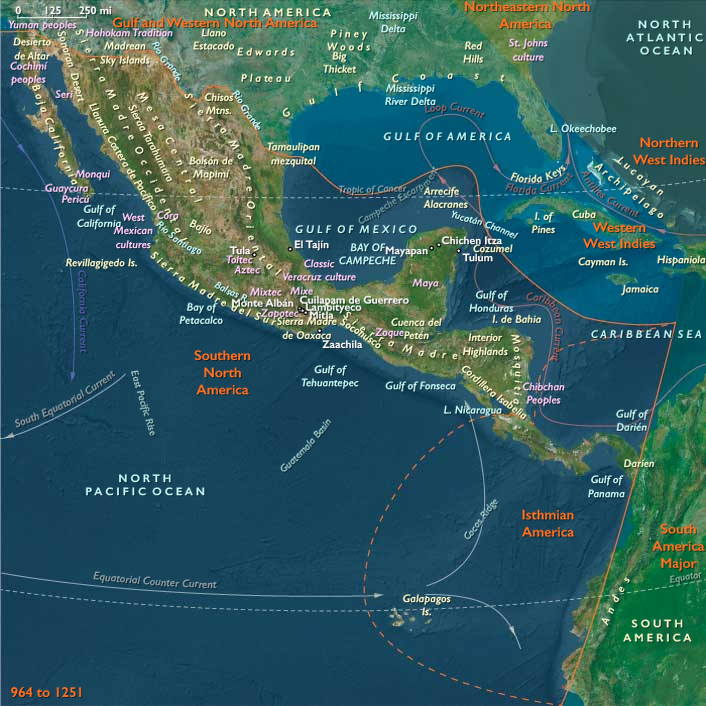
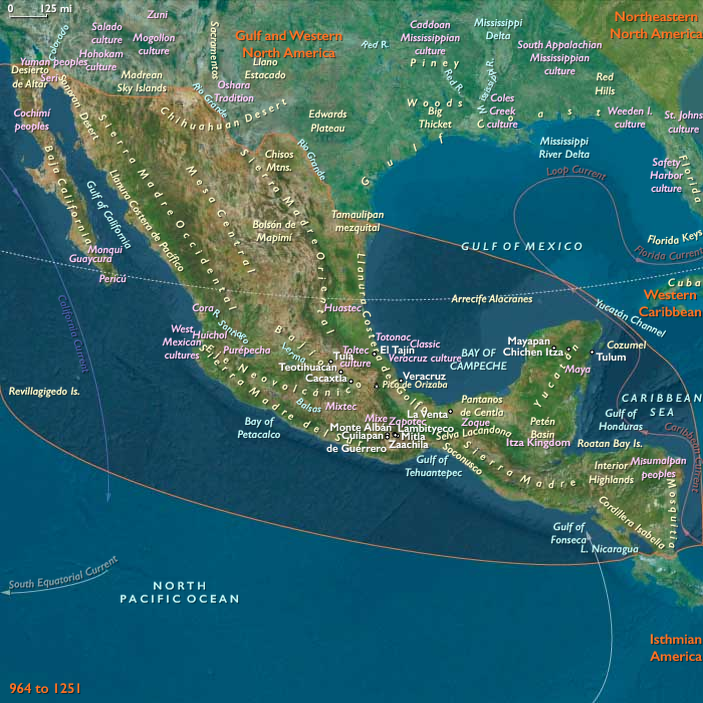
Middle America spanned the volcanic highlands of Mexico and Central America, the tropical lowlands of the Caribbean and Pacific coasts, and the narrow Isthmian bridge of Panama and Costa Rica.
-
Northern sphere: the Valley of Mexico, Oaxaca, and Yucatán, where temple–plaza cities presided over irrigated and terraced landscapes.
-
Southern sphere: the isthmus of Panama–Costa Rica and the Darién forests, bridging the Andes and the Mesoamerican world.
-
Maritime sphere: the Caribbean and Pacific coasts, where canoe fleets navigated cacao estuaries and jade-bearing rivers.
This geography formed a continental hinge — a bridge of volcanoes, rainforests, and reefs uniting both hemispheres.
Climate and Environmental Shifts
The Medieval Warm Period brought alternating intervals of warmth and dryness.
-
Yucatán drought cycles spurred population shifts from inland cities to cenote-linked settlements and coastal markets.
-
Guatemalan and Oaxacan highlands maintained stability through terracing and canal irrigation.
-
Isthmian tropics remained humid, sustaining cacao and forest cultivation, while the Pacific slopes enjoyed reliable dry seasons for maize.
Environmental variation encouraged regional specialization and intensified trade between highland farmers, lowland horticulturalists, and maritime traders.
Societies and Political Developments
The Isthmian Chiefdoms:
In Costa Rica and Panama, hereditary caciques ruled multi-village chiefdoms from plaza centers with mounds, ballcourts, and ceremonial goldworks.
Power rested on control of goldworking, cacao estates, and portage routes between the Caribbean and the Pacific.
The Cueva chiefdoms of Darién connected the isthmus with northern Colombia, while Ecuador’s coastal polities shared in maritime trade networks.
These societies represented the southern threshold of Mesoamerican influence and the northern reach of Andean metallurgy.
The Highland States of Mexico and Guatemala:
Across the Valley of Mexico, city-states (altepetl)—Azcapotzalco, Texcoco, Culhuacan—vied for supremacy.
The Mexica, newly arrived migrants, served as mercenaries under the Tepanec lords, awaiting the foundation of their own capital.
In Michoacán, Tarascan elites consolidated, advancing copper metallurgy and developing a unique state structure distinct from the Aztec pattern.
In Oaxaca, Mixtec and Zapotec dynasties ruled Mitla and Tututepec through elaborate marriage alliances and codified genealogy, their painted manuscripts chronicling divine ancestry.
The Maya Realms:
The Mayapán League emerged in northern Yucatán after the decline of Chichén Itzá (~1200), centralizing tribute and diplomacy through shared temples and merchant guilds.
In the Guatemalan Highlands, the K’iche’ and Kaqchikel formed fortified hilltop capitals, uniting clans under sacred lineages later immortalized in the Popol Vuh.
The southern Pacific slope (Soconusco to El Salvador) prospered as a cacao-exporting corridor linking Maya and central Mexican trade.
Economy and Trade
Agriculture and Artisanship:
-
Maize, beans, and squash formed the subsistence triad from Mexico to Panama.
-
Cacao, cotton, and manioc supported lowland wealth and luxury economies.
-
Copper and gold metallurgy flourished in Michoacán and the Isthmus.
-
Terraced and raised fields intensified production in volcanic valleys.
Trade Networks:
-
Two-ocean portages across Panama and Costa Rica funneled gold, jade, Spondylus shell, and cacao between the Caribbean and Pacific.
-
Canoe fleets linked Nicaragua and Honduras with Colombia and Ecuador.
-
Overland corridors connected Oaxaca and Michoacán to Gulf and Pacific coasts.
-
Maritime Yucatán–Belize–Honduras route carried obsidian, cotton mantles, and copper bells to Maya and highland markets.
Trade served not merely economic but ritual ends—each transaction an offering in the maintenance of cosmic balance.
Belief and Symbolism
Ritual Power and the Sacred Cosmos:
Across Middle America, rulers were divine intermediaries between celestial and underworld forces.
-
Feathered Serpent cults expressed renewal and cosmic movement.
-
Ballcourts symbolized the struggle of life and death, the sun’s passage through the underworld.
-
Maya temples and Zapotec tombs embodied mountain–cave cosmology, centers of fertility and ancestry.
-
Isthmian metallurgy reflected the transformation of matter into spirit—gold as sunlight, jade as breath, Spondylus shell as blood.
Astral and Codical Knowledge:
Postclassic scholars maintained Venus calendars, eclipse tables, and ritual almanacs, merging timekeeping with prophecy.
Deities of war, rain, and maize governed the agricultural and political cycles alike.
Subsistence and Technology
-
Terraces and irrigation canals in highland valleys sustained maize and beans.
-
Raised fields and chinampas enhanced lowland and lake agriculture.
-
Dugout canoes and balsa rafts enabled long-distance maritime trade.
-
Lost-wax casting in the isthmus and hammered sheet-gold ornaments adorned elites.
-
Codex painting, stucco relief, and obsidian blade production reflected unmatched artistic precision.
Innovation was continuous and integrated—hydraulic, metallurgical, and aesthetic.
Movement and Interaction Corridors
-
Isthmian portages: Caribbean ⇄ Pacific gold and jade transfer, precursor to later canals.
-
Mesoamerican interior roads: Valley of Mexico ⇄ Oaxaca ⇄ Soconusco ⇄ Nicaragua.
-
Coastal canoe highways: Yucatán ⇄ Belize ⇄ Honduras ⇄ Darién ⇄ Ecuador.
-
Lake basins: Michoacán’s waterways and Yucatán’s cenote routes facilitated inland transport.
Together, these corridors linked metallurgy and cacao to the broader hemispheric economy, forming a vibrant chain between Andes, Amazon, and the Caribbean.
Adaptation and Resilience
-
Multicore political systems—Mayapán, Oaxaca, Michoacán, Isthmus—ensured regional balance against collapse.
-
Diversified economies (highland maize, coastal cacao, isthmian gold) buffered local shocks.
-
Maritime redundancy through dual ocean access kept trade resilient.
-
Religious diplomacy—shared deities and ballcourt rituals—mitigated war and stabilized alliances.
Resilience here lay in complexity: a system of redundancy, ritual integration, and inter-oceanic flow.
Long-Term Significance
By 1251 CE, Middle America stood at its Postclassic apogee:
-
Mayapán dominated Yucatán’s tribute and trade.
-
Mixtec–Zapotec dynasties perfected codical history and sacred kingship.
-
Tarascan metallurgy and Mexica migration prepared the stage for future empires.
-
Isthmian chiefdoms transformed gold and jade into instruments of divine authority.
-
Pan-American trade routes bound the Caribbean, Pacific, and Andes in a continuous chain of exchange.
This was a world of gold and jade, maize and cacao—a world that fused technology and theology, making Middle America the hemispheric fulcrum of the late pre-Columbian age.
Images

Isthmian America (with civilization) ©2024-25 Electric Prism, Inc. All rights reserved.
Commodities
Subjects
Regions