
Louis XVI declares to the National Assembly…
February 1790 CE
Louis XVI declares to the National Assembly on February 4 that he will maintain the constitutional laws.
Factions in France within the Assembly begin to clarify.
The opposition to revolution sits on the right-hand side of the Assembly.
The "Royalist democrats" or monarchiens incline toward organizing France along lines similar to the British constitutional model.
The "National Party", representing the center or center-left of the assembly represents somewhat more extreme views.
The increasingly middle-class National Guard under Lafayette also slowly emerges as a power in its own right.
Locations
Topics
Regions
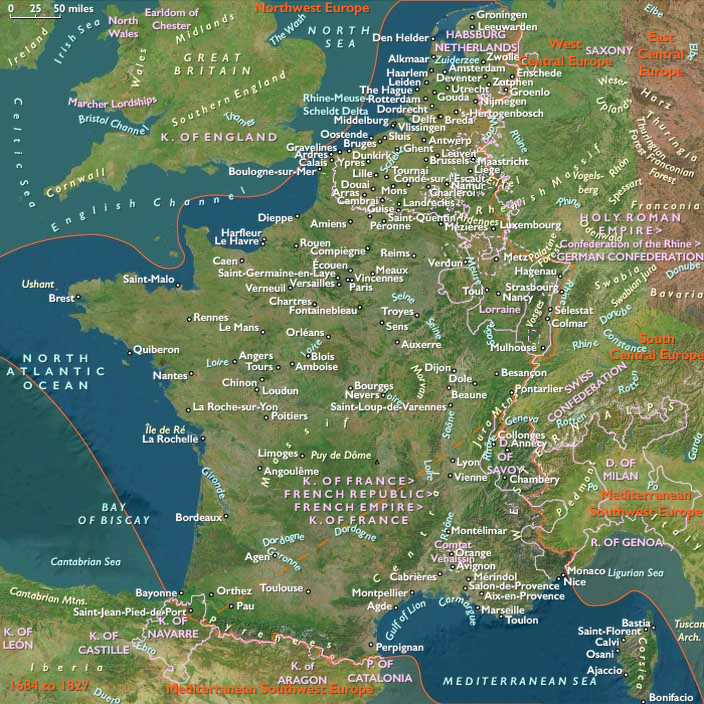
West Europe
View →Subregions
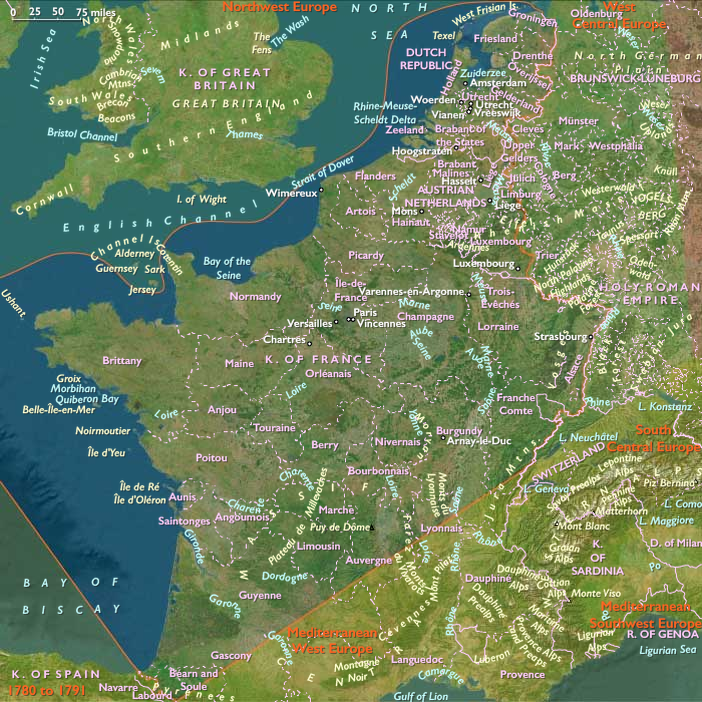
Atlantic West Europe
View →Related Events
Showing 10 events out of 19 total
The Netherlands had been annexed to the French Empire by Napoleon in 1810, but now city after city has been evacuated by the French occupation troops.
In the ensuing power vacuum a number of former Orangist politicians and former Patriots form a provisional government in November 1813.
It is headed by a triumvirate of three Dutch noblemen, Frans Adam van der Duyn van Maasdam, Leopold of Limburg Stirum and Gijsbert Karel van Hogendorp.
This Driemanschap formally takes control over the liberated country on November 20 and declares the Principality of the United Netherlands a day thereafter.
It is taken for granted that any new regime will have to be headed by William Frederick, the son of the last Stadtholder of the Dutch Republic, William V.
Although many members of the provisional government had helped drive out William V eighteen years earlier, most of its leading members agree that it will be better for the Dutch to invite William Frederick themselves rather than have him imposed by the Allies.
William Frederick accepts sovereignty over the principality on December 2, proclaiming himself "Sovereign Prince" of the United Netherlands.
William Frederick, Prince of Orange, feeling threatened by Napoleon, who has escaped from Elba, proclaims the Netherlands a kingdom on March 16, 1815, at the urging of the powers gathered at the Congress of Vienna.
The Congress of Vienna form,ally confirms as hereditary ruler of what is known as the United Kingdom of the Netherlands, created through a fusion of territories that had belonged to the former Dutch Republic, Austrian Netherlands, and Prince-Bishopric of Liège.
His son, the future king William II, will fight as a commander at the Battle of Waterloo.
After Napoleon has been sent into exile, William will adopt a new constitution that includes many features of the old constitution, such as extensive royal powers.
The Post-Napoleonic Order – The Congress of Vienna (1815) and the Rise of the Holy Alliance
Following Napoleon’s defeat, the Congress of Vienna (1815) aimed to restore Europe’s monarchies, reestablish national borders, and prevent future revolutionary upheaval. While France, Britain, Portugal, and Spain retained their pre-Revolutionary boundaries, new states emerged, and a reactionary alliance sought to crush liberalism across Europe.
Territorial Adjustments and the Kingdom of the Netherlands
- France reverted to its pre-1789 borders, undoing Napoleon’s territorial expansions but keeping its core territories intact.
- Great Britain emerged as the world’s dominant global power, expanding its colonial influence while maintaining its maritime supremacy.
- Portugal and Spain retained their traditional Iberian boundaries, though Spain remained weakened by the Peninsular War.
- The Netherlands was reconfigured:
- The formerly Spanish, later Austrian Netherlands (modern Belgium) merged with the Dutch Republic (United Provinces).
- This formed the Kingdom of the Netherlands, ruled by William I of Orange-Nassau, intended to serve as a buffer state against future French aggression.
The Holy Alliance – A Reactionary Coalition Against Liberalism
-
The Holy Alliance, formed in 1815, included:
- Austria (Habsburg Empire)
- Russia (Tsarist Empire)
- Prussia
- Spain
- The Pope (representing the Papal States and the Catholic Church’s interests)
-
The alliance aimed to suppress revolutionary movements, democracy, and individual rights, reinforcing absolute monarchies and religious conservatism across Europe.
Britain’s Refusal to Join – A Strategic Move
- Britain refused to join the Holy Alliance, seeing it as a reactionary force that threatened its global influence.
- The British had used liberalism as a tool against their rivals, particularly against:
- The Vatican’s Catholic Church, which Britain saw as an opponent to Protestant and constitutional governance.
- The Russian Orthodox Church and Tsarist autocracy, which Britain viewed as a rival in Eastern Europe and Asia.
- Instead of joining conservative monarchies, Britain pursued a policy of controlled liberalism, using constitutional monarchy and economic expansion to further its global dominance.
Conclusion – The Post-Napoleonic World Order
- Britain emerged as the supreme global power, using trade, naval dominance, and controlled liberalism as strategic tools.
- The Holy Alliance sought to restore absolute monarchy and religious authority, but its repression would spark new revolutionary movements in the coming decades.
- The Congress of Vienna restored the balance of power, but the ideological struggle between reactionary forces and liberal movements would define 19th-century Europe, leading to future conflicts, including the Revolutions of 1848.
The post-Napoleonic world was one of monarchical restoration, political repression, and imperial expansion, yet the seeds of liberal and national revolutions had already been planted, ensuring that the struggles unleashed by the French Revolution were far from over.
Atlantic West Europe (1816–1827): Restoration, Economic Recovery, and the Rise of Liberalism
From 1816 to 1827, Atlantic West Europe—covering northern France, the Low Countries (modern Belgium, the Netherlands, and Luxembourg), and regions along the Atlantic and English Channel coasts—underwent a period of political restoration, economic reconstruction, and burgeoning liberal and nationalist sentiments following the upheaval of the Napoleonic Wars. This era saw conservative attempts to re-establish traditional monarchies and social orders clashing increasingly with rising demands for constitutional reform, economic liberalization, and national self-determination.
Political and Military Developments
Post-Napoleonic Restoration (1815–1818)
-
Following Napoleon’s defeat at Waterloo (1815), the Congress of Vienna (1814–1815) reshaped Europe, emphasizing balance of power and legitimacy, leading to the re-establishment of Bourbon monarchy in France under Louis XVIII (r. 1814–1824).
-
The Low Countries were united into the newly formed United Kingdom of the Netherlands under King William I (r. 1815–1840), intended as a buffer state against French aggression. Belgium, dominated by Catholic, French-speaking elites, was merged uneasily with Protestant, Dutch-speaking northern provinces.
French Monarchical Consolidation and Challenges
-
Louis XVIII established a constitutional monarchy with the Charter of 1814, providing limited parliamentary governance while preserving royal authority. His reign saw efforts to balance conservative royalists and liberal factions.
-
After Louis XVIII’s death in 1824, Charles X (r. 1824–1830) attempted stronger conservative restoration, antagonizing liberals through press restrictions and increased clerical influence, laying foundations for future conflicts.
Growing National and Political Tensions in the Netherlands
-
Belgium’s forced union with the Netherlands created political, religious, and cultural friction, as southern (Belgian) provinces increasingly resented Dutch political dominance and Protestant policies. Initial liberal resistance emerged strongly in Brussels and other Belgian cities by the late 1820s, foreshadowing eventual revolution (1830).
Economic Developments: Recovery and Early Industrialization
Post-War Economic Recovery
-
Following severe wartime economic disruptions, Atlantic West Europe experienced gradual economic recovery, aided by peace, agricultural revival, and renewed commercial activity through ports such as Antwerp, Rotterdam, Nantes, and Bordeaux.
-
Infrastructure restoration became essential, notably improving canal and road networks to facilitate regional and international trade, stimulating commerce and urban revival.
Early Industrial Growth
-
Northern France, particularly Lille, Rouen, and areas around the Loire and Seine valleys, saw early industrial growth in textiles, coal mining, and iron production. This marked the beginning of significant industrialization that later accelerated mid-century.
-
In the Low Countries, Belgium’s industrialization rapidly expanded, notably around Liège and Ghent, focused on textiles, iron, and machinery, setting the stage for Belgium’s prominent industrial role in continental Europe.
Maritime Commerce and Atlantic Trade
-
Atlantic and Channel ports regained importance, notably Bordeaux’s wine exports, Antwerp’s re-established trade networks, and Amsterdam’s revival as a financial and mercantile hub. These developments significantly boosted regional prosperity.
Social and Cultural Developments
Liberalism and Nationalism
-
Intellectual and political liberalism gained strength, influenced by Enlightenment ideas, emphasizing constitutional government, civic freedoms, press liberties, and parliamentary representation. These ideals gained support in urban centers across northern France and Belgium.
-
Nationalist sentiment grew, especially in Belgium, where distinct cultural identity strengthened opposition to Dutch rule. Increasingly vocal demands for political autonomy and cultural recognition became prominent.
Urban Revival and Social Change
-
Urban centers, particularly Paris, Brussels, Antwerp, and Amsterdam, experienced rapid growth, driven by industrialization and trade. A dynamic urban middle class emerged, advocating for economic liberalization and political reforms.
-
Improved educational institutions and expanding literacy facilitated greater political consciousness among urban populations, laying the groundwork for future political activism and cultural vibrancy.
Intellectual and Religious Developments
Revival of Catholic Influence
-
Post-Napoleonic restorations revived Catholic institutional strength, particularly evident in Belgium and northern France, influencing social policies, education, and cultural life. This resurgence sometimes fueled conflicts between liberal secularists and conservative Catholics.
-
Belgium became a key center of Catholic cultural revival, reflecting broader European patterns of post-revolutionary religious revival.
Liberal Intellectual Movements
-
Liberal intellectual circles in Brussels, Ghent, Paris, and Amsterdam advocated constitutional reform, freedom of expression, and economic liberalization, influencing public debates and setting the stage for political changes in subsequent decades.
-
Prominent figures such as François Guizot in France began formulating doctrines combining conservative order with liberal governance principles, significantly shaping political thought in France and beyond.
Legacy and Historical Significance
The era 1816–1827 represented a crucial transitional phase for Atlantic West Europe, bridging the turbulent Napoleonic era and the subsequent revolutionary period:
-
Politically, it established fragile restorations of conservative monarchies, which encountered mounting challenges from liberal and nationalist forces.
-
Economically, it marked initial recovery and significant early industrialization, laying essential foundations for future economic transformation and prosperity.
-
Socially and culturally, rising liberalism and nationalism increasingly shaped political identities, influencing societal values, political organization, and intellectual debates.
Ultimately, this period set the stage for major revolutionary and constitutional upheavals, notably Belgium’s independence (1830) and France’s July Revolution (1830), critically defining the region’s path toward modern nation-states, constitutional governance, and industrial economies.
William I became king and also became the hereditary Grand Duke of Luxembourg, that was part of the Netherlands but at the same time part of the German Confederation.
The newly created country has two capitals: Amsterdam and Brussels.
The new nation has two equal parts.
The north (Netherlands proper) has two million people, speaking chiefly Dutch but divided religiously between a Protestant majority and a large Catholic minority.
The south (which will be known as "Belgium" after 1830) has a population of three point four million people.
Nearly all are Catholic, but the region is divided between French-speaking Walloons and Dutch-speaking Flemings.
The upper and middle classes in the south are mostly French-speaking.
About sixty thousand Belgians are eligible to vote, compared to about eighty thousand Dutch people.
Officially Amsterdam is the capital, but in a compromise the government meets alternately in Brussels and The Hague.
An enlightened despot, he accepts the modernizing transformations of the previous twenty-five years, including equality of all before the law.
However, he resurrects the estates as a political class and elevates a large number of people to the nobility.
Voting rights are still limited, and only the nobility are eligible for seats in the upper house.
The old provinces are reestablished in name only.
The government is now fundamentally unitary, and all authority flows from the center.
William I is a Calvinist and unsympathetic to the religious culture and practices of the Catholic majority.
He promulgates the "Fundamental Law of Holland", with some modifications.
This entirely overthrows the old order of things in the southern Netherlands: it abolishes the privileges of the Catholic Church, and guarantees equal protection to every religious creed and the enjoyment of the same civil and political rights to every subject of the king.
It reflects the spirit of the French Revolution and in so doing does not please the Catholic bishops in the south, who had detested the Revolution.
William I actively promotes economic modernization.
The first fifteen years of the Kingdom show progress and prosperity, as industrialization proceed rapidly in the south, where the Industrial Revolution allows entrepreneurs and labor to combine in a new textile industry, powered by local coal mines.
There is little industry in the northern provinces, but most overseas colonies are restored, and highly profitable trade resumes after a twenty-five-year hiatus.
Economic liberalism combines with moderate monarchical authoritarianism to accelerate the adaptation of the Netherlands to the new conditions of the nineteenth century.
The country will prospers until a crisis arises in relations with the southern provinces.
Atlantic West Europe (1828–1839): Liberal Revolutions, Nationalism, and Early Industrial Expansion
From 1828 to 1839, Atlantic West Europe—encompassing northern France, the Low Countries (Belgium, Netherlands, Luxembourg), and coastal areas along the Atlantic and English Channel—entered an era of profound political upheaval, early industrial acceleration, and rising nationalism. This period was defined by liberal challenges to conservative rule, industrial transformations reshaping economies and societies, and national movements significantly altering political boundaries and regional identities.
Political and Military Developments
The Belgian Revolution and Independence (1830–1839)
-
Belgium erupted in revolution against Dutch rule in 1830, driven by liberal demands for constitutional governance and resistance to Dutch linguistic and religious dominance.
-
Initial revolts in Brussels rapidly expanded, leading to a provisional government, independence declaration, and the adoption of a liberal constitution in 1831, establishing Belgium as a parliamentary monarchy under King Leopold I.
-
Belgium’s independence was formally recognized by the Treaty of London (1839), confirming its neutrality and reshaping Atlantic West Europe’s political map.
July Revolution in France (1830)
-
In France, the July Revolution (1830) dramatically transformed politics by overthrowing the conservative Bourbon King Charles X and installing the more liberal Louis-Philippe, the "Citizen King."
-
This shift solidified the influence of the middle class, strengthening constitutional monarchy and liberal policies, yet fell short of radical republican aspirations, laying foundations for future political conflicts.
Stability and Constitutional Reform in the Netherlands and Luxembourg
-
The Netherlands, having lost Belgium, consolidated politically under King William I, though the loss profoundly altered its national identity and reduced its economic and strategic influence.
-
Luxembourg emerged in 1839 as a distinct state (Grand Duchy), maintaining a complex relationship of autonomy under Dutch sovereignty while also part of the German Confederation, symbolizing the region's complex nationalist and political dynamics.
Economic and Social Developments
Early Industrial Revolution
-
Belgium emerged as an industrial pioneer in continental Europe, notably in textiles, coal mining, and metallurgy. Regions around Liège, Ghent, and Charleroi saw rapid industrial growth driven by British technology transfers and local innovation.
-
Northern France, particularly around Lille, Roubaix, and Tourcoing, experienced rapid industrial expansion in textiles and coal mining, accelerating urbanization and fostering a significant working-class presence.
Expansion of Transport Infrastructure
-
Infrastructure improvements, notably railways, roads, and canals, accelerated dramatically. Belgium inaugurated its first steam-powered railway between Brussels and Mechelen in 1835, significantly enhancing economic integration and mobility.
-
France also invested heavily in transportation infrastructure, notably railways connecting industrial centers, facilitating raw material transport, industrial production, and commercial trade.
Cultural and Intellectual Developments
Romantic Nationalism and Literary Expression
-
Romanticism flourished, expressing nationalist and liberal ideals in literature, poetry, art, and music. Victor Hugo, prominent during this period, reflected these revolutionary and nationalist ideals in his work, especially in "Les Misérables" (though published later, his literary prominence began in this era).
-
Flemish and Walloon cultural identities gained momentum through literature and arts, reinforcing emerging Belgian nationalism distinct from Dutch identity.
Education and Secularization Reforms
-
Educational reforms expanded literacy and secular instruction, especially in Belgium and France, emphasizing civic values and national identity. The rise of secular, state-run schools reduced church influence, reflecting liberal ideals.
Religious Developments
Religious Divides and Secularization
-
Catholicism maintained a strong social and cultural influence, especially in Belgium and northern France, though increasingly challenged by liberal secular reforms promoting separation of church and state.
-
Protestantism in the Netherlands continued fostering liberal and intellectual traditions, reinforcing its cultural divergence from predominantly Catholic Belgium.
Social and Urban Dynamics
Rapid Urbanization and Social Changes
-
Industrial growth significantly transformed urban landscapes, with cities like Lille, Brussels, Liège, Ghent, and Antwerp experiencing rapid demographic expansion, creating new urban social dynamics, including influential working-class and bourgeois communities.
-
Social tensions rose due to industrialization-related issues such as labor conditions, urban overcrowding, poverty, and class divisions, foreshadowing future social conflicts and demands for reform.
Long-Term Consequences and Historical Significance
The years 1828–1839 set the stage for profound transformations in Atlantic West Europe:
-
Politically, the liberal revolutions established constitutional governance, notably Belgium’s successful independence and France’s transition to constitutional monarchy, fundamentally reshaping national identities.
-
Economically, early industrialization significantly boosted regional prosperity and integration, positioning the region as a continental industrial powerhouse.
-
Culturally and intellectually, the period reinforced Romantic nationalism, fueling future nationalist movements, artistic innovations, and socio-political activism.
-
Socially, industrialization and urbanization triggered critical socio-economic challenges, laying foundations for labor movements, social reforms, and the emerging class politics that would define subsequent decades.
By 1839, Atlantic West Europe stood at the forefront of continental transformation, firmly on a trajectory toward political modernity, industrial prominence, and intense national consciousness, significantly shaping Europe's broader historical evolution.
The Netherlands have always been part of the precarious balance of power that has kept France in check.
The Russian tsar in particular had wanted the Netherlands to resume this role after the defeat of Napoleon in 1815 and had wanted the colonies to be returned.
In a secret protocol, known as the Eight Articles of London, a compromise had been struck with the United Kingdom before the Congress of Vienna, whereby only the Dutch East Indies were returned, and the Congress had created a kingdom for the House of Orange-Nassau in order to create a strong buffer state north of France.
The Kingdom of the United Netherlands combines, for the first time as a united sovereign state, the United Provinces of the Netherlands with the former Austrian Netherlands, with two capitals: Amsterdam and Brussels.
The son of the last stadtholder, William V, the Prince of Orange, had become King William I as well as hereditary Grand Duke of Luxembourg.
Catholic partisans have watched with excitement the unfolding of the July Revolution in France, details of which have been swiftly reported in the newspapers.
Daniel Auber’s La Muette de Portici, a sentimental and patriotic opera suited to fire National Romanticism, set as it is against Masaniello's uprising against the Spanish masters of Naples in the seventeenth century, has rapidly become a European favorite, its overture, arias, and choruses heard everywhere.
The duet Amour sacré de la patrie is welcomed like a new Marseillaise; the Brussels premiere on August 25, 1830, engenders a riot that becomes the spark for the Belgian Revolution.
The crowd pours into the streets after the performance, shouting patriotic slogans, and swiftly takes possession of government buildings.
The ensuing days will see an explosion of the desperate and exasperated proletariat of Brussels.