
Macartney and Dundas, even before the former's…
September 1793 CE
Dundas had instructed Macartney to accept "all ceremonials of the Court which may not commit the honour of your Sovereign or lessen your own dignity", and not to let any "trifling punctilio" get in the way of the mission.
The ritual of the kowtow, which requires an individual to kneel with both knees on the ground and bow so as to touch their forehead to the ground, presents a particular dilemma.
The kowtow is required not only when meeting the emperor, but also when receiving imperial edicts from his messengers.
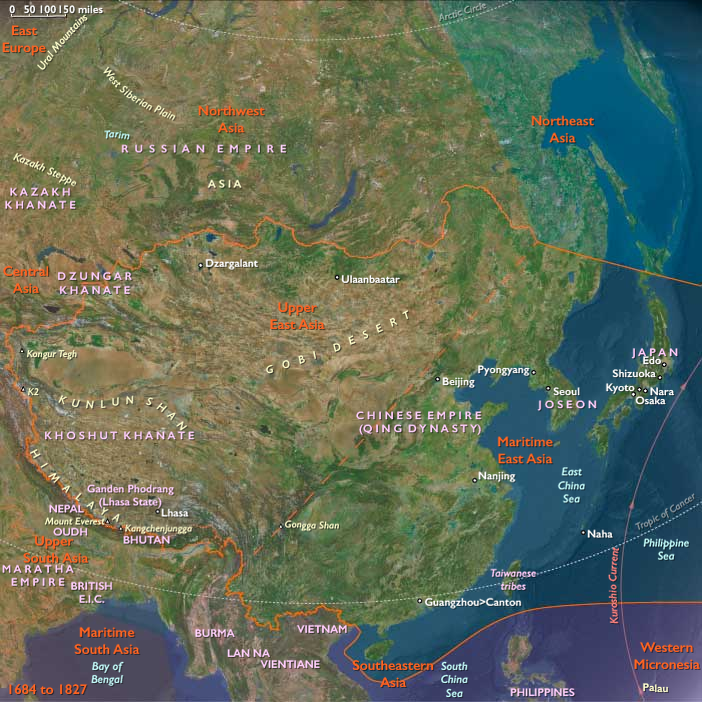
While Portuguese and Dutch merchants in Canton (now Guangzhou) had acquiesced to the ritual, British subjects, who regard the act as slavish and humiliating, generally avoid kowtowing to the emperor's edicts by leaving the room when such messages are received.
For Macartney, one sticking point is the relative status of the two sovereigns, George III and Qianlong.
Macartney believes that Britain is now the most powerful nation on Earth.
However, as a diplomat, he has decided that whatever ceremony he participates in must present the two monarchs as equals.
Throughout his meetings with Chinese officials, Macartney has been repeatedly urged to perform the kowtow during his audience with the emperor.
In one message to legate Zhengrui and viceroy Liang Kentang during Macartney's stay in Tianjin, Heshen had instructed the two men to inform Britain's representative that he will be regarded as a "boor" and a "laughingstock" if he does not perform the ritual when the time came.
Nevertheless, Macartney submits to Zhengrui a written proposal that will satisfy his requirement of equal status: whatever ceremony he performs, a Chinese official of equal rank will do the same before a portrait of George III.
Zhengrui objects to this proposal, on the grounds that this notion of reciprocal equality is incompatible with the Chinese view of the emperor as the Son of Heaven, who has no equal.
According to such a view, the British embassy is regarded officially as a tribute mission like any other.
Despite Macartney and Staunton's insistence that the items the embassy have brought are "gifts", Chinese officials see them as "tribute" items.
Macartney himself is to be seen as only a "conveyor of tribute", not a "legate of the sovereign" as he had earlier referred to himself, to the annoyance of the emperor.
Qianlong's compromise on the issue, stated in an edict dated September 8 (the day of the embassy's arrival in Chengde), is that Macartney can perform a single prostration in lieu of the nine typically called for.
However, Staunton submits Macartney's proposal to Heshen the day after their arrival, reiterating the British stance on the issue.
With no agreement in sight and the ceremony only days away, Qianlong grows increasingly impatient, and considers scrapping the meeting altogether.
Finally, it is agreed that Macartney will genuflect before the emperor as he would before his own sovereign, touching one knee to the ground, although without the usual hand kissing, as it is not customary for anyone to kiss the emperor's hand.
People
George Macartney, 1st Earl Macartney
View →
Henry Dundas, 1st Viscount Melville
View →
James Dinwiddie
View →
John Barrow, 1st Baronet
View →
Joseph Banks
View →
Qianlong Emperor
View →
Sir George Leonard Staunton
View →
Sir George Staunton, 2nd Baronet
View →
Thomas Hickey
View →
William Alexander
View →
William Grenville, 1st Baron Grenville
View →
William Pitt the Younger
View →
Groups
Topics
Subjects
Regions
East Asia
View →Subregions
