
Italian monk and legal scholar Gratian, who…
1143 CE
Italian monk and legal scholar Gratian, who teaches at the Camaldolese monastery in Bologna, produces, in 1140, the Concordia discordantium canonum, commonly known as the Decretum Gratiani (“Gratian's Decretals”), a collection of all previous canon law.
In the Decretum, Gratian attempts to analyze conflicting authorities and arrive at some specific conclusion in the case of each question at issue.
Gratian, whose collection soon becomes standard, serves a consultant to a papal judge in 1143.
Locations
Groups
Regions
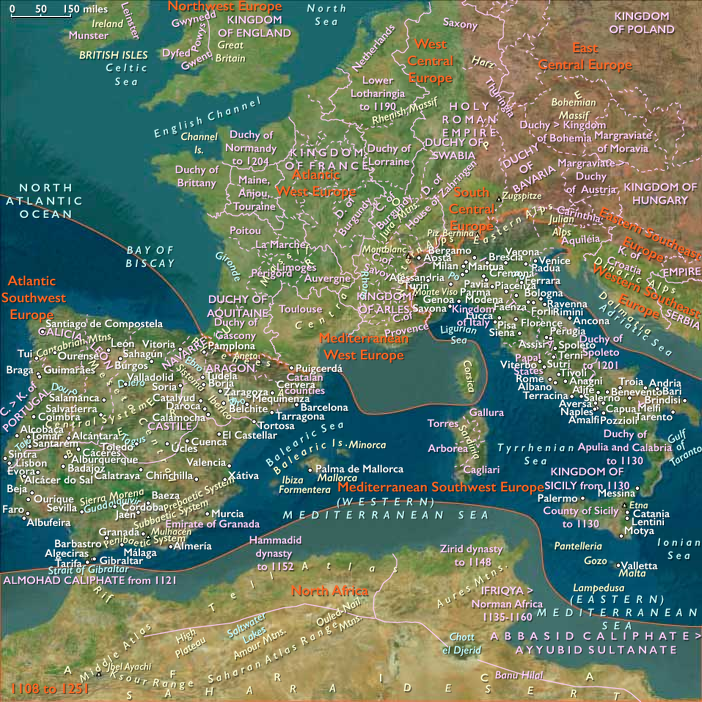
Southwest Europe
View →Subregions

Mediterranean Southwest Europe
View →Related Events
No active filters.
Showing 10 events out of 48926 total
Olaf Haraldsen is at last defeated by Eric III and around 1143 is killed in a battle in Middle Scania.
Albert, although embroiled in rivalry with the Welf dukes of Saxony, has campaigned successfully against the Slavic Wends to emerge as one of the leaders of the twelfth century German conquests in eastern Europe.
The exploration of the uncharted eastern parts of Germany begins, and results in the founding of cities such as Lübeck.
Rukn al-Dīn Mas'ud, Sultan of Rüm from 1116, has continued to hold back Constantinople while patiently expanding his territories at the expense of his crusader, Danishmendid, and other Muslim neighbors.
When the Danishmendids break into warring factions after 1142, Rukn ad-Din Mas'ud begins to absorb their holdings in east-central Anatolia and begins the real development of Konya as a capital city.
While Fulk and Melisánde are on holiday in Acre, the king’s horse stumbles and falls, and the saddle crushes Fulk's skull.
He is carried back to Acre where he dies on November 13, 1143, and is buried in the Church of the Holy Sepulchre.
Though her marriage had begun in conflict, Melisánde mourns for Fulk privately as well as publicly.
He is survived by Geoffrey of Anjou, the issue of his first wife Matilda of England, and by Baldwin and Amalric, his sons by Melisánde.
Herman of Carinthia translates Claudius Ptolemy's significant work, Planisphaerium, producing it in Toulouse in 1143 from an Arabic translation from the Greek (jointly with commentaries of Maslamah Ibn Ahmad al-Majriti, who worked in Córdoba in the tenth century).
Western European scholastics became aware of Ptolemy's astronomical views via this translation dedicated to Thierry of Chartres. (This translation will for a long time be believed to be the only surviving link to Ptolemy's original. Later, another Arabic translation will be found to have been preserved in Istanbul).
Herman also translates Ptolemy's Canon (Canon of Kings).
For a long time, many will think that Ptolemy had been translated by the German Herman Contractus and not by Herman of Carinthia.
Herman’s original contribution to philosophy is De essentiis ("On essences").
In this work Herman deals with five Aristotelian categories (causa, motus, spatium, tempus, habitudo).
He starts to write this treatise in 1143 in Toulouse and he completes it the same year in Béziers.
Alphonse, whose wife Faydid of Uzes had either recently died or been repudiated, had sought to marry the now-adolescent Ermengardein 1142.
In reaction to this prospect, which would overturn the balance of power in the region by adding Narbonne to the direct control of Toulouse, a coalition of Occitan lords led by Roger II of Béziers, viscount of Carcassonne, Béziers, Albi and Razès, has formed an alliance against Toulouse.
In 1143, Ermengarde is married to a vassal of Roger II, Bernard of Anduze.
Alphonse is defeated by the coalition and taken prisoner, and is forced to make peace with Narbonne and restore Ermengarde and her new husband to the viscounty before being released.
Guido di Castello, possibly the son of a local noble, Niccolo di Castello, was born either in Città di Castello, situated in Paterna Santa Felicità upon the Apennines, or at Macerata in the March of Ancona.
Guido had studied under Pierre Abélard, and eventually became a distinguished master in the schools.
Eventually, Guido began his career in Rome as a subdeacon and a scriptor apostolicus under Pope Callixtus II.
He was created Cardinal-Deacon of Santa Maria in Via Lata by Pope Honorius II in 1127; as such, he signed the papal bulls issued between April 3, 1130 and December 21, 1133.
In the double papal election of 1130, he joined the obedience of Pope Innocent II.
In December 1133, Innocent promoted him to the rank of Cardinal-Priest of San Marco.
He signed the papal bulls as S.R.E.
indignus sacerdos between January 111, 134 and May 16, 1143.
As the cardinal of San Marco’s, he supported Innocent’s claims with regards to Monte Cassino, and as a mark of his confidence in him, Innocent made Guido the rector of Benevento.
Afterwards, he made him a papal legate to France in 1140.
He participates in the papal election of 1143, the first undisturbed papal election that Rome has seen for eighty-two years, and is elected pope two days after the death of Innocent II, on September 25, 1143, taking the name of Celestine.
Celestine II will govern the Church for only five months and thirteen days from his election until his death on March 8, 1144.
Upon his accession he writes to Peter the Venerable and the monks of Cluny, asking them to pray for him, while he is congratulated by Arnulf of Lisieux.
Regardless of the brevity of his reign, he is prepared to chart a very different course from that of his predecessor.
He is opposed to Innocent II’s concessions to King Roger II of Sicily and is in favor of the House of Plantagenet’s claim to the English throne, thus opposed to King Stephen of England.
To emphasize this shift, he refuses to renew the legatine authority that Innocent II had granted to King Stephen’s brother, Henry of Blois.
Celestine also favors the Templars, ordering a general collection for them, as well as the Hospitallers, giving them control of the hospital of Saint Mary Teutonicorum in Jerusalem.
Robert of Ketton receives support from the Church—he becomes Archdeacon of Pamplona in 1143—but his preference is for translating scientific rather than theological works.
He is known to have studied Euclid and to have translated the work of Al Battani and Avicenna, and it seems that he would not have made the translation for which he is famous, that of the Qur'an, without the encouragement of the French Abbot Peter the Venerable, who wished to have access to Islamic texts.
Robert and other scholars had met in 1142 with Peter the Venerable, who was visiting Spain, and Robert set to work translating the Qur'an into Latin.
The translation is done by 1143; entitled Lex Mahumet pseudoprophete, it is the first translation of the book into a European language and will remain the standard well into the sixteenth century.
The translation is not viewed by modern scholars as having been faithful, but rather includes some passages with distortions or exaggerations of the original Arabic.
Aragon expands its frontier at the expense of the Almoravids, then incorporates the Counties of Barcelona and Provence in 1140.