Italian Renaissance painter Giovanni Battista Cima, commonly…
1507 CE
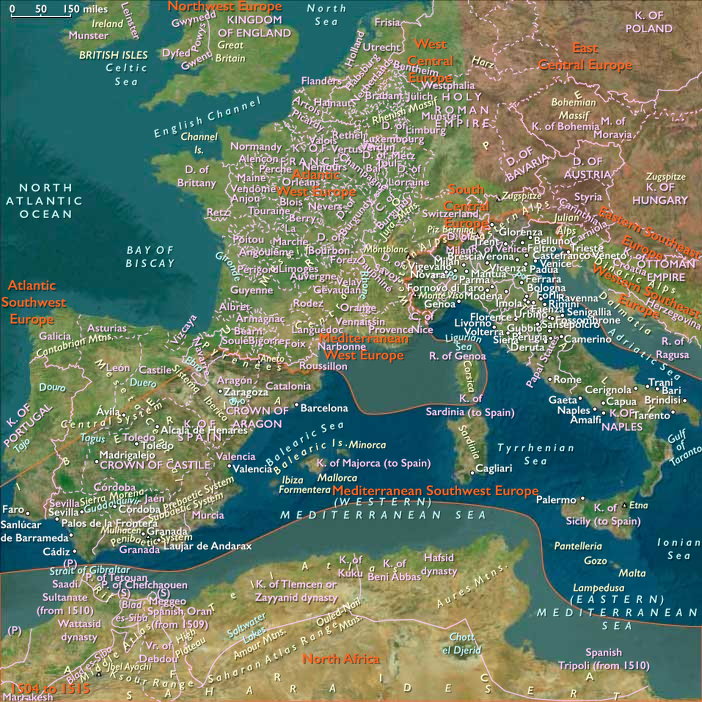
Italian Renaissance painter Giovanni Battista Cima, commonly known as Cima da Conegliano after the Dolomite hill town where he was born, and active in Venice from 1492, creates another version of his “Madonna with Six Saints” in 1507, originally executed around 1496-99.
His typically contemplative paintings, strongly influenced by Giovanni Bellini and Vittore Carpaccio, feature isolated forms that receive their shape by light in sharply delineated, often architectonic, compositions.
The work, executed for the Parma Cathedral, adopts the same scheme of several altarpieces by Giovanni Bellini, such as the San Giobbe Altarpiece.
It shows the Virgin Mary on a high throne in a mosaic-decorated apse, while placing her hand on the heads of kneeling Saints Cosmas and Damian.
Saint John the Baptist is portrayed on the right.
On the right, the Christ Child is blessing Saint Mary Magdalene, Saint Catherine of Alexandria (with her characteristic broken wheel), and Saint John the Evangelist (with a book).
An angel sits at the foot of the throne in the center foreground and holds a stringed musical instrument.
Locations
People
Regions
Southwest Europe
View →Subregions