
Jean Bullant, whose architectural works represent the…
1578 CE
Jean Bullant, whose architectural works represent the transition from High Renaissance to Mannerist design, had in his youth studied in Italy, and his exposure to the ancient buildings there have had a profound influence on his later work.
Returning to France about 1540, he had entered the service of the constable of Montmorency.
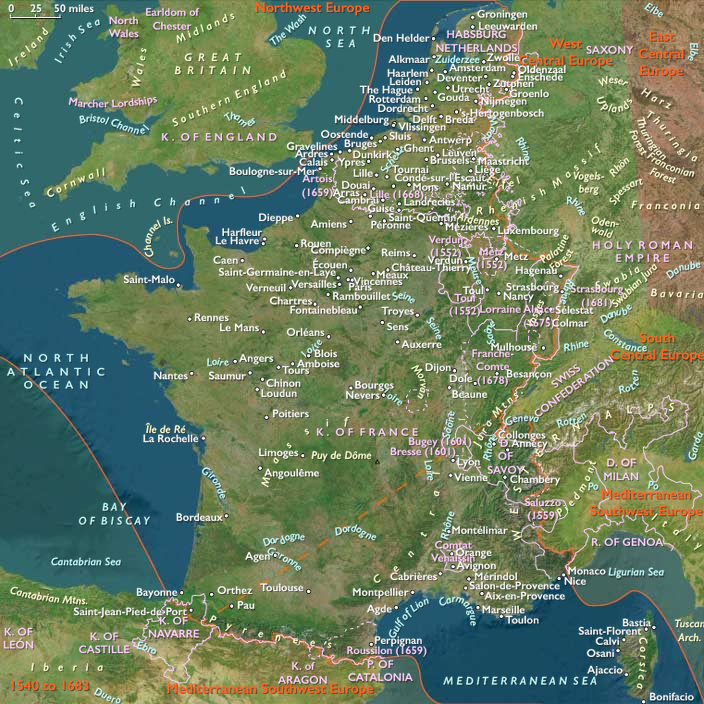
Bullant had worked in at Écouen on the constable's château, which clearly evidences the effect of Bullant's exposure to the Pantheon in Rome.
At Fére-en-Tardenois he had from 1552 to 1562 constructed a bridge and gallery in which he created the effect of a Roman aqueduct built across a gorge.
The placement of the window over the main door, with its penetration into the pediment, represents Bullant's use of the artificiality and formalism of Mannerism.
He had built the Petit-Château in about 1560 for the constable of Montmorency's château at Chantilly, which also reflects Bullant's Mannerist style.
Little more is known of Bullant's life and work until 1570, when he was appointed as Catherine de Médicis' architect.
He has contributed to the Chapelle des Valois and added a wing to the Tuileries, although the exact nature of his contribution is not known.
His influential Régle générale d 'architecture des cinq manières de colonnes (1564) has been adopted as one of the textbooks of French architecture.
He dies in his late fifties at Écouen in 1578.
Images

Bullant's Galerie over Philibert Delorme's bridge at Chenonceaux (Photo by Luke van Grieken, 2006)
Locations
Subjects
Regions
West Europe
View →Subregions
