
Joan of Arc’s Journey to Chinon and …
Years: 1429 - 1429
Joan of Arc’s Journey to Chinon and Her Theological Examination (1429)
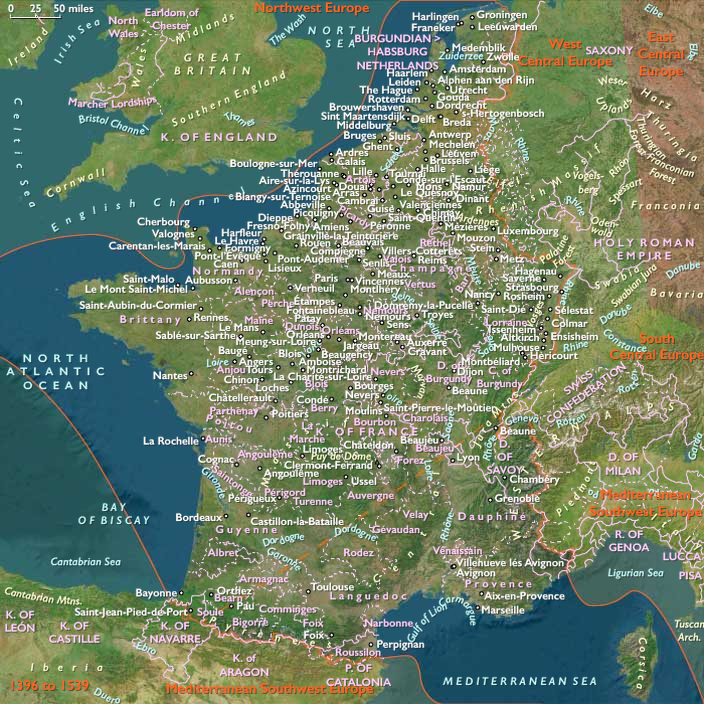
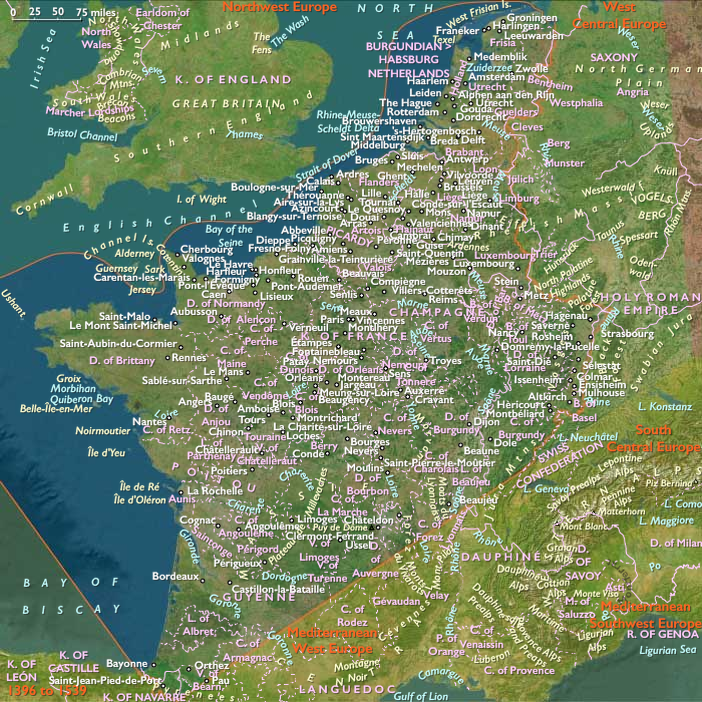
After receiving an armed escort from Robert de Baudricourt, Joan of Arc undertook a perilous journey westward to Chinon, traveling through Burgundian-held territory disguised as a male soldier. This disguise, a practical safety measure suggested by her supporters in Vaucouleurs, would later become one of the charges against her during her trial.
Upon reaching the Royal Court at Chinon, she impressed Charles VII in a private audience, offering him hope when his cause seemed near collapse. However, before allowing her to lead troops to relieve the siege of Orléans, Charles ordered a theological inquiry at Poitiers to verify her orthodoxy and legitimacy, ensuring she could not be dismissed as a heretic or sorceress.
I. Joan’s Dangerous Journey to Chinon (February–March 1429)
- Joan traveled through hostile Burgundian-controlled lands, a journey that took eleven days.
- She disguised herself as a male soldier, a decision made for:
- Personal safety against enemy patrols and bandits.
- Practicality in travel with an armed escort.
- Two members of her escort later testified that the people of Vaucouleurs had provided her with this clothingand had suggested the disguise as a necessary precaution.
II. Her Arrival at the Royal Court in Chinon (March 1429)
- Joan arrived at Chinon, where Charles VII’s court was demoralized, as his regime appeared on the verge of collapse.
- She met privately with the Dauphin, reportedly revealing knowledge only he could have known, convincing him of her divine mission.
III. The Need for Religious Verification
- Joan’s arrival reframed the Hundred Years’ War as a religious struggle, a high-risk strategy.
- Charles’ advisors worried that if her orthodoxy was questioned, his enemies could claim that his legitimacy as king was granted by the Devil.
- To protect Charles from accusations of heresy, he ordered:
- Background inquiries into Joan’s life and character.
- A theological examination at Poitiers, to ensure she was not a heretic or sorceress.
IV. Joan’s Military Preparation
- While awaiting the results of the investigation, Joan requested:
- Permission to accompany the relief army to Orléans.
- Protective armor, which was provided by the Royal government.
- A horse, sword, banner, and other military equipment, all donated to her cause.
V. Conclusion: Joan’s Legitimacy and the Next Step Toward Orléans
- The theological inquiry at Poitiers would ultimately confirm Joan’s orthodoxy, clearing the way for her to lead troops into battle.
- Her arrival at Chinon marked the beginning of her extraordinary military campaign, transforming the French war effort and Charles VII’s legitimacy as king.
Joan of Arc’s journey to Chinon, her reception by Charles VII, and her subsequent theological examination were critical moments that solidified her role as France’s divinely inspired leader, setting the stage for her historic intervention at Orléans.
Locations
People
Groups
- Normandy, Duchy of
- Burgundy, Duchy of
- Christians, Roman Catholic
- Scotland, Kingdom of
- France, (Valois) Kingdom of
- England, (Plantagenet, Lancastrian) Kingdom of
Topics
- Hundred Years' War
- Armagnac-Burgundian Civil War
- Hundred Years' War: Resumption of the war under Henry V
- Hundred Years' War: French Victory
Commodoties
Subjects
Regions
Subregions
Years: 1429 - 1429
Locations
People
Groups
- Normandy, Duchy of
- Burgundy, Duchy of
- Christians, Roman Catholic
- Scotland, Kingdom of
- France, (Valois) Kingdom of
- England, (Plantagenet, Lancastrian) Kingdom of
Topics
- Hundred Years' War
- Armagnac-Burgundian Civil War
- Hundred Years' War: Resumption of the war under Henry V
- Hundred Years' War: French Victory
Commodoties
Subjects
Regions
Subregions