
Juan del Encina: The Founder of Spanish…
1530 CE
Juan del Encina: The Founder of Spanish Renaissance Drama
Juan del Encina (1468–1529/30) was a pioneering playwright, poet, and composer, regarded as the founder of Spanish Renaissance drama. His pastoral eclogues laid the foundation for secular theater in Spain, bridging the transition from medieval religious plays to the vibrant Spanish Golden Age drama of the 16th and 17th centuries.
Early Career and Patronage
- Encina began his career as program director for the Duke of Alba, working alongside Lucas Fernández.
- He wrote pastoral eclogues, focusing on shepherds and themes of unrequited love, establishing Spanish secular drama.
- Around 1500, seeking greater opportunities, he relocated to Rome, where he worked for various cardinals and noble patrons in the papal court.
Ecclesiastical Appointments and Pilgrimage to Jerusalem
- In 1508, Pope Julius II appointed him to the Archdiaconate of Málaga Cathedral.
- In 1518, he resigned from Málaga for a benefice at Morón, and in 1519, he traveled to Jerusalem, where he sang his first Mass.
- He chronicled his pilgrimage in "Trivagia o Via Sacra de Hierusalem."
- In 1523, he was appointed Prior of León Cathedral, where he remained until his final illness in 1529.
Encina’s Literary and Musical Contributions
1. Dramatic Works: The Transition to Secular Theater
- Encina’s fourteen dramatic pieces mark the shift from purely religious plays to secular drama, influencing later Spanish autos sacramentales (allegorical religious plays).
- Key works include:
- "Aucto del Repelón" and "Égloga de Fileno", which dramatize the adventures of shepherds.
- "Plácida y Vitoriano", strongly influenced by Fernando de Rojas' La Celestina.
- Although their intrinsic literary value is modest, these plays were historically significant, as they introduced lay theater in Spain.
2. Cancionero and Spanish Lyric Poetry
- Encina’s Cancionero contains sixty or more songs, showcasing his mastery of lyric poetry.
- It is preceded by a prose treatise, Arte de Trobar, analyzing the poetic art in Spain.
- His villancicos (a Spanish counterpart to the Italian frottola), composed for three and four voices, demonstrate:
- Simple yet strong harmonic progressions.
- Flexible rhythms, following the natural accents of the verse.
- Limited melodic movement, ensuring text clarity.
Final Years and Death
- Encina remained in León Cathedral from 1523 until his death in late 1529 or early 1530.
- His will was presented on January 14, 1530, instructing that he be buried beneath the choir of Salamanca Cathedral.
- In 1534, his remains were transferred to Salamanca, fulfilling his wishes.
Legacy: A Pioneer of Spanish Drama and Music
- Encina’s works shaped the early Spanish Renaissance, influencing later dramatists like Lope de Rueda and Cervantes.
- His pastoral eclogues laid the foundation for Spanish secular drama, and his villancicos became a defining genre of Iberian Renaissance music.
- Though he never joined a royal chapel, his contributions to Spanish theater, poetry, and music made him one of the most important cultural figures of his time.
Juan del Encina’s innovations in drama and music ensured that his influence endured well beyond his lifetime, earning him the title of "Father of Spanish Renaissance Theater."
Locations
People
Regions
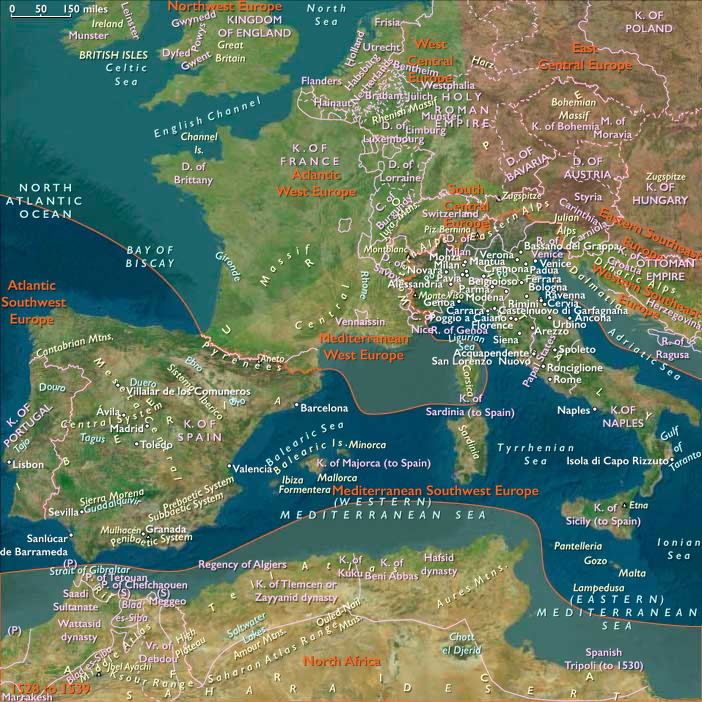
Southwest Europe
View →Subregions
