The Crisis of the Portuguese Monarchy (1816–1821)…
1821 CE
The Crisis of the Portuguese Monarchy (1816–1821) – Liberalism, Colonial Politics, and Royal Intrigue
The period following Queen Maria I’s death on March 20, 1816, and the ascension of King João VI, was marked by political instability, liberal revolutions, colonial expansion, and dynastic maneuvering. Though João VI officially began governing in 1816, he was only acclaimed as king on February 6, 1818, with elaborate festivities.
Queen Carlota Joaquina’s Political Ambitions
- Carlota Joaquina, João VI’s wife, had long been conspiring against Portuguese interests.
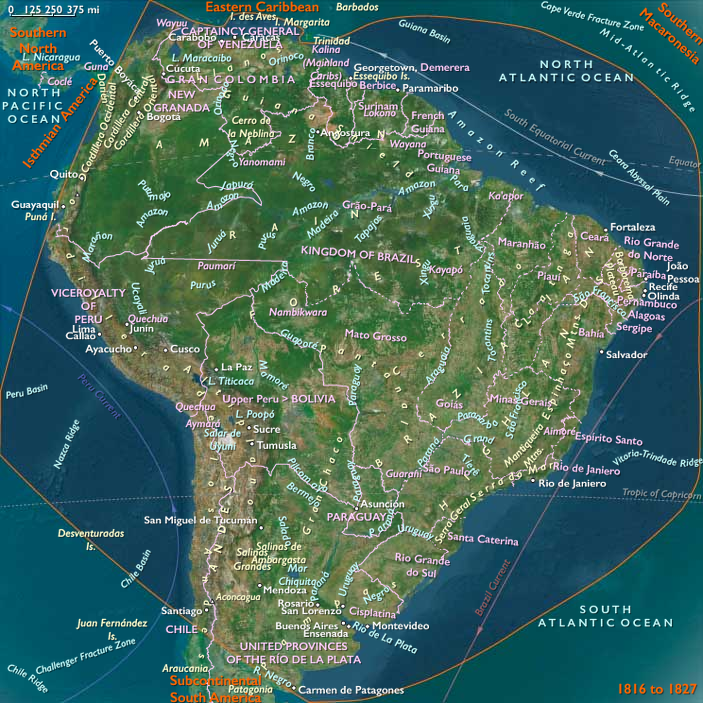
- Since her arrival in Brazil, she attempted to position herself as a ruler, forming alliances with Spaniards and nationalist factions in the Río de la Plata region (now Argentina and Uruguay).
- Her ambitions included:
- Becoming a regent of Spain.
- Ruling a new monarchy carved out of Spain’s South American colonies.
- Even deposing her husband, João VI, to seize power.
- Despite her numerous plots, all of them failed. However, she did manage to influence João VI to involve himself more directly in Spanish colonial affairs, leading to the annexation of Cisplatina (modern Uruguay) in 1821.
Dynastic Challenges – The Marriage of Pedro I of Brazil
- Finding a suitable wife for Pedro I, the heir to the throne, proved difficult.
- Europe viewed Brazil as distant, backward, and unstable, making it unattractive for European royal families.
- After a year of searching, Portuguese diplomat Pedro José Joaquim Vito de Meneses Coutinho, 6th Marquis of Marialva, secured a marriage alliance with Austria by:
- Exaggerating Brazil’s wealth and stability.
- Displaying pomp and ceremony to impress the Austrian court.
- Bribing nobility with gold bars and diamonds.
- In 1817, Pedro married Archduchess Maria Leopoldina of Austria, daughter of Emperor Francis I.
- Austrian Chancellor Metternich viewed this alliance as strategically beneficial, strengthening monarchical rule across both hemispheres and giving Austria a new sphere of influence in South America.
Portugal in Crisis – British Rule and Liberal Agitation
- After the final expulsion of the French in 1811, Portugal was devastated by war, famine, and mass emigration.
- With João VI still in Brazil, Marshal William Carr Beresford effectively ruled Portugal as a British protectorate, governing with an iron fist.
- Growing resentment of British control led to:
- Pressure for João VI to return.
- The formation of liberal secret societies.
- Calls to reconvene the Portuguese Cortes, which had not met since 1698.
Liberal Revolutions in Portugal and Brazil (1817–1820)
-
The Pernambucan Revolt (1817, Brazil)
- A republican uprising in Recife, inspired by liberal ideas and the independence movements in Spanish America.
- Rebels seized power in Pernambuco and formed a provisional government.
- The revolt was harshly suppressed, but it signaled growing dissatisfaction with Portuguese rule in Brazil.
-
The Liberal Revolution of 1820 (Portugal)
- August 24, 1820: A constitutionalist uprising began in Porto.
- A governing junta was formed, spreading liberalism to Lisbon, Madeira, the Azores, and even Brazil (Grão-Pará and Bahia).
- The revolutionaries convened a General Extraordinary and Constituent Cortes to draft a constitutionwithout consulting João VI.
- Even Rio de Janeiro’s military garrison rose up, showing that liberal ideas had penetrated Portuguese and Brazilian politics alike.
Conclusion – The Unraveling of the Portuguese Empire
The years 1816–1821 saw Portugal and Brazil at a crossroads, with:
- A monarchy in crisis, torn between liberal and absolutist factions.
- João VI trapped between Portugal’s demands for his return and Brazil’s push for greater autonomy.
- Carlota Joaquina’s intrigues fueling further instability.
- A growing divide between Portugal and Brazil, setting the stage for Brazilian independence in 1822.
This period marked the beginning of the end of Portugal’s colonial empire, as liberal movements and independence struggles reshaped the Atlantic world.