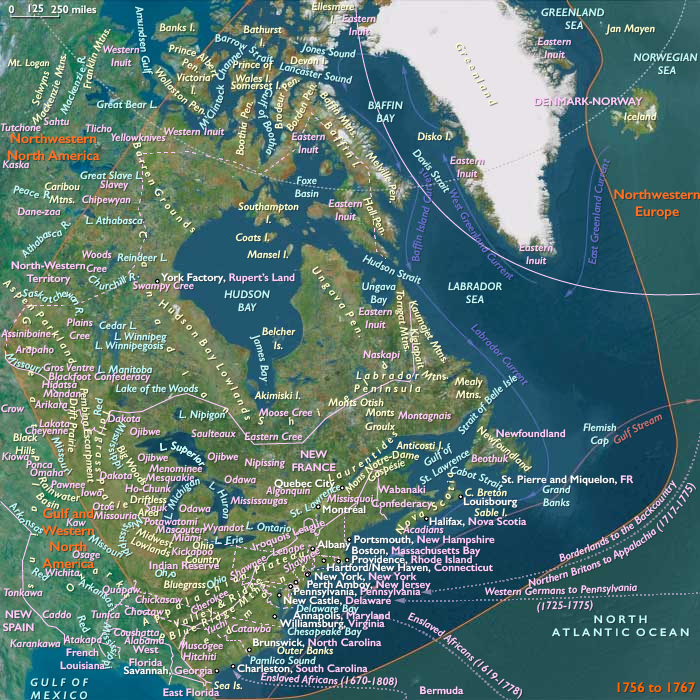
Fighting in Pontiac's Rebellion begins in 1763,…
1763 CE
Senecas of the Ohio Country (Mingos) had circulated messages ("war belts" made of wampum) that called for the tribes to form a confederacy and drive away the British.
The Mingos, led by Guyasuta and Tahaiadoris, are concerned about being surrounded by British forts.
Similar war belts originate from Detroit and the Illinois Country.
The natives were not unified, however, and in June 1761, natives at Detroit had informed the British commander of the Seneca plot.
After William Johnson held a large council with the tribes at Detroit in September 1761 a tenuous peace had been maintained, but war belts continued to circulate.
Violence finally erupts after the natives learn in early 1763 of the imminent French cession of the pays d'en haut to the British.
The war begins at Fort Detroit under the leadership of Pontiac, and quickly spreads throughout the region.
Eight British forts are taken; others, including Fort Detroit and Fort Pitt, are unsuccessfully besieged.
Francis Parkman's The Conspiracy of Pontiac will portray these attacks as a coordinated operation planned by Pontiac.
Parkman's interpretation remains well known, but other historians have since argued that there is no clear evidence that the attacks were part of a master plan or overall "conspiracy".
The prevailing view among scholars today is that, rather than being planned in advance, the uprising spread as word of Pontiac's actions at Detroit traveled throughout the pays d'en haut, inspiring already discontented natives to join the revolt.
The attacks on British forts were not simultaneous: most Ohio natives do not enter the war until nearly a month after the beginning of Pontiac's siege at Detroit.
Parkman also believed that Pontiac's War had been secretly instigated by French colonists who were stirring up the natives in order to make trouble for the British.
This belief was widely held by British officials at the time, but subsequent historians have found no evidence of official French involvement in the uprising. (The rumor of French instigation arose in part because French war belts from the Seven Years' War were still in circulation in some Native villages.)
Rather than the French stirring up the natives, some historians now argue that the natives were trying to stir up the French.
Pontiac and other native leaders frequently speak of the imminent return of French power and the revival of the Franco-Native alliance; Pontiac even flies a French flag in his village.
All this is apparently intended to inspire the French to rejoin the struggle against the British.
Although some French colonists and traders support the uprising, the war is initiated and conducted by natives who have native—not French—objectives.
Historian Richard Middleton (2007) argues that Pontiac's vision, courage, persistence, and organizational abilities allowed him to activate a remarkable coalition of native nations prepared to fight successfully against the British.
Though the idea to gain independence for all natives west of the Allegheny Mountains did not originate with him but with two Seneca leaders, Tahaiadoris and Guyasuta, by February 1763 Pontiac appeared to embrace the idea.
At an emergency council meeting, Pontiac had clarified his military support of the broad Seneca plan and worked to galvanize other nations into the military operation that he helped lead, in direct contradiction to traditional native leadership and tribal structure.
He achieves this coordination through the distribution of war belts: first to the northern Ojibwa and Ottawa near Michilimackinac; then, after the failure to seize Detroit by stratagem, to the Mingo (Seneca) on the upper Allegheny River, the Ohio Delaware near Fort Pitt, and the more westerly Miami, Kickapoo, Piankashaw and Wea peoples.
People
Groups
Iroquois (Haudenosaunee, also known as the League of Peace and Power, Five Nations, or Six Nations)
View →
Wyandot, or Wendat, or Huron people (Amerind tribe)
View →
Miami (Amerind tribe)
View →
Lenape or Lenni-Lenape (later named Delaware Indians by Europeans)
View →
Ojibwa, or Ojibwe, aka or Chippewa (Amerind tribe)
View →
Odawa, or Ottawa, people (Amerind tribe)
View →
Seneca (Amerind tribe)
View →
Mascouten (Amerind tribe)
View →
Kickapoo people (Amerind tribe)
View →
Potawatomi (Amerind tribe)
View →
Wea (Amerind tribe)
View →
Piankeshaw (Amerind tribe)
View →
Shawnees, or Shawanos (Amerind tribe)
View →
Ohio Country
View →
Illinois Country
View →
Britain, Kingdom of Great
View →
Mingo (Seneca-Cayuga Tribe of Oklahoma)
View →
Topics
Regions
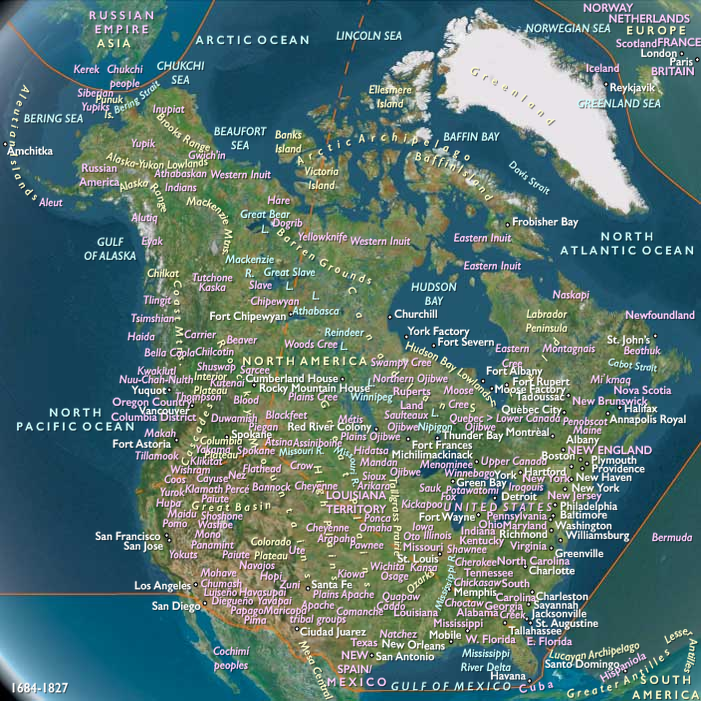
Northern North America
View →Subregions