Atlantic West Europe: Burgundy’s Ambitions and French…
1468 CE to 1479 CE
Atlantic West Europe: Burgundy’s Ambitions and French Resurgence (1468–1479)
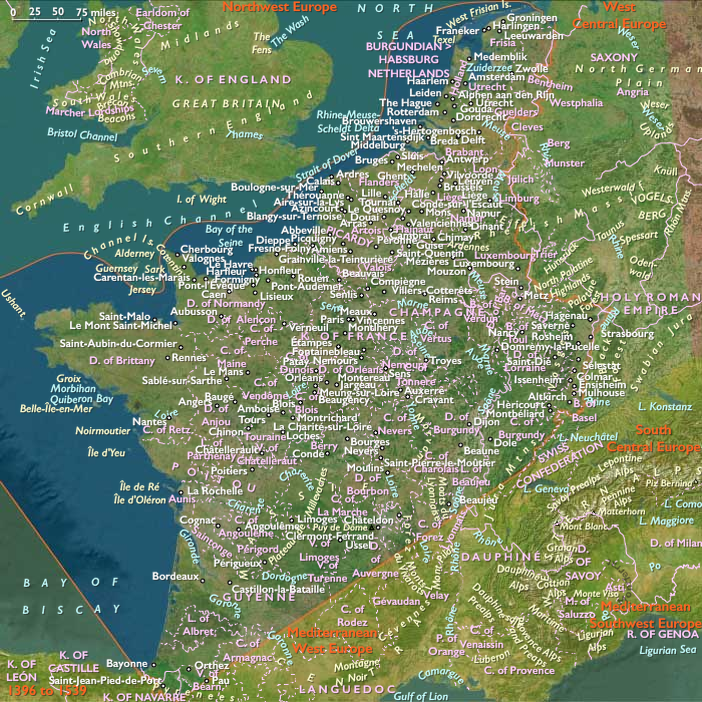
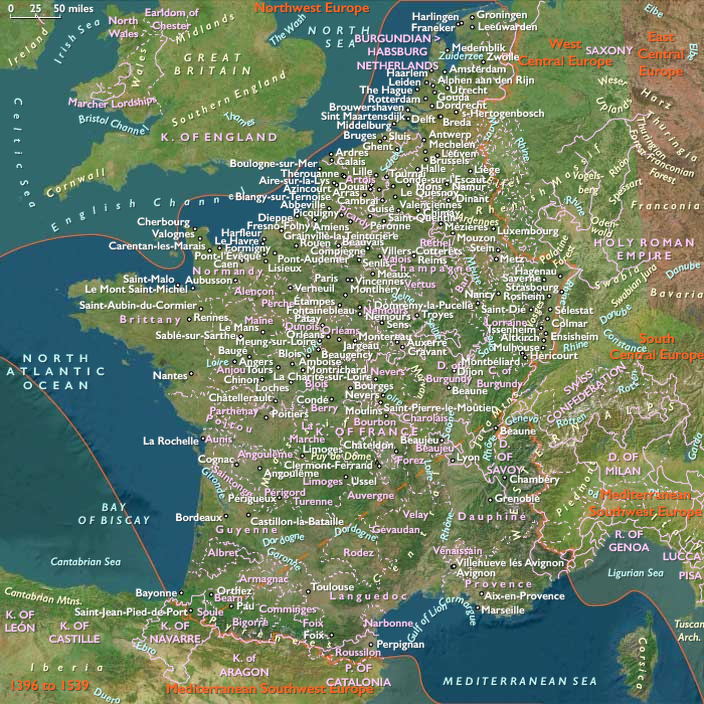
Between 1468 and 1479, Atlantic West Europe experiences dramatic shifts in power, as the rivalry between France and the Duchy of Burgundy escalates into open conflict. This pivotal era witnesses Burgundy’s peak territorial expansion under the ambitious Duke Charles the Bold, followed by his eventual downfall, and Louis XI of France's strategic moves to reassert royal authority over contested lands. At the same time, the region enjoys remarkable cultural developments and significant commercial prosperity, particularly in the Low Countries.
Political and Military Developments
The era opens with Charles the Bold’s dramatic capture and humiliation of King Louis XI at the Treaty of Péronne (1468). Initially gaining dominance, Burgundy ambitiously attempts to consolidate a sovereign realm independent of France and the Holy Roman Empire, comprising the Low Countries and parts of eastern France. However, Charles’s aggressive military campaigns increasingly antagonize neighboring powers, culminating in disastrous defeats at Grandson and Morat in 1476, and ultimately, his death at the Battle of Nancy in 1477. The sudden fall of Burgundy prompts immediate French action: Louis XI quickly annexes key Burgundian territories, including the strategic duchy itself, significantly enlarging and strengthening the French crown.
Economic Developments
Throughout this era, the economic vitality of Atlantic West Europe remains strong, notably in the Low Countries, particularly the thriving mercantile cities of Bruges, Ghent, and Antwerp. Even amidst warfare, Burgundian rule has fostered considerable commercial prosperity through protection of trade routes, encouragement of skilled craftsmanship (especially textile industries), and support for powerful merchant guilds. Burgundy's decline does not immediately disrupt these networks; rather, the absorption of its wealthy territories into French influence opens new markets and economic alliances.
Cultural and Artistic Flourishing
Culturally, this period represents the high point of Burgundian patronage, epitomized by lavish artistic commissions and court festivities designed to reflect ducal prestige. Flemish artists—such as Hugo van der Goes, Hans Memling, and the final works of Rogier van der Weyden—thrive, showcasing the meticulous realism and detailed symbolism characteristic of Northern Renaissance painting. Burgundian illumination and manuscript production flourish, demonstrating the sophistication and artistic taste of the Burgundian court, which sets a standard soon emulated across Europe.
Technological and Societal Shifts
This period sees increased application of new military technology, notably artillery and siege weaponry, in battles that define the fate of territories like Lorraine and Burgundy. Socially, the era is marked by the shifting political fortunes of urban merchant elites, who leverage their wealth to maintain economic stability amid the political turmoil. The death of Charles the Bold brings significant societal change, redistributing power dynamics between the urban bourgeoisie, landed nobility, and the French crown.
Long-term Consequences and Significance
The years 1468–1479 decisively reshape the political landscape of Atlantic West Europe. The dramatic fall of Burgundy ends the dream of an independent kingdom, fundamentally altering the regional balance of power in favor of the increasingly centralized French monarchy. This shift not only sets the stage for a newly invigorated French state but also defines future conflicts in the Low Countries. Economically and culturally, the legacy of Burgundian patronage continues to influence European art, commerce, and political structures well into the subsequent era, marking the transition toward early modernity.
People
Groups
Topics
Commodities
Subjects
Regions
West Europe
View →Subregions