
Event
The Revolution has caused a massive shift…
The Revolution has caused a massive shift of power from the Roman Catholic Church to the state.
Under the Ancien Régime, the Church had been the largest single landowner in the country, owning about ten percent of the land in the kingdom.
The Church is exempt from paying taxes to the government, while it levies a tithe—a ten percent tax on income, often collected in the form of crops—on the general population, only a fraction of which it then redistributes to the poor.
Resentment towards the Church had weakened its power during the opening of the Estates General in May 1789.
The Church composed the First Estate with one hundred and thirty thousand members of the clergy.
When the National Assembly was later created in June 1789 by the Third Estate, the clergy had voted to join them, which perpetuated the destruction of the Estates General as a governing body.
The National Assembly began to enact social and economic reform.
Legislation sanctioned on August 4, 1789, had abolished the Church's authority to impose the tithe.
In an attempt to address the financial crisis, the Assembly declared, on November 2, 1789, that the property of the Church was "at the disposal of the nation".
They have used this property to back a new currency, the assignats.
Thus, the nation has now also taken on the responsibility of the Church, which includes paying the clergy and caring for the poor, the sick and the orphaned.
In December, the Assembly began to sell the lands to the highest bidder to raise revenue, effectively decreasing the value of the assignats by twenty-five percent in two years.
In autumn 1789, legislation had abolished monastic vows and on February 13, 1790, all religious orders are dissolved.
Monks and nuns are encouraged to return to private life and a small percentage will eventually marry.
-
{# Image navigates to the detail page; the magnifying-glass chip is the only Fancybox lightbox trigger (kept a separate sibling — anchors can't nest). #}
 The North Atlantic Lands
World
-
{# Image navigates to the detail page; the magnifying-glass chip is the only Fancybox lightbox trigger (kept a separate sibling — anchors can't nest). #}
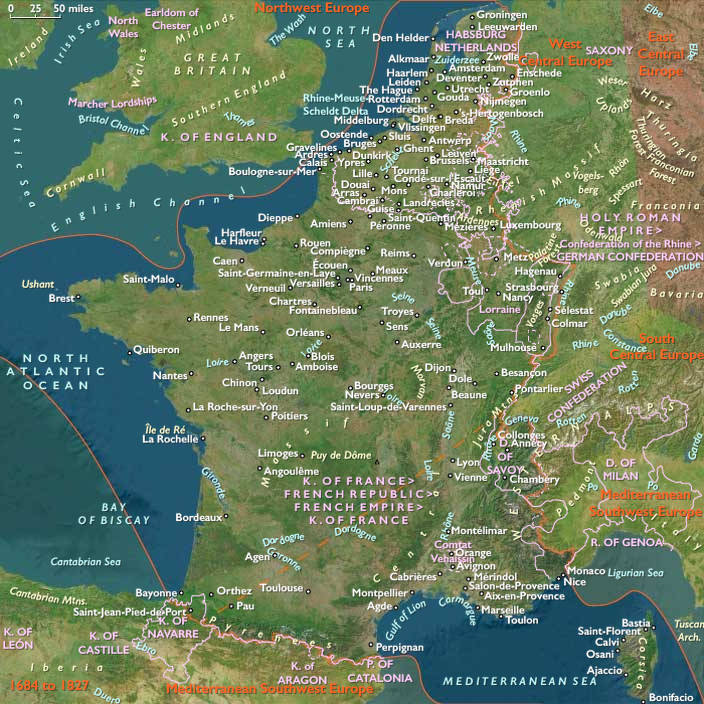 West Europe
Region
-
{# Image navigates to the detail page; the magnifying-glass chip is the only Fancybox lightbox trigger (kept a separate sibling — anchors can't nest). #}
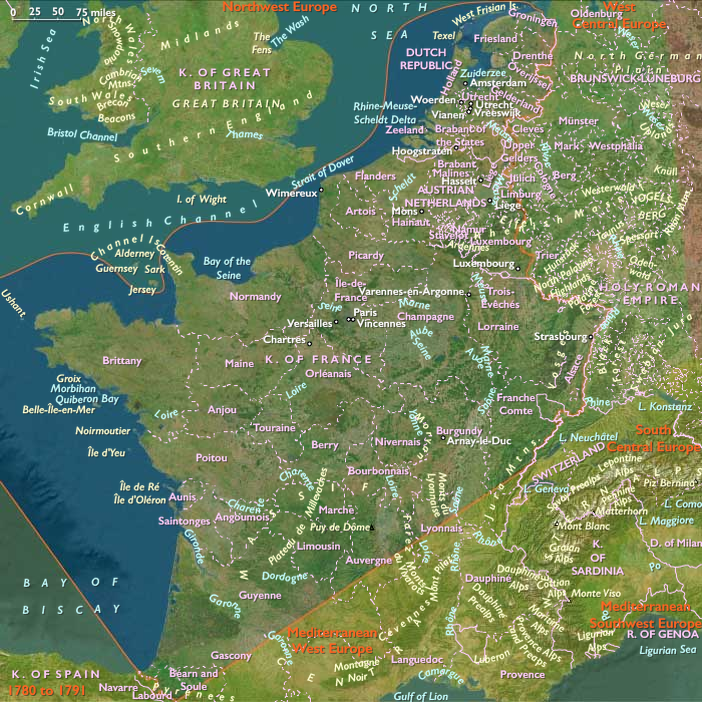 Atlantic West Europe
Subregion
