
Louis XV's courtiers (including the princes of…
July 1734 CE
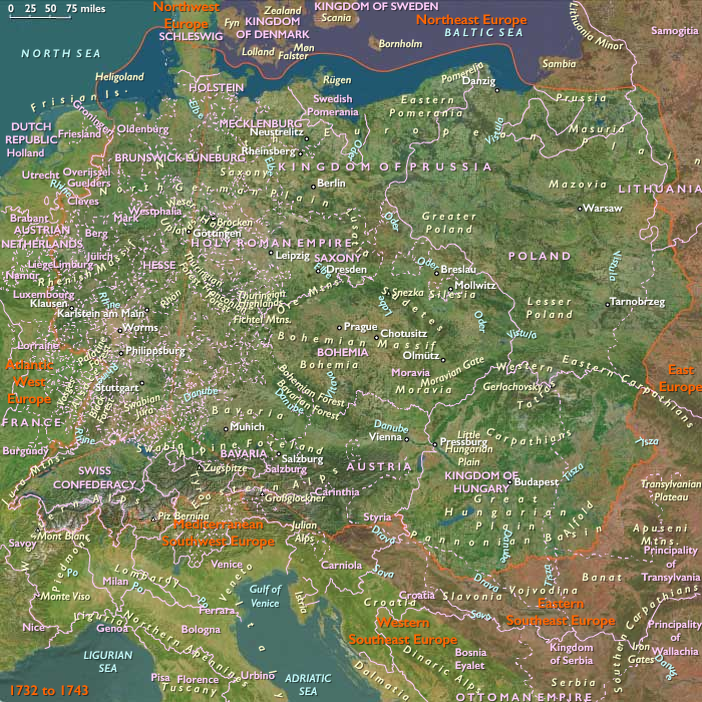
Louis XV's courtiers (including the princes of Conti and Eu, the counts of Clermont, Charolais and Belle-Isle, the duc de Richelieu, but also Maurice de Saxe, Augustus III's half-brother and the former lover of Anna Ivanovna, now the tsarina of Russia) have joined up under marshal James FitzJames, Duke of Berwick, to form an army for invading the Rhineland with the objectives of gaining the Duchy of Lorraine and distracting Austria from events in Poland.
The French had penetrated the defenses of fortress at Philippsburg to its inner moat by July 17, and were threatening the heart of the fortress.
After failing to establish contact with Eugene, Freiherr Gottfried Ernst von Wuttgenau and d'Asfeld agree early on July 18 to terms of capitulation.
Wuttgenau had been given command of the fortress in December 1733.
The fortress was in deplorable condition, and its moat had in places been filled to the point where the ramparts could easily be approached.
He had focused defensive preparations on the fortress' flood controls, a significant defense against besiegers who were required to work in the swampy terrain below the fortress, while his engineer, Gerhard Cornelius von Walrave, had directed repairs and improvements to the fortress' eastern works, where attacks had been focused in the past.
These preparations were largely complete by the spring of 1734, although the garrison was short of ammunition and experienced artillery personnel and engineers.
The French had begun surrounding the fortress in late May, deploying a total of forty-six battalions, with fourteen on the left bank of the Rhine, and the balance on the right bank, cutting the land approaches to the fortress.
Of the troops on the right bank, half were dedicated to the siege, while the rest were detailed to defend the siege camp against any attempts to relieve the siege.
They had begun digging the outer trench surrounding the fortress on May 26 with a complement of twelve thousand men.
The siege works progressed under Berwick until June 12, when a lucky shot by a cannon ball decapitated him while he was examining siege works at a forward position
Berwick had not again been called to serve in the field until 1733, in which year he had been chosen to lead the Army of the Rhine in the War of the Polish Succession.
The French army had crossed the Rhine and besieged Kehl, near Strasbourg, in the fall of 1733.
Although they had captured and occupied the fortress, most of the army had been withdrawn to the west bank of the Rhine due to the onset of winter in December.
During the winter, Austrian field marshal Prince Eugene of Savoy had begun gathering forces of the empire at a camp near Heilbronn to oppose the French.
By the spring of 1734 these forces were still significantly smaller than those of France, which has nearly seventy thousand men in the field.
People
Groups
Regions
Central Europe
View →Subregions
