José de San Martín, for twenty years…
March 1812 CE
José de San Martín, for twenty years a soldier for the Spanish crown, serving mostly in European campaigns, returns to Buenos Aires in 1812 to join the forces fighting for the liberation of his homeland.
Historians will propose several explanations for this action: the common ones are that he missed his native country, that he was a British agent and the congruence of the goals of both wars.
The first explanation suggests that when the wars of independence began San Martín thought that his duty was to return to his country and serve in the military conflict.
The second explanation suggests that Britain, which would benefit from the independence of the South American countries, sent San Martín to achieve it.
The third suggests that both wars were caused by the conflicts between Enlightenment ideas and absolutism, so San Martín still waged the same war; the wars in the Americas only developed separatist goals after the Spanish Absolutist Restoration.
San Martín had been initiated in the Lodge of Rational Knights in 1811.
They met at the house of Carlos María de Alvear, other members were José Miguel Carrera, Aldao, Blanco Encalada and other criollos, American-born Spaniards.
They had agreed to return to their home countries and join the local revolutionary movements.
San Martín had asked for his retirement from the military, and moved to Britain, staying in the country for a short time, and meeting many other South Americans at a lodge held at the house of Venezuelan general Francisco de Miranda at 27 Grafton Street (now 58 Grafton Way), Bloomsbury, London (the house now has a blue plaque with Miranda's name).
He then sailed to Buenos Aires aboard the frigate George Canning, along with the South Americans Alvear, Francisco José de Vera and Matías Zapiola, and the Spaniards Francisco Chilavert and Eduardo Kailitz.
They arrives on March 9, 1812, to serve under the First Triumvirate.
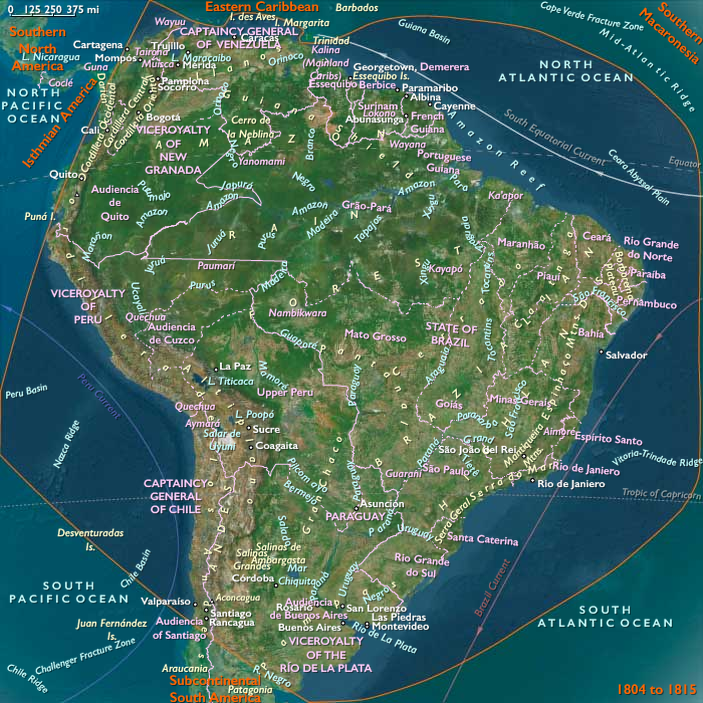
San Martín, proving himself a master military tactician, will aid General Belgrano in his defeat of Spanish royalist forces in early clashes in Paraguay, Chile, Peru and Uruguay.
Groups
Regions
South America
View →Subregions