
Maximian, who is responsible for the West,…
April 286 CE
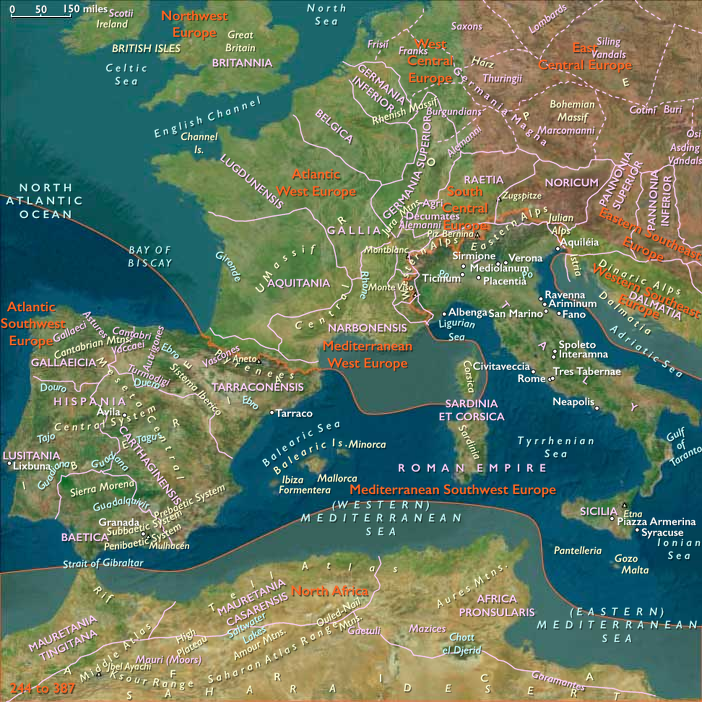
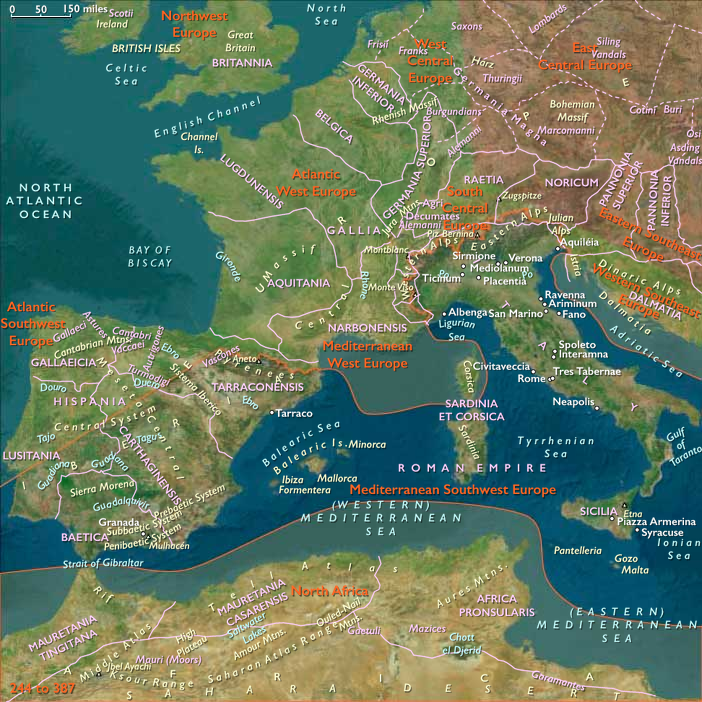
Maximian, who is responsible for the West, is installed at Milan in northern Italy, in order to prevent German invasions.
As an Augustus, Maximian has thus become in theory the colleague of Diocletian, but his role will always be subordinate.
People
Commodities
Subjects
Regions
Southwest Europe
View →Subregions
Mediterranean Southwest Europe
View →Related Events
No active filters.
Showing 10 events out of 59869 total
Diocletian is not, properly speaking, a soldier, although he comes from the army's ranks, having lived most of his life in military camps (these may have been either in Gaul, as reported in the Historia Augusta, or in Moesia), he The empire is too great for one man to administer; nearly every week, either in Africa, or somewhere on the frontier that extends from Britain to the Persian Gulf, along the Rhine, the Danube, the Pontus Euxinus (Black Sea), and the Euphrates, he has been forced to suppress a revolt or stop an invasion.
Diocletian and his lieutenants have in the past six months calmed the stirrings of revolt among Roman troops stationed on the frontiers.
He is in Nicomedia in the beginning of 286, and from this point forward, he dedicates himself to restoring civil order to the empire by removing the army from politics.
Being more attracted to administration, Diocletian requires a man who is both a soldier and a faithful companion to take responsibility for military defense.
He now makes an unexpected decision-to share the throne with a colleague of his choice.
He chooses Maximian, an Illyrian, the son of a peasant from the area around Sirmium, whom he had made Caesar in 285, and now makes him Augustus.
A little later, though still keeping Rome as the official capital, he chooses two other residences.
Diocletian establishes himself at Nicomedia, in western Anatolia and close to the Persian frontier, in order to keep watch on the East.
Maximian’s Naval Defense Against the Franks and Saxons (Late 3rd Century CE)
By the late 3rd century CE, the Franks and Saxons had intensified their maritime raids, pillaging the coasts of Spain and Gaul. In response, Emperor Maximian (co-ruler with Diocletian) assembled a naval force to counter these threats and secure the Roman Channel and North Sea regions.
The Fleet at Gesoriacum and the Appointment of Carausius
- The Roman fleet was based at Gesoriacum (modern Boulogne, France), a key naval and commercial hub on the Channel.
- Command of this newly assembled fleet was given to Mausaeus Carausius, a skilled naval officer and former pilot, originally from Menapia (modern Belgium).
- Carausius had previously won distinction fighting the Bagaudae, a group of peasant rebels and brigands who had destabilized parts of Gaul and Hispania.
Carausius’ Mission and Rise to Power
- His primary objective was to intercept and destroy Frisian, Frankish, and Saxon raiders before they could reach the Roman coasts.
- However, he was accused of corruption, as he allegedly allowed the pirates to raid first before attacking them and seizing their loot.
- Facing execution by Maximian, Carausius declared himself Emperor of Britain and Northern Gaul in 286 CE, breaking away from Roman central authority and forming his own rebel state known as the Britannic Empire.
Impact of Maximian’s Naval Campaign
- While the Franks and Saxons were a major threat, Rome’s internal power struggles undermined its ability to effectively police the Channel.
- Carausius' seizure of power in Britain and northern Gaul forced Maximian and Diocletian to focus on civil war rather than frontier defense.
- The Franks and Saxons continued raiding, exploiting Rome’s weakening grip over its northern provinces.
Conclusion: The Prelude to Further Roman Decline in the West
Maximian’s naval efforts were a necessary response to the growing barbarian threat, but the rise of Carausius as a breakaway ruler demonstrated the empire’s internal instability. These events foreshadowed later Germanic incursions and the eventual breakdown of Roman control in the West.
The overthrow of Hormizd has made Bahram secure.
Diocletian signs a peace treaty with him, and …
…installs Tiridates III, a Roman protégé, as king of Armenia, which the Persians have been forced to relinquish.
Carausius’ Rebellion and the Creation of the Britannic Empire (286 CE)
After being entrusted by Emperor Maximian with the command of the Roman fleet at Gesoriacum (Boulogne) to combat Saxon and Frankish pirates, Mausaeus Carausius was soon accused of corruption. His alleged crime was:
- Allowing pirates to raid Roman territories first, then attacking them afterward and seizing their stolen cargoes for himself rather than returning them to the imperial treasury.
Maximian’s Response and Carausius’ Escape to Britain
- Furious at this betrayal, Maximian ordered the execution of Carausius.
- Before he could be arrested, Carausius fled with his loyal troops to Britain in 286 CE.
- Once in Britain, he declared himself ruler, taking the imperial title of Augustus, effectively seceding from the Roman Empire and forming an independent state, later known as the Britannic Empire.
The Britannic Empire: A Breakaway Roman State
- Carausius established a power base in Britain, securing support from British legions, local elites, and even some northern Gallic territories.
- He minted his own coins, emphasizing his legitimacy with the phrase "Restorer of Britain" (Restitutor Britanniae).
- His control over naval forces allowed him to dominate the English Channel, making any Roman attempt to retake Britain difficult.
Significance of Carausius’ Revolt
- His rebellion exposed the weaknesses of Roman control over Britain and the northern provinces.
- The Franks and Saxons continued their raids, taking advantage of Rome’s internal instability.
- His rule set a precedent for future breakaway states in the Western Roman Empire, showing that provincial military leaders could defy central authority and establish their own rule.
Though Carausius would eventually be assassinated by his own finance minister, Allectus, in 293 CE, his secession from Rome marked a major turning point in the empire’s struggle to maintain control over its far-flung provinces.
Empress Yang Zhi, Emperor Wu’s second wife, had borne him a son, Sima Hui, in 283, but Prince Hui had died in 284.
Empress Yang has been instrumental in keeping Crown Prince Zhong's wife Crown Princess Jia Nanfeng from being deposed, as Princess Jia is jealous and violent.
After several of the crown prince's concubines had become pregnant, Princess Jia had personally had them killed.
When Emperor Wu heard about this, he had been angry and wanted to depose the crown princess, but Empress Yang had persuaded him to remember the crown princess' father Jia Chong's contribution to the establishment of Jin.
She had also rebuked the crown princess to try to rein in her behavior—but the crown princess, not knowing that the empress had persuaded the emperor not to depose her, bears a grudge against the empress as a result.
Carausius’ Naval Dominance and Expansion into Gaul (286–293 CE)
After seizing power in Britain in 286 CE, Carausius strengthened his rule by training local barbarians as sailors, allowing him to control the western sea. His naval supremacy enabled him to extend his rule beyond Britain, securing parts of northern Gaul, including Rotomagus (modern Rouen).
1. Naval Supremacy and Control of the English Channel
- Carausius, a former pilot and naval commander, understood the strategic importance of controlling the sea.
- He trained local Britons and Germanic mercenaries as sailors, creating a powerful fleet.
- With command over the western sea, he was able to prevent Rome from launching an immediate counterattack.
- His fleet patrolled the Channel and North Sea, securing trade routes and blocking Roman military movements.
2. Expansion into Northern Gaul
- By securing maritime dominance, Carausius was able to expand into Gaul, taking control of coastal cities and river routes.
- His rule extended as far as Rotomagus (modern Rouen), a strategically important city along the Seine River.
- He maintained Roman-style governance in his territories, minting his own coins and presenting himself as a legitimate emperor.
3. A Challenge to Rome’s Authority
- By controlling Britain and northern Gaul, Carausius posed a serious threat to Roman rule in the West.
- His ability to defend his domain for nearly seven years demonstrated the effectiveness of his military and naval strategies.
- His breakaway state, often referred to as the "Britannic Empire," was the first lasting secession from Roman central authority.
4. Rome’s Response and Carausius’ Downfall
- In 293 CE, Emperor Constantius Chlorus, the western Caesar under Diocletian's Tetrarchy, launched a campaign to reclaim northern Gaul.
- He successfully recaptured Gesoriacum (Boulogne), cutting Carausius off from his continental holdings.
- Soon after, Carausius was assassinated by his finance minister, Allectus, who briefly ruled before being defeated by Roman forces in 296 CE.
Conclusion: A Temporary Maritime Empire
- Carausius' naval supremacy gave him unparalleled control over Britain and the English Channel, allowing him to rule parts of northern Gaul.
- His ability to hold power for seven years demonstrated that Rome’s control over its western provinces was weakening.
- Though ultimately defeated, Carausius' rule foreshadowed the fragmentation of the Western Roman Empire, proving that regional commanders could defy central Rome and create independent states.
His reign remains a fascinating episode in Roman history, where a rogue commander leveraged naval power to challenge the might of the empire.
Emperor Wu’s generosity and kindness have undermined his rule, as he has become overly tolerant of the noble families' corruption and wastefulness, which has drained the state’s resources.
Further, when the emperor had established the Jìn Dynasty, he had been concerned about his regime's stability, and, believing that the predecessor state, Cao Wei, had been doomed by its failure to empower the princes of the imperial clan, he has greatly empowered his uncles, his cousins, and his sons with authority including high military ranking.
This, ironically, will lead to the destabilization of the Jìn Dynasty.
In 289, as Emperor Wu nears death, he considers whom to make the regent for Crown Prince Zhong, who is developmentally disabled.
He considered both Empress Yang's father Yang Jun and his uncle Sima Liang the Prince of Ru'nan, the most respected of the imperial princes.
As a result, Yang Jun becomes fearful of Sima Liang and has him posted to …
…the key city of Xuchang (in modern Xuchang, Henan).
Maximian’s Failed Invasion of Britain (288/289 CE) and the Continued Rule of Carausius
By 288 or 289 CE, Emperor Maximian, co-ruler of the Western Roman Empire, prepared to invade Britain to reclaim the province from Carausius, the rogue naval commander who had declared himself Augustus of Britain and northern Gaul. However, the invasion failed, allowing Carausius to remain in power for several more years.
1. The Roman Invasion Attempt and Its Failure
- Maximian assembled a fleet, likely at Gesoriacum (modern Boulogne), intending to retake Britain by force.
- The invasion failed, but sources disagree on why:
- A panegyric to Constantius Chlorus blames bad weather, implying that storms or rough seas prevented the fleet from landing.
- Eutropius, a 4th-century historian, states that the failure was due to Carausius’ military skill, suggesting that his fleet successfully repelled the attack.
- Carausius himself claimed a military victory, further bolstering his legitimacy as ruler of Britain and parts of Gaul.
2. The Aftermath: Stalemate and a Peace Agreement
- Following the failed invasion, neither side could force a decisive outcome, leading to a stalemate.
- Eutropius records that hostilities were in vain, meaning that Rome was unable to dislodge Carausius, despite its military strength.
- As a result, peace was agreed, possibly recognizing de facto independence for Carausius' rule over Britain and northern Gaul.
- Carausius continued to issue coins, portraying himself as a legitimate emperor, emphasizing slogans such as "Restitutor Britanniae" (Restorer of Britain).
3. The Continued Threat of Carausius to Roman Authority
- Carausius’ control over the English Channel meant that Rome could not easily launch another invasionwithout a large naval force.
- His alliance with local Britons, Frankish and Saxon mercenaries, and Roman deserters strengthened his rule.
- However, his separatist state was not politically stable, leading to internal tensions.
4. The Road to Carausius’ Downfall (293 CE)
- In 293 CE, Emperor Diocletian’s Tetrarchy restructured the empire, and Constantius Chlorus was appointed Caesar of the West, tasked with recovering Britain.
- Constantius recaptured Boulogne, cutting Carausius off from his Gallic territories and weakening his position.
- Soon after, Carausius was assassinated by his finance minister, Allectus, who briefly ruled Britain before being defeated by Roman forces in 296 CE.
Conclusion: A Temporary British Empire
- Maximian’s failed invasion of 288/289 CE allowed Carausius to maintain his rule over Britain for several more years.
- His control of the sea and military skill prevented Rome from reclaiming the province until a more coordinated campaign under Constantius Chlorus in 296 CE.
- While Carausius' breakaway state eventually fell, his reign demonstrated the increasing instability of the Western Roman Empire and foreshadowed later provincial revolts that would contribute to Rome’s eventual decline.
Despite his defiance of Roman authority, Carausius' rule remains one of the most remarkable secessionist movements in Roman history, where a naval commander successfully held Britain against the might of the empire for nearly a decade.