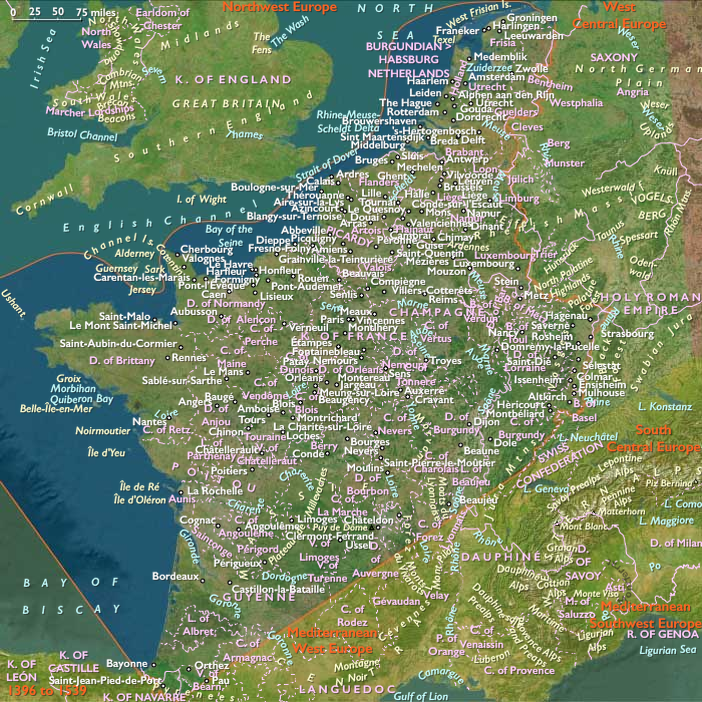
The Treaty of Étaples and the Absorption…
November 1492 CE
The Treaty of Étaples and the Absorption of Brittany into France (1492)
In the context of escalating conflict between France and Maximilian of Austria over the Burgundian inheritance, French king Charles VIII sought to neutralize external threats to his consolidation of power in Brittany. This critical juncture unfolded in late 1492, during a period marked by intensified Franco-Habsburg rivalry and English intervention to preserve Breton independence.
The Siege of Boulogne and English Intervention
In response to France’s assertive move against Brittany, King Henry VII of England had dispatched forces to Brittany and subsequently besieged the strategic French port of Boulogne. Henry's action represented an effort to safeguard England’s long-standing strategic interests in Brittany, counter French expansion, and reaffirm England's continental claims.
However, Henry VII’s campaign faltered due to insufficient support from Breton allies and the financial burden of prolonged military operations, prompting him to negotiate with France.
The Treaty of Étaples (November 3, 1492)
Facing simultaneous military pressures—Henry VII’s siege of Boulogne and Archduke Maximilian’s renewed aggression in Flanders—King Charles VIII sought a swift resolution to remove England from the conflict. Consequently, the two monarchs signed the decisive Treaty of Étaples on November 3, 1492.
Under the treaty’s terms:
- Henry VII received a substantial sum of 745,000 gold crowns from the French treasury.
- England was granted an annual French pension, further incentivizing peaceful relations.
- Henry agreed to withdraw from Brittany, effectively ending England’s military intervention and leaving the duchy vulnerable to full absorption by France.
Breton Incorporation into France
With England neutralized, Charles VIII swiftly finalized Brittany’s incorporation into the French royal domains. This represented a fundamental shift in regional power dynamics, completing a decades-long French ambition to control Brittany, solidifying royal authority, and significantly diminishing Brittany's long-held political autonomy.
The treaty’s signing thus symbolized not only the end of England’s resistance but also the decisive triumph of French ambitions to unite its territories along the Atlantic seaboard, fulfilling strategic and dynastic objectives that had shaped royal policy for decades.
Broader Historical Impact
The Treaty of Étaples marked a critical turning point in the geopolitics of Atlantic West Europe. The absorption of Brittany into France strengthened royal authority and territorial cohesion, furthering centralization under the monarchy and significantly altering the regional balance of power. England’s withdrawal, motivated largely by economic expediency rather than decisive military defeat, illustrated a shift toward pragmatic diplomacy over prolonged warfare, presaging early-modern statecraft patterns emphasizing financial negotiation over battlefield engagements.
Ultimately, this treaty and Brittany’s annexation not only transformed French territorial integrity but also foreshadowed future diplomatic alliances and rivalries, setting the stage for broader European conflicts in the ensuing decades.
Locations
Groups
Commodities
Subjects
Regions
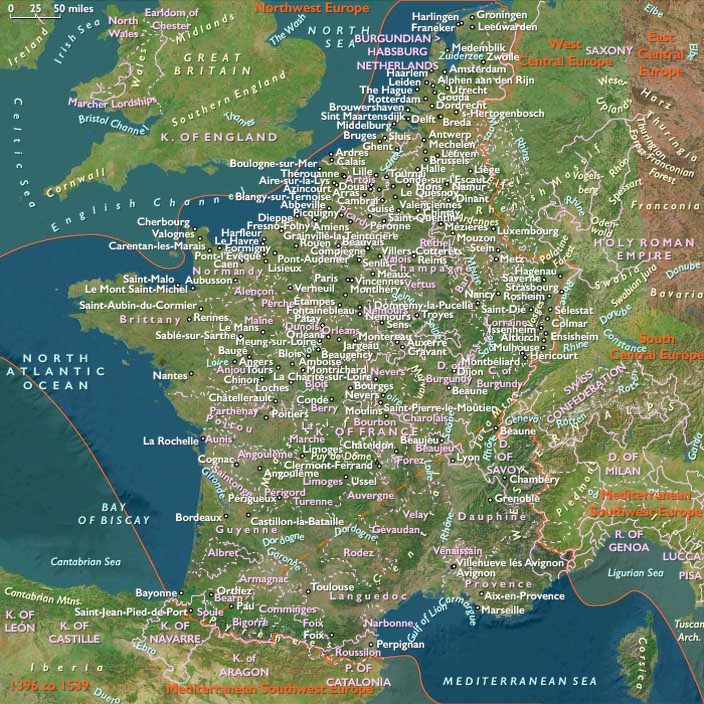
West Europe
View →Subregions